Teeth Names & Numbers: Complete Chart, Types & Functions Ultimate Guide (2026)
This article has been medically reviewed for accuracy and follows evidence-based dental information from trusted healthcare organizations. It is intended for educational purposes and does not replace professional dental advice, diagnosis, or treatment.
Learn all teeth names and numbers with a complete adult and baby teeth chart. Discover tooth types, functions, numbering systems, and dental anatomy.
Most adults have 32 teeth, but very few people can actually name them. Knowing your teeth names helps you understand your dentist, read a dental x-ray, and figure out which tooth is bothering you before your next appointment. This guide breaks down every type of tooth, explains the Universal Numbering System dentists use, and shows how your primary dentition (baby teeth) turns into permanent dentition over time. Whether you’re a parent tracking a child’s tooth eruption chart or just curious about your own mouth, this page covers what you need to know.
How Many Teeth Do Adults Have? (Quick Answer)
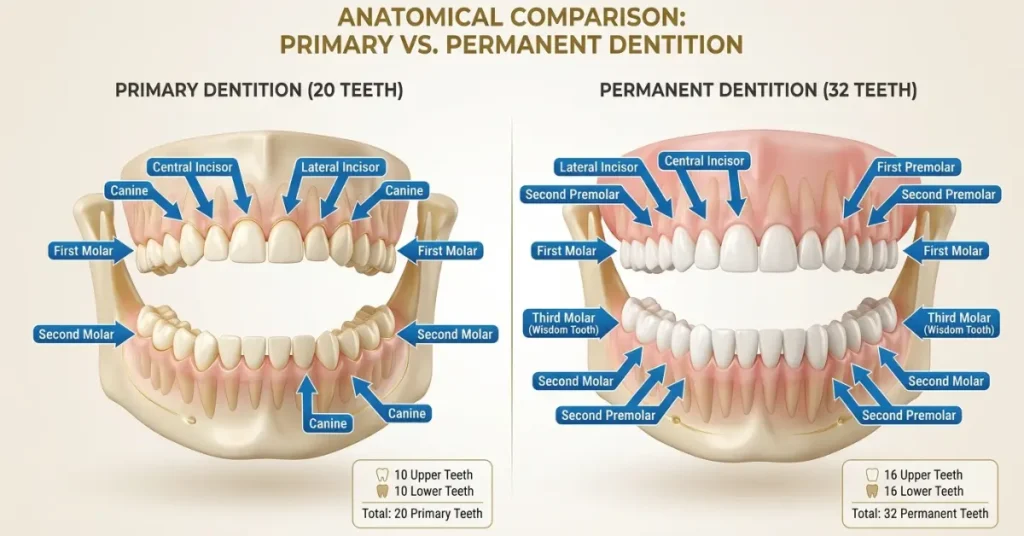
Direct answer: Adults have 32 teeth, including 4 wisdom teeth. Children have 20 baby teeth, known as deciduous teeth.
That 32-tooth count includes 8 incisors, 4 canines, 8 premolars, and 12 molars (4 of which are wisdom teeth). Not everyone keeps all 32. Many people have their wisdom teeth removed, and some are born without them at all, a trait linked to genetics.
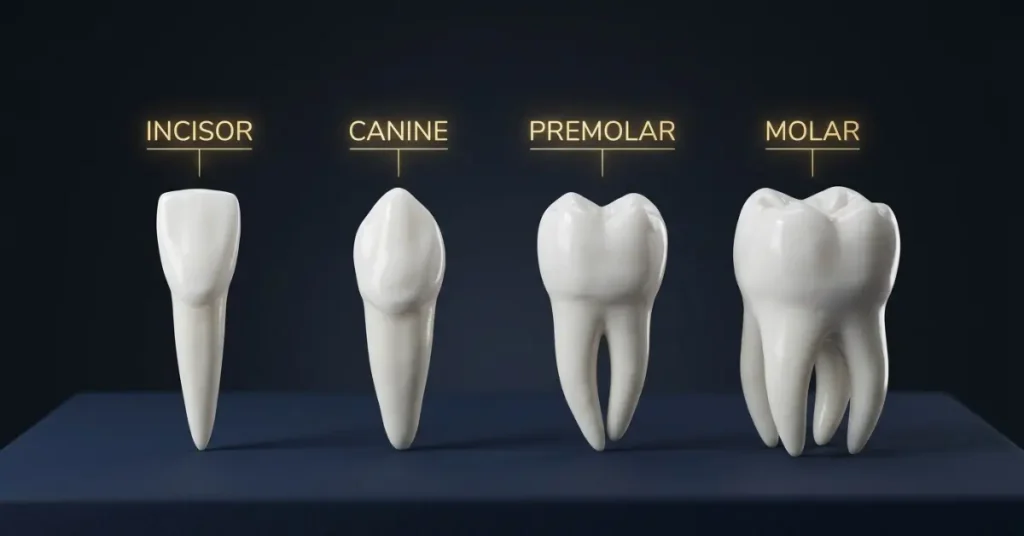
The 4 Main Types of Teeth
Incisors: Your Front Cutting Teeth
Direct answer: Incisors are the eight flat, sharp-edged teeth at the front of your mouth used for biting food.
You have four on top and four on bottom. They’re the first teeth to erupt in babies, usually around six months, and the first permanent ones to replace them around age six or seven.
Canines (Cuspids): The Pointed Teeth
Direct answer: Canines, also called cuspids, are the four pointed teeth next to your incisors used for tearing food.
They sit right at the corners of your mouth and are the longest teeth you have, anchored by the deepest roots. That deep root is why canines rarely need extraction compared to other teeth.
Premolars (Bicuspids): The Transition Teeth
Direct answer: Premolars, or bicuspids, are the eight teeth between your canines and molars that crush and grind food.
Adults have eight premolars total, two on each side, top and bottom. Kids don’t have premolars at all. Baby teeth skip straight from canines to molars, which is why premolars only show up during the permanent teeth stage.
Molars: The Grinding Powerhouses
Direct answer: Molars are your largest, flattest teeth in the back of your mouth, built for grinding and chewing food thoroughly.
Adults have 12 molars, including four wisdom teeth (third molars). Wisdom teeth usually show up between ages 17 and 25. Many oral surgeons recommend removing them because of third molar impaction, which happens when there isn’t enough room in the jaw for them to come in straight.
| Tooth Type | Count (Adult) | Location | Main Job |
| Incisors | 8 | Front, top & bottom | Biting/cutting |
| Canines | 4 | Corners of mouth | Tearing |
| Premolars | 8 | Between canines & molars | Crushing |
| Molars | 12 | Back of mouth | Grinding |
Teeth Numbering Systems Explained
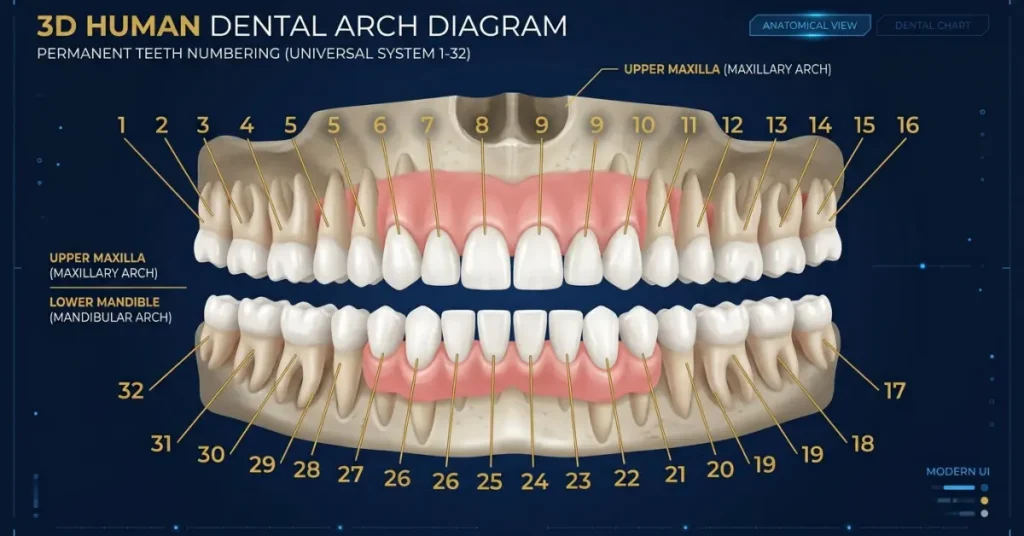
Direct answer: Dentists in the U.S. mostly use the Universal Numbering System, numbering teeth 1 through 32 starting from the upper right wisdom tooth.
There are actually three systems in use worldwide:
- Universal Numbering System. Numbers 1-32, most common in American dental offices.
- Palmer Notation. Uses a grid symbol with numbers 1-8 per quadrant, common in orthodontics.
- FDI World Dental Federation system. A two-digit code (like 18 or 46), used internationally and recommended by global health bodies.
If your dentist mentions “tooth number 19” or “tooth 3,” they’re using the Universal system. That’s your lower left first molar. Understanding this chart makes it a lot easier to follow along during a root canal consultation or when reading your treatment plan.
Tooth Anatomy: What’s Actually Inside a Tooth
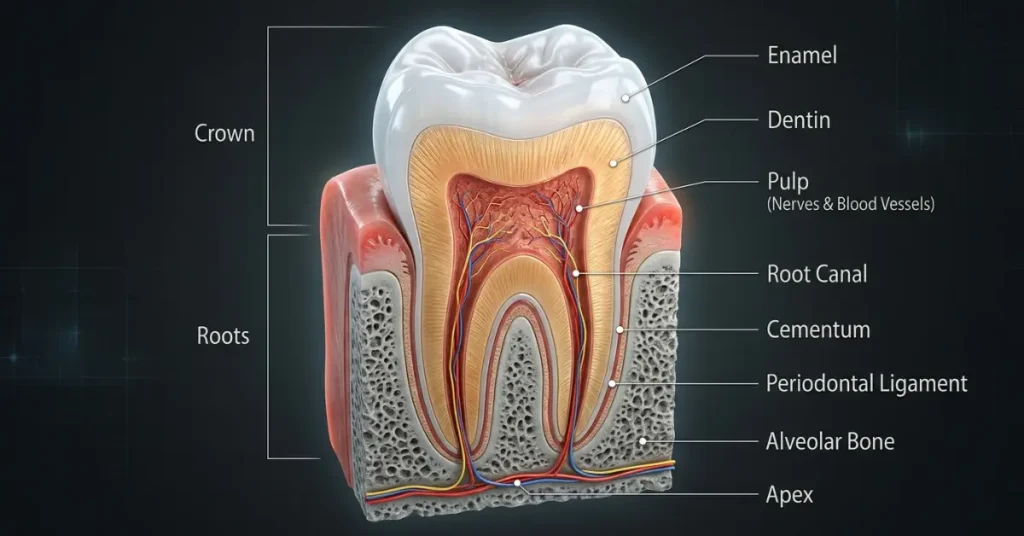
Direct answer: Every tooth has a crown above the gum line and a root below it, held in place by the jawbone.
The visible part is covered in enamel, the hardest substance in your body. Underneath sits dentin, then the pulp, where nerves and blood vessels live. This is why a cavity that reaches the pulp causes real pain, and why enamel erosion from acidic foods or aggressive brushing can lead to tooth sensitivity over time. The gingiva (gum tissue) protects the root and connects to the jaw structure, whether that’s the maxilla (upper jaw) or mandible (lower jaw).
Baby Teeth vs. Permanent Teeth: The Eruption Timeline
Direct answer: Baby teeth start coming in around 6 months and are usually all replaced by age 12 or 13.
| Age Range | What’s Happening |
| 6-10 months | First incisors erupt |
| 1-3 years | Full set of 20 baby unteeth in |
| 6-7 years | First permanent molars & incisors arrive |
| 9-13 years | Baby teeth replaced by adult teeth |
| 17-25 years | Wisdom teeth may erupt |
A pediatric dentist typically tracks this timeline closely, since early or late eruption can signal spacing issues or future malocclusion (bad bite alignment).
When Something’s Off: Extra, Missing, or Impacted Teeth
Direct answer: Some people have fewer or more teeth than average due to conditions like hypodontia (missing teeth) or hyperdontia (extra teeth).
Hypodontia is fairly common and often runs in families. It usually affects wisdom teeth or lateral incisors. Hyperdontia causes supernumerary teeth, extra teeth that can crowd the jaw and need removal. Both conditions are usually caught early through routine dental x-rays, and an orthodontist or oral surgeon can map out a treatment plan from there.
How to Tell Which Tooth Is Hurting
Direct answer: Pain in the back of your jaw is usually a molar issue. Sharp pain up front often points to an incisor or canine.
If you’re chewing and feel a sudden zing, try to notice which side and how far back it is. That’s genuinely useful information to give your dentist before you even sit in the chair. It can speed up diagnosis, especially for a possible cracked filling or the start of tooth decay. According to the American Dental Association and research from the NIDCR, most tooth pain traces back to either decay, a cracked crown, or gum recession exposing the root.
Keeping Your Teeth Healthy
Direct answer: Brushing twice daily, flossing once a day, and seeing a dental hygienist every six months prevents most tooth problems.
I’ve sat through enough cleanings to know the drill. Plaque builds up fast around the back molars and along the gum line, especially if flossing gets skipped. Cavities and gum disease are almost always preventable with consistent care. Institutions like Cleveland Clinic and Mayo Clinic both recommend fluoride toothpaste and limiting sugary drinks as two of the easiest habits to start. If a cavity does form, a dental filling usually fixes it early. Wait too long and you’re looking at a root canal or even extraction.
Frequently Asked Questions About Teeth Names and Numbers
1. What are the names of all 32 adult teeth?
The 32 adult teeth include 8 incisors, 4 canines, 8 premolars, and 12 molars. These include central incisors, lateral incisors, canines, first and second premolars, first and second molars, and four wisdom teeth.
2. What are the 4 main types of teeth and their functions?
The four main types of teeth are incisors, canines, premolars, and molars. Incisors cut food, canines tear food, premolars crush food, and molars grind food during chewing.
3. How are teeth numbered by dentists?
Dentists use different tooth numbering systems, including the Universal Numbering System, Palmer Notation, and FDI system. The Universal System numbers adult teeth from 1 to 32, starting from the upper right wisdom tooth.
4. What are the front teeth called?
The front teeth are called incisors. Adults have eight incisors, including four upper and four lower incisors, which help bite and cut food.
5. What are the back teeth called?
The back teeth are called premolars and molars. Premolars help crush food, while molars have large chewing surfaces designed for grinding food.
Key Takeaways
- Adults have 32 teeth: 8 incisors, 4 canines, 8 premolars, and 12 molars (including wisdom teeth).
- The Universal Numbering System (1-32) is the standard used by most U.S. dentists.
- Baby teeth start around 6 months and are fully replaced by early teens.
- Tooth pain location often hints at which tooth is affected. That’s useful info before a dental visit.
- Simple daily habits prevent most cavities and gum issues long-term.
Not sure which tooth is giving you trouble, or overdue for a cleaning? Book a checkup with your local dentist this week. Catching an issue early is always cheaper and less painful than waiting it out.
- Can Wisdom Teeth Grow Back? What Actually Happens
 Can wisdom teeth grow back after removal? No, but something else may be happening. Learn the real causes, exceptions, and when to see a dentist. No, wisdom teeth cannot grow back once they have been fully removed. If you’re feeling something new in that spot, weeks, months, or even years later, it isn’t a wisdom…
 - Are Orthodontists Doctors? Yes, Here’s Why
 Are orthodontists doctors? Yes: they earn a DDS or DMD, then complete 2 to 3 more years of orthodontic residency training after dental school. Yes, orthodontists are doctors. Every practicing orthodontist first completes dental school and earns a Doctor of Dental Surgery (DDS) or Doctor of Medicine in Dentistry (DMD) degree, the same doctoral-level degree…
 - Are Eggs Good for Teeth? What the Nutrients Actually Do
 Are eggs good for teeth? Yes: phosphorus, vitamin D and protein support enamel and gums, though preparation matters more than the egg itself. Eggs show up on nearly every “foods for healthy teeth” list, usually next to a vague line about calcium. That framing undersells what eggs actually do and overstates the one thing (calcium)…
 - Stuck Food in Teeth: Causes, Fixes, and Prevention
 Stuck food in teeth is common, but chronic cases can signal cavities or gum problems. Learn safe removal steps, causes, and when to see a dentist. Food gets stuck in teeth because of small gaps, worn dental work, or gum changes that create pockets where a toothbrush cannot reach on its own. In most cases,…
 - Toothache and Headache at the Same Time: Causes and Relief
 Toothache and headache at the same time can mean dental infection, TMJ, sinusitis, or migraine. Learn the real causes, red flags, and how to get relief. A toothache and headache happening at the same time is usually not a coincidence. In most cases, the two are connected through shared nerve pathways in your face and…