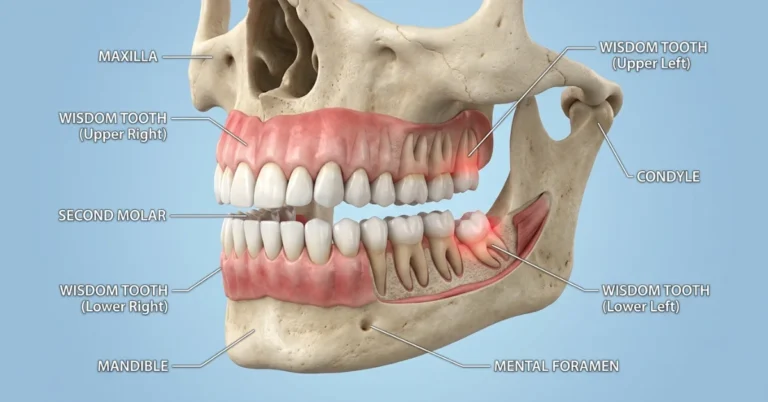
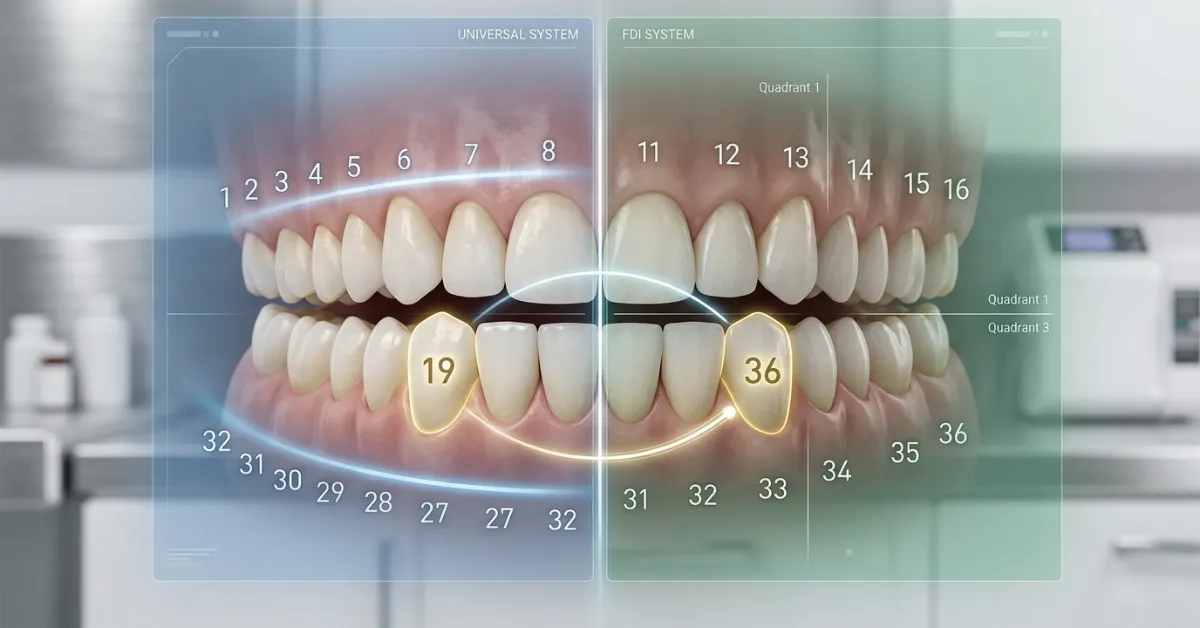
Universal Tooth Numbering System vs FDI: Full detail Guide
The universal tooth numbering system vs FDI, explained with a full 1-32 to 11-48 chart, why the US skips the ISO standard, and where mix-ups happen.
If you have ever heard a US dentist call out “tooth number 19” and then seen a European report list the same tooth as “36,” you were not looking at two different problems. You were looking at the same tooth described by two different numbering systems, and that gap causes more confusion in dentistry than almost any other charting issue.
The Universal Numbering System labels the 32 adult teeth 1 through 32 and is the default in the United States. The FDI system, also called ISO 3950, uses a two digit code where the first digit names the quadrant and the second names the tooth position, and it is the standard almost everywhere else on earth. Neither system is wrong. They just were not built to talk to each other, and that is exactly the problem this guide solves.
I have pulled together every practical comparison a US patient, dental assistant, or biller actually needs: how each system counts, a full conversion chart for all 32 teeth, why American dentistry still resists the international standard, and the real situations, from insurance denials to forensic identification, where mixing the two up has caused actual harm.
What Is the Universal Tooth Numbering System?
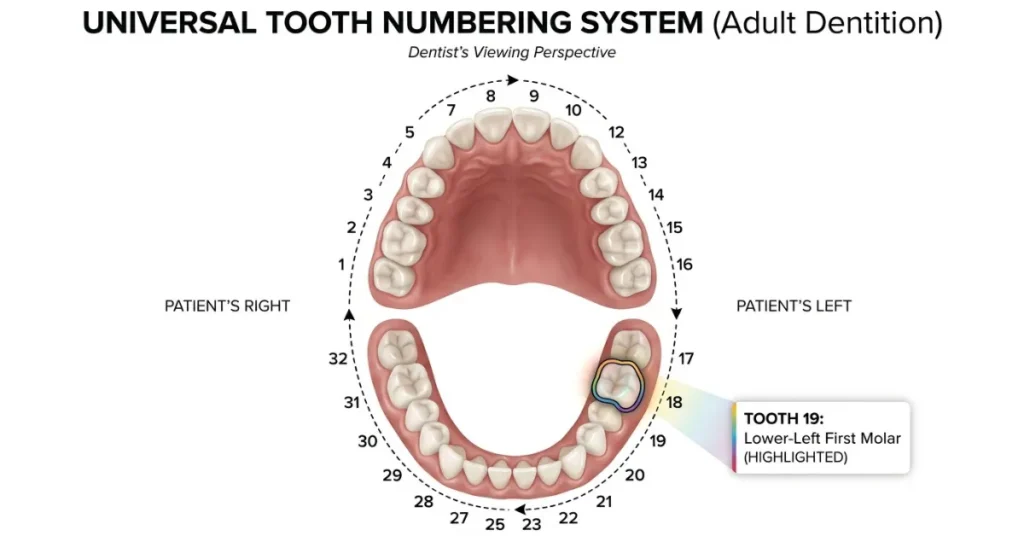
The Universal Numbering System, sometimes called the American system, was adopted by the American Dental Association in 1968 after an earlier attempt to standardize on Palmer notation ran into a practical wall: Palmer’s bracket symbols could not be typed on a keyboard, and by the late 1960s dental offices were starting to computerize their records.
Universal solved that by giving every permanent tooth a plain, single number with no symbols required. Counting starts at the upper right third molar, which is tooth 1, and moves left across the upper arch to tooth 16 at the upper left third molar. It then drops to the lower left third molar, tooth 17, and continues right across the bottom arch to tooth 32 at the lower right third molar. Primary teeth, the twenty baby teeth children have before their adult set comes in, use capital letters A through T in the same clockwise pattern instead of numbers.
That single, unbroken sequence is Universal’s biggest strength. Any staff member, regardless of training, can glance at a chart and read “tooth 8” without doing quadrant math first. It is also why the system remains embedded in US dental insurance claim forms, practice management software, and CDT billing codes decades after an international alternative became available.
What Is the FDI (ISO) Tooth Numbering System?
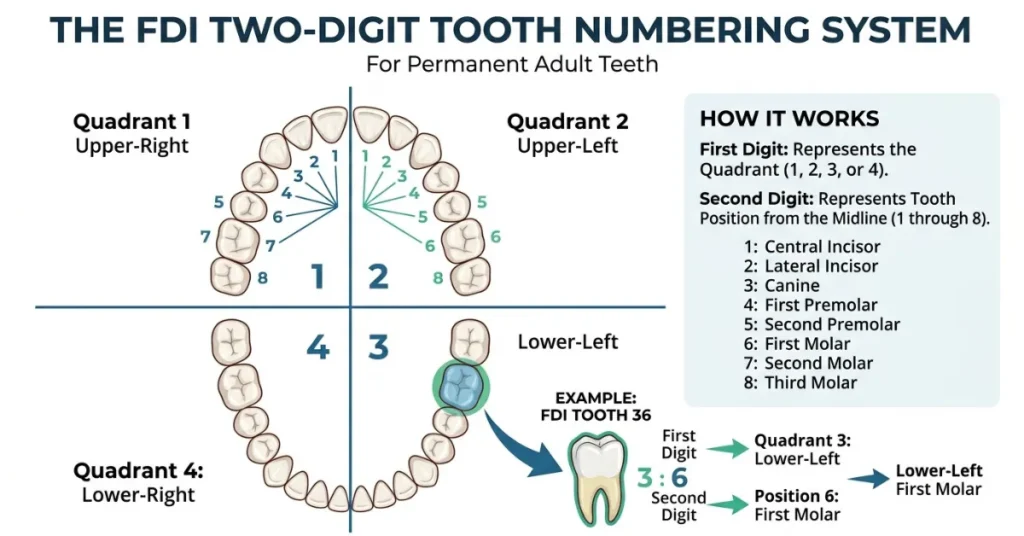
FDI notation was developed by the FDI World Dental Federation and is formally recognized by the International Organization for Standardization as ISO 3950, “Dentistry: Designation system for teeth and areas of the oral cavity.” It is the world’s most commonly used dental notation system and is used in most countries except the United States. The World Health Organization also uses it, which is part of why it dominates outside North America.
Instead of one running number, FDI assigns each tooth a two digit code. The first digit identifies the quadrant: 1 for upper right, 2 for upper left, 3 for lower left, and 4 for lower right in the permanent dentition, with 5 through 8 used for the same four quadrants in primary teeth. The second digit gives the tooth’s position within that quadrant, counting outward from the midline, so position 1 is always the central incisor closest to the front and position 8 is always the third molar at the very back.
Read the two digits separately rather than as one number and the logic clicks fast. Tooth “36” is not “thirty six,” it is quadrant 3 (lower left) plus position 6 (first molar), so it names the lower left first molar. Once you know that rule, you can decode any FDI number on sight without memorizing a chart, which is the main reason software developers and international researchers favor it over Universal’s sequential list.
Universal vs FDI: Key Differences at a Glance
Gap-fill: none of the competing guides lay the two logics side by side this directly, which is usually the first thing someone comparing the systems actually wants.
| Feature | Universal System | FDI (ISO 3950) System |
|---|---|---|
| Format | Single number, 1 to 32 | Two digit code (quadrant + position) |
| Where it starts | Upper right third molar (1) | Upper right central incisor (11) |
| Primary teeth | Letters A through T | Digits, quadrants 5 to 8 |
| Logic required | None, memorize the sequence | Read quadrant, then position |
| Primary region | United States | Most of the world, plus WHO |
| Official body | American Dental Association | FDI World Dental Federation, ISO |
| Adopted | 1968 | Recognized as ISO 3950 |
| Best suited for | Fast, low-training data entry | Cross-border and multilingual records |
Full Universal-to-FDI Conversion Chart
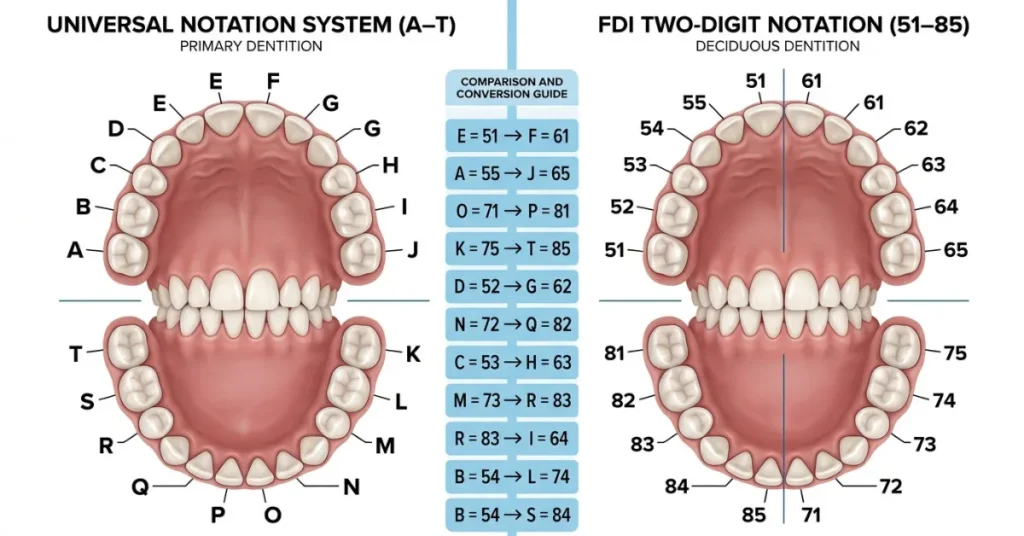
Gap-fill: most competing pages give three or four example teeth. A complete reference for all 32 is what actually gets bookmarked.
Dental charts are drawn from the practitioner’s point of view facing the patient, so the patient’s right side sits on the left of the diagram. Keep that orientation in mind when you read either column below.
Upper right quadrant Universal 1 to 8 = FDI 18, 17, 16, 15, 14, 13, 12, 11
Upper left quadrant Universal 9 to 16 = FDI 21, 22, 23, 24, 25, 26, 27, 28
Lower left quadrant Universal 17 to 24 = FDI 38, 37, 36, 35, 34, 33, 32, 31
Lower right quadrant Universal 25 to 32 = FDI 41, 42, 43, 44, 45, 46, 47, 48
A few reference points worth memorizing on their own: the four wisdom teeth are Universal 1, 16, 17, and 32, which correspond to FDI 18, 28, 38, and 48. Dental charts are normally arranged from the viewpoint of a dental practitioner facing the patient, so the patient’s right side appears on the left side of the chart.
Why the US Still Uses Universal Instead of FDI
Gap-fill: competitors state that the US uses Universal, but rarely explain why an ISO-recognized global standard did not displace it.
This is the question dental students and international patients ask most, and the honest answer is inertia backed by infrastructure, not a technical flaw in FDI. The Universal system was officially adopted by the American Dental Association in 1968, standardizing a method that was already familiar in practice, and it created a clear, sequential notation that reduces errors for everyday use. By the time FDI notation gained international traction through ISO 3950, American insurance billing, CDT procedure codes, and practice management software had already been built around Universal’s single-number format.
Ripping that out and replacing it with a two digit quadrant system would mean retraining every front desk and billing coder in the country, rewriting claim form logic at every major insurer, and migrating decades of patient records. Universal remains the most widely used system in North America and is embedded in most practice management software platforms and insurance documentation protocols, so the switching cost has consistently outweighed the benefit for a country that rarely has to reconcile its own records against a foreign chart. Where FDI actually enters US dentistry is at the edges: dental schools that teach both systems, oral and maxillofacial radiology software with international roots, and any US practice that regularly receives referrals or lab cases from abroad.
How to Convert Between the Two Systems in Your Head
Gap-fill: existing guides supply a table but not a repeatable method for converting a number you have not memorized.
You do not need to memorize all 32 pairings to work between the two systems. Three steps get you there every time.
First, find the quadrant. In FDI, the first digit tells you directly: 1 is upper right, 2 is upper left, 3 is lower left, 4 is lower right. In Universal, you have to place the number in a range: 1 to 8 is upper right, 9 to 16 is upper left, 17 to 24 is lower left, 25 to 32 is lower right.
Second, find the position within that quadrant. FDI’s second digit already gives you this, counting 1 at the midline out to 8 at the back. Universal runs in the opposite direction on the right side of the mouth and the same direction on the left, which is the single most common source of manual conversion errors, so it is worth double checking rather than trusting memory.
Third, match position to name. Positions 1 and 2 are incisors, 3 is the canine, 4 and 5 are premolars, and 6, 7, and 8 are the first, second, and third molars. That mapping is identical in both systems, so once you know the position number you know the tooth type regardless of which chart you started from.
Where the Two Systems Create Real Problems
Gap-fill: nearly every competitor mentions that mix-ups “can happen,” but few show what actually goes wrong when they do.
The clearest example comes from cross-border patient care and dental identification work, where the same tooth genuinely gets recorded twice under two different labels. A postmortem dental chart completed using FDI notation might record a restoration on tooth 36. An antemortem record from a different country, filed in Universal numbers, might describe the identical filling on tooth 19. Both entries are correct. Both describe the same lower left first molar. But an examiner who does not recognize that the two labels overlap can log it as a discrepancy that does not exist, or miss a genuine match entirely. The FDI two-digit system is the worldwide standard and is required on INTERPOL DVI forms specifically because of this risk.
Dental labs run into the same failure mode on a smaller, more frequent scale. A lab serving both US and international clinics can receive prescriptions in Universal one day and FDI the next, and a case written for “tooth 3,” the upper right first molar in Universal, can get confused with a completely different tooth if the system in use is not verified before the crown or bridge is fabricated. Getting that wrong is not a paperwork error, it is a restoration built for the wrong location in someone’s mouth.
Patients feel this most directly when they travel for dental work. If you receive treatment abroad and your home dentist works in Universal, ask for the tooth numbers in both formats before you leave, or request a marked diagram alongside the numeric code. A number by itself, disconnected from a system label, is not enough information to safely continue treatment back home.
Primary (Baby) Teeth: Universal vs FDI
Children’s twenty primary teeth follow the same underlying logic as the adult systems, just with different labels. Universal uses capital letters A through T, moving clockwise from the upper right second primary molar (A) around to the lower right second primary molar (T). FDI keeps its two digit format for primary teeth but shifts the quadrant digit to 5 through 8 instead of 1 through 4, so the same quadrant structure applies while the numbers stay visually distinct from the permanent set.
That distinction matters most in mixed dentition charting, the transitional years when a child has both baby and adult teeth present at once. A chart has to make it unmistakable which system, and which dentition, a given code refers to, since a stray permanent-tooth number sitting next to primary-tooth letters can be misread if the labeling is inconsistent.
Which System Should You Use?
For a general dental practice operating entirely within the United States, Universal remains the practical default. It matches CDT billing codes, integrates with the practice management software most US clinics already run, and every staff member and insurer you deal with already reads it fluently.
Reach for FDI when your practice regularly receives referrals or lab work from outside the US, when you are documenting for research or academic publication, when you are dealing with an international patient’s existing records, or when you are working in a forensic or humanitarian identification context where INTERPOL and WHO standards apply. Some larger US dental schools now teach both systems for exactly this reason, so graduates can move between either environment without a translation step.
FAQ
What is the difference between the Universal tooth numbering system and FDI?
The Universal tooth numbering system labels permanent teeth from 1 to 32, while the FDI system uses two digits: the first identifies the quadrant and the second identifies the tooth’s position. Both systems refer to the same teeth but use different numbering methods.
What is Universal tooth number 19 in the FDI system?
Universal tooth number 19 is the lower left first molar. Its corresponding FDI number is 36. In FDI notation, 3 identifies the lower left quadrant and 6 identifies the first molar.
What is FDI tooth number 36 in the Universal system?
FDI tooth number 36 corresponds to Universal tooth number 19, which is the permanent lower left first molar.
Which tooth numbering system is used in the United States?
The Universal tooth numbering system is commonly used in the United States. Permanent teeth are numbered 1 through 32, beginning with the upper right third molar and ending with the lower right third molar.
Which tooth numbering system is used internationally?
The FDI two-digit tooth numbering system is widely used internationally. It identifies each permanent tooth with a quadrant number followed by a position number, making it different from the 1-to-32 Universal system used in the United States.
How do you convert Universal tooth numbers to FDI?
To convert Universal to FDI, identify the tooth’s location, determine its quadrant, and then identify its position from the midline. For example, Universal #19 is the lower left first molar, which converts to FDI #36.
Conclusion: Key Takeaways
The universal tooth numbering system vs FDI comparison comes down to geography and infrastructure, not accuracy. Universal gives US dentistry a fast, single-number sequence that is baked into its billing and software; FDI gives the rest of the world, plus researchers and forensic identification teams, a quadrant-based code that scales cleanly across languages and borders.
Neither system will replace the other soon, which means the real skill is knowing both exist and checking which one a given chart uses before you act on it. Whether you are a dental professional reading an international referral, a lab tech filling a cross-border case, or a patient bringing home records from treatment abroad, that one habit, confirming the system before comparing the numbers, is what prevents the identical tooth from ever being treated as two different ones.