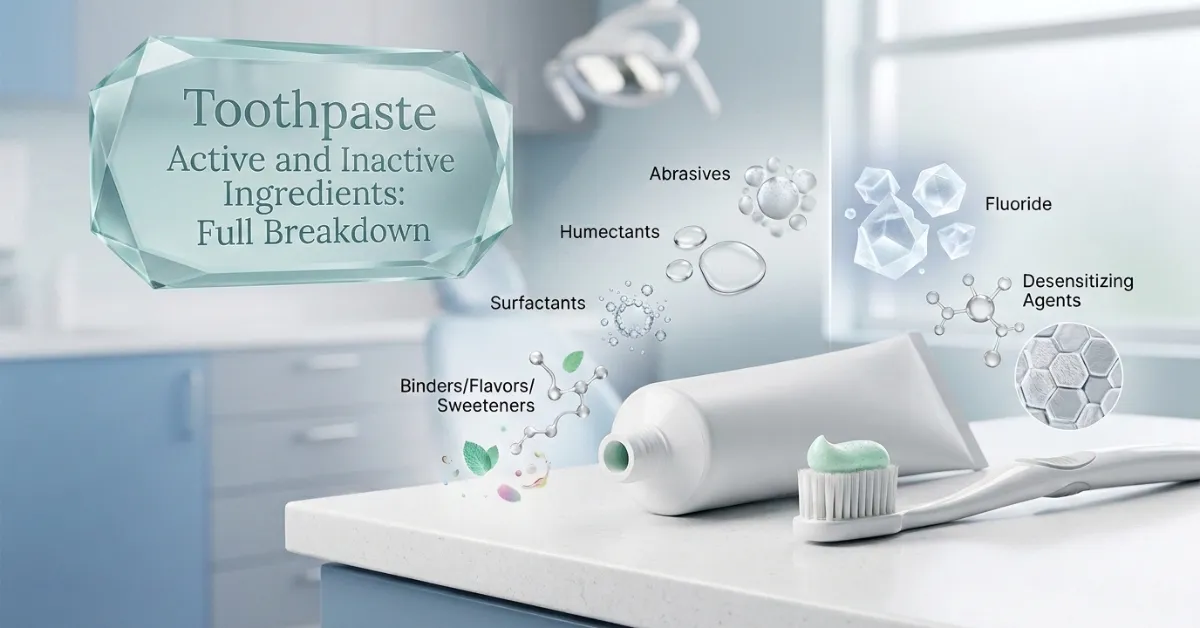
Toothpaste Active and Inactive Ingredients: Full Breakdown
Toothpaste active and inactive ingredients fall into two legal categories: one fights cavities, the other adds texture, foam, and flavor.
Pick up almost any toothpaste tube in your bathroom and flip it over. You’ll see a “Drug Facts” box listing one or two active ingredients, followed by a much longer list labeled “inactive ingredients.” That split isn’t marketing. It’s a federal labeling requirement, and it tells you exactly which parts of the paste are doing medical work and which parts are just there to make brushing bearable.
I’ve spent time going through actual Drug Facts panels from a dozen mainstream and boutique toothpaste brands for this guide, cross-checking them against the FDA’s own anticaries monograph, and the pattern holds up every time. Once you know what to look for, reading a toothpaste label takes about ten seconds.
What “Active” and “Inactive” Actually Mean on a Toothpaste Label
The FDA classifies most toothpaste as an over-the-counter drug product, specifically a “dentifrice,” because it’s designed to deliver an anticaries drug to your teeth. That single fact is why toothpaste boxes look more like medicine packaging than like a cosmetics label.
Under FDA rules, an active ingredient is any component that treats or prevents a disease, or that affects the structure or function of the body. For toothpaste, that almost always means fluoride, since fluoride is the only ingredient category the FDA’s anticaries monograph currently recognizes for cavity prevention claims. Everything else on the ingredient list, from the water to the mint flavor, is legally inactive, even if it plays a real functional role in how well the paste cleans your teeth.
That last point trips people up. “Inactive” does not mean “useless.” It means the ingredient isn’t regulated as a drug. An abrasive that physically scrubs plaque off your enamel is doing real work, it just isn’t classified the same way fluoride is.
Active Ingredients: The Ones the FDA Actually Regulates
Active ingredients are listed first on the Drug Facts panel, usually with a percentage and a stated purpose right next to them, such as “Sodium Fluoride 0.24% … Anticavity.”
Fluoride Compounds: Sodium Fluoride, Stannous Fluoride, and Sodium Monofluorophosphate
Fluoride is the backbone of modern cavity prevention, and it’s the only compound category the FDA monograph accepts for an anticaries claim in over-the-counter toothpaste. You’ll see it in one of three forms:
- Sodium fluoride, typically around 0.24 percent
- Stannous fluoride, typically around 0.45 percent, which also has some antimicrobial benefit against gum disease
- Sodium monofluorophosphate, typically around 0.76 percent
Standard over-the-counter toothpaste tops out at roughly 1,000 to 1,150 parts per million of available fluoride. Prescription-strength pastes can run as high as 5,000 ppm, and in-office varnishes go far higher still, which is why those stronger formulas require a dentist’s involvement rather than sitting on a store shelf.
Fluoride works by strengthening the outer layer of enamel and helping reverse very early, microscopic decay before it turns into a cavity you can feel.
Desensitizing Agents: Potassium Nitrate and Stannous Fluoride
If cold water or ice cream makes you wince, the active ingredient doing the work is usually potassium nitrate or stannous fluoride. Both interrupt the pain signal traveling through the microscopic tubules in your dentin, the layer just under the enamel, so hot, cold, and sweet stimuli stop registering as sharp pain. These typically need two to four weeks of consistent use before the effect becomes noticeable, which is worth knowing before you assume a sensitivity toothpaste “isn’t working.”
Inactive Ingredients: What Gives Toothpaste Its Texture, Foam, and Flavor
Inactive ingredients usually make up 70 to 80 percent of the tube by weight. None of them are legally required to prevent disease, but strip them out and you’d be brushing with a gritty, flavorless paste that dries out in the tube within a week.
Abrasives
Abrasives are the ingredients that physically polish plaque and surface stains off your teeth, and they typically make up close to half the formula. Common examples include hydrated silica, calcium carbonate, and baking soda (sodium bicarbonate). This is technically an inactive ingredient category, but functionally it’s doing more of the visible cleaning work than almost anything else in the tube. Dentists measure abrasiveness with a scale called RDA (Relative Dentin Abrasivity), and anything under about 250 is considered safe for daily use on enamel.
Humectants
Humectants such as glycerin, sorbitol, and propylene glycol keep the paste from drying into a hard, unusable brick between uses. They hold water inside the formula and give toothpaste that smooth, spreadable texture you expect when you squeeze the tube.
Detergents and Surfactants
The foam you see while brushing comes from a detergent, most commonly sodium lauryl sulfate (SLS). It lowers surface tension so the paste spreads across your teeth and helps loosen debris. SLS is effective, but it’s also the single most common cause of toothpaste-related mouth irritation, which is why “SLS-free” formulas exist for people prone to canker sores.
Binders and Thickeners
Binders, usually plant-derived gums like xanthan gum or carrageenan, keep the abrasives, water, and flavoring from separating inside the tube. Without a binder, you’d get watery liquid pooling at the cap and dry powder clumping at the bottom.
Flavoring Agents and Sweeteners
Mint oils dominate the category, but cinnamon, fruit, and bubblegum flavors show up in kids’ formulas. Since sugar itself would feed the exact bacteria toothpaste is trying to fight, sweetness comes from non-cariogenic sweeteners like saccharin or xylitol instead. Xylitol is worth noting specifically, since some research suggests it has a mild independent effect against cavity-causing bacteria on top of just tasting sweet.
How to Read the Drug Facts Panel on Your Toothpaste Box
Every FDA-regulated toothpaste carries a standardized panel, laid out the same way medicine boxes are, under a rule called 21 CFR 201.66. Once you know the five sections, you can evaluate any tube in about ten seconds:
- Active ingredient, with its percentage and purpose (for example, “Anticavity” or “Antisensitivity”)
- Uses, a one-line statement of what the product treats
- Warnings, including the standard “keep out of reach of children under 6” fluoride warning
- Directions, covering how much to use and by what age
- Other information and inactive ingredients, listed in descending order by concentration under FDA cosmetic labeling rules
If a tube skips the Drug Facts box entirely, it’s not being sold as an anticaries drug, which is common for some natural or hydroxyapatite-based pastes that make cosmetic claims (cleaning, whitening) instead of a disease-prevention claim.
Fluoride-Free Alternatives: What Hydroxyapatite Does Differently
Hydroxyapatite, and its nano-sized form nano-hydroxyapatite, has become the main fluoride alternative on ingredient lists over the past few years. Enamel is naturally made of a mineral called hydroxyapatite, so the idea behind these formulas is straightforward: supply the same mineral your tooth is already built from, in a form small enough to fill in microscopic gaps on the enamel surface.
The FDA has approved at least one bioactive-glass, fluoride-containing hydroxyapatite toothpaste for sale in the U.S., and it works by slowly releasing calcium, phosphate, and fluoride ions for hours after brushing rather than delivering everything in one quick rinse. Fluoride-free nano-hydroxyapatite pastes work on a similar remineralization principle but without the fluoride ion. Independent, large-scale clinical evidence for fluoride-free hydroxyapatite is still thinner than the decades of data behind fluoride, so most dentists treat it as a reasonable option for people who want or need to avoid fluoride, rather than a proven head-to-head replacement for it.
Ingredients Some People Choose to Avoid
A handful of ingredients show up repeatedly in “what to avoid” searches. Here’s the honest, non-alarmist version of each:
- SLS (sodium lauryl sulfate): A detergent, not a toxin. It’s linked to canker sores and mouth irritation in a subset of users, roughly estimated at around one in ten people, but it’s considered safe for the rest of the population. If you get frequent mouth sores, switching to an SLS-free formula is a reasonable, low-cost experiment.
- Triclosan: An antibacterial agent that was phased out of U.S. toothpaste by 2019 over endocrine-disruption and antibiotic-resistance concerns. If you’re using a current mainstream U.S. brand, you’re very unlikely to encounter it.
- Titanium dioxide: A whitening colorant used mainly in whitening formulas. Some consumers avoid it out of general caution, though the concern is mostly theoretical for a rinse-and-spit product used briefly twice a day.
- Microbeads (polyethylene): Largely banned from rinse-off personal care products in the U.S. since 2017 under the Microbead-Free Waters Act, so this is now rare to encounter in mainstream toothpaste.
None of these ingredients are automatically dangerous at the concentrations used in modern, reputable toothpaste. The decision to avoid one usually comes down to a specific personal sensitivity, not a universal safety failure.
Active vs. Inactive Ingredients at a Glance
| Category | Examples | Job |
|---|---|---|
| Active | Sodium fluoride, stannous fluoride, sodium monofluorophosphate | Prevent cavities, strengthen enamel |
| Active | Potassium nitrate, stannous fluoride | Reduce tooth sensitivity |
| Inactive | Hydrated silica, calcium carbonate, baking soda | Physically remove plaque and stains |
| Inactive | Glycerin, sorbitol | Keep the paste moist and spreadable |
| Inactive | Sodium lauryl sulfate | Create foam, spread the paste |
| Inactive | Xanthan gum, carrageenan | Bind ingredients into a stable paste |
| Inactive | Mint oil, saccharin, xylitol | Flavor and sweeten without feeding decay |
How to Choose a Toothpaste Based on What You Actually Need
- You get frequent cavities: Prioritize fluoride concentration first. Sodium fluoride or stannous fluoride at standard OTC strength is the best-supported choice.
- You have sensitive teeth: Look for potassium nitrate or stannous fluoride specifically labeled “sensitivity,” and give it two to four weeks before judging the result.
- You get canker sores or mouth irritation: Switch to an SLS-free formula and see if the frequency drops within a month.
- You want to avoid fluoride entirely: Choose a nano-hydroxyapatite formula from a brand that discloses its full ingredient percentages, and mention the switch to your dentist so they can watch your cavity risk more closely.
- You want whitening: Check for added abrasives or mild peroxide compounds, and confirm the product’s RDA value if you already have thin or sensitive enamel.
FAQ
What is the active ingredient in most toothpaste?
In the vast majority of U.S. toothpaste, it’s fluoride, in the form of sodium fluoride, stannous fluoride, or sodium monofluorophosphate. It’s the only ingredient category the FDA currently allows for a cavity-prevention claim.
What are inactive ingredients in toothpaste?
Everything that isn’t fluoride (or another drug-classified active): abrasives, humectants, detergents, binders, flavoring, sweeteners, and preservatives. They control texture, foam, and taste rather than treating a condition.
Is fluoride an active or inactive ingredient?
Active. It’s the compound the FDA regulates and the one manufacturers must list with a percentage and stated purpose on the Drug Facts panel.
What happens if you swallow fluoride toothpaste?
A pea-sized amount swallowed occasionally is not typically dangerous for most people, which is why the standard guidance is a rice-grain smear for children under three. Swallowing large amounts repeatedly over time is the actual concern, which is why fluoride toothpaste carries a specific warning to keep it away from young children and to call Poison Control for large ingestions.
Is SLS in toothpaste bad for you?
For most people, no. It’s a well-studied detergent, not a toxin. A minority of users experience irritation or canker sores from it, and for that group an SLS-free formula genuinely helps.
Is hydroxyapatite as effective as fluoride?
It shows promising early results, and one fluoride-containing hydroxyapatite formula has FDA approval, but fluoride still has decades more large-scale clinical evidence behind it. Hydroxyapatite is a reasonable choice for people who want to avoid fluoride, not yet a proven equal replacement across the board.
Do inactive ingredients affect how well toothpaste works?
Yes, indirectly. The abrasive determines how well plaque and stains get removed, the detergent affects how the paste spreads, and the humectant and binder determine whether you’ll actually want to use the product twice a day. A toothpaste with the right active ingredient but an unpleasant texture often doesn’t get used consistently, which matters more for long-term oral health than the label alone.
Key Takeaways
Fluoride is the one ingredient category doing regulated, FDA-recognized medical work in your toothpaste, whether that’s cavity prevention or sensitivity relief. Everything else on the label, the abrasives, humectants, detergents, binders, and flavoring, is legally “inactive” but still shapes how well the paste cleans, how it feels, and whether you’ll actually stick with brushing twice a day. Read the Drug Facts panel first for the active ingredient and its concentration, then check the inactive ingredients list only if you have a specific sensitivity, like SLS-triggered canker sores or a personal choice to avoid fluoride. For most people, a standard fluoride toothpaste with an ADA Seal of Acceptance remains the best-supported daily choice.