Why Is It Called an Eye Tooth? The Surprising Reason
Why is it called an eye tooth? Discover the origin of the name, whether eye teeth are connected to your eyes, what they do, when they erupt, and how to keep them healthy.
Medical review: This article is based on established scientific and dental facts and is for general educational purposes only. It does not replace professional dental advice, diagnosis, or treatment.
Have you ever wondered why is it called an eye tooth when the tooth itself is nowhere near your actual eye?
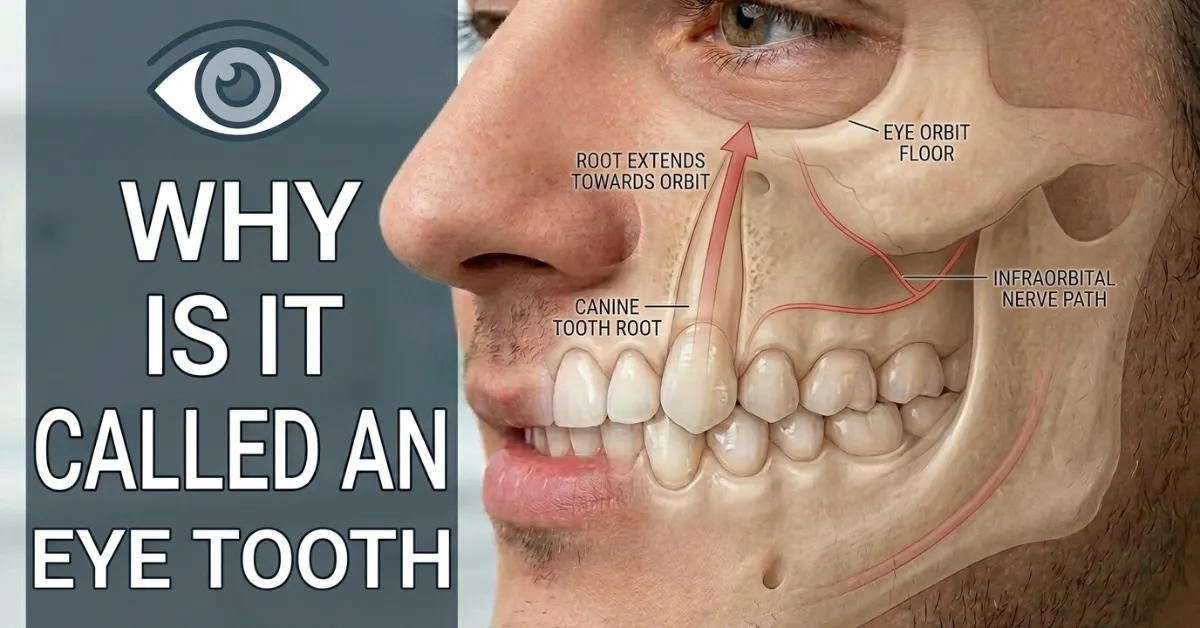
The answer is surprisingly simple. An eye tooth is another name for an upper canine tooth, and the name comes from its position near the eye. The English term dates back to the 1570s, when it was used for the upper canine because of its location immediately beneath or beside the eye.
Despite the unusual name, an eye tooth is not directly connected to your eye, and it does not control your eyesight. The name describes the tooth’s location, not a special relationship between the tooth and your vision.
But that’s only part of the story. Here’s what an eye tooth actually is, what it does, why it can become impacted, when it comes in, and why dentists try to preserve it whenever possible.
Why Is It Called an Eye Tooth?
The term “eye tooth” comes from the position of the upper canine in the face.
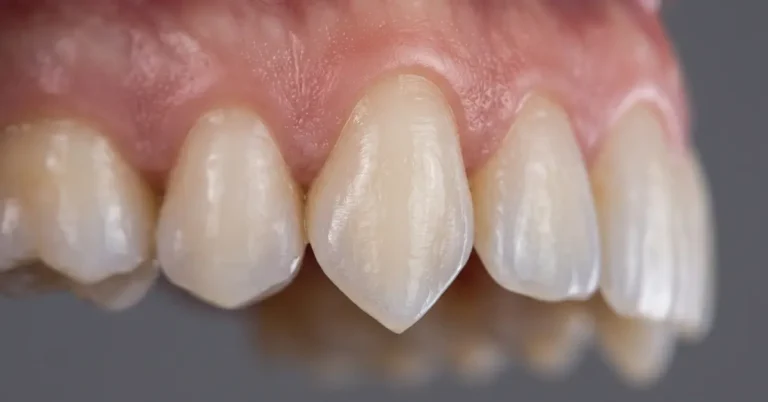
An upper canine sits toward the front of the upper jaw, between the lateral incisor and first premolar. Because of its position beneath and near the eye region, people historically associated the tooth with the eye.
That led to the descriptive name eye tooth.
Historical etymology sources trace the English term “eye-tooth” to the 1570s and specifically describe it as the upper canine, named for its position immediately under or next to the eye.
So the simplest answer is:
It is called an eye tooth because of where the upper canine is located, not because it is connected to the eye.
Is the eye tooth connected to the eye?
No.
Your upper canine and your eye are separate anatomical structures. There is no special nerve connecting an eye tooth directly to the eye that controls your vision.
However, the upper jaw is close to several structures of the face. Dental pain can sometimes be felt in nearby areas, which may make pain from an upper tooth seem as though it is coming from the cheek or area around the eye.
That is very different from having a direct nerve connection.
What Is an Eye Tooth?
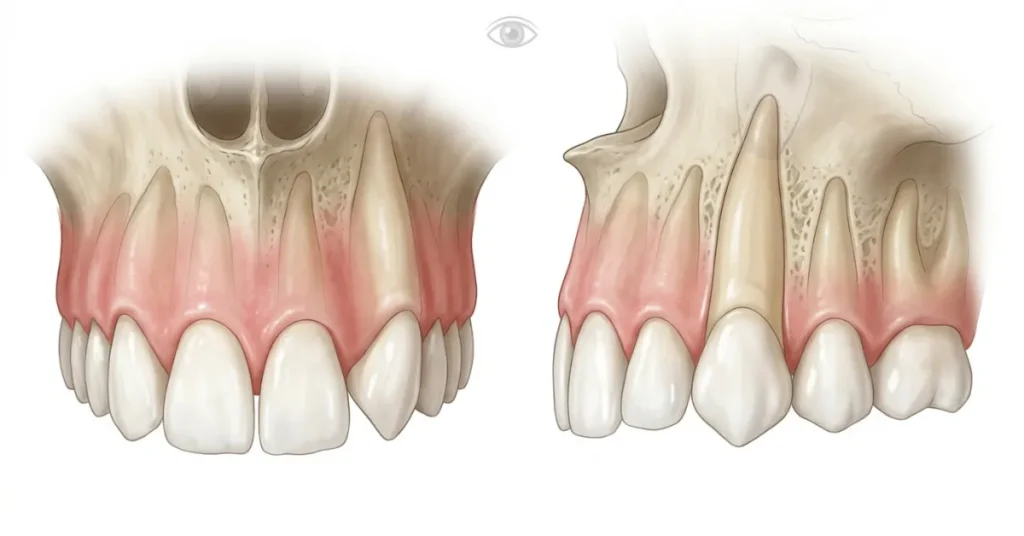
An eye tooth is a canine tooth, with the term most commonly referring to an upper canine.
Canines are the pointed teeth located between the incisors and premolars. Adults normally have four permanent canine teeth:
- Two upper canines
- Two lower canines
The upper canines are the teeth most commonly known as eye teeth.
Dentists usually use the term canine rather than eye tooth when discussing anatomy, diagnosis, treatment, or dental records.
Where is the eye tooth located?
Starting from the center of the upper jaw and moving toward the back, the teeth appear in this order:
Central incisor → lateral incisor → canine → first premolar
So the upper canine is the third tooth from the midline on either side of the upper jaw.
In the Universal Numbering System commonly used in the United States, the upper canines are teeth #6 and #11.
The canine is easy to recognize because it usually has a prominent pointed cusp and sits at the transition between the front teeth and the premolars.
Eye Tooth vs. Canine Tooth: Are They the Same?
Yes.
Eye tooth and canine tooth refer to the same type of tooth.
“Eye tooth” is a common, informal term, while canine is the standard dental term.
Another word you may hear is cuspid, which is also used to describe a canine tooth.
| Feature | Eye Tooth | Canine Tooth |
|---|---|---|
| Type | Common name | Dental name |
| Usually refers to | Upper canine | Upper or lower canine |
| Shape | Pointed | Pointed |
| Location | Near the eye region | Between incisors and premolars |
| Main functions | Biting, tearing, and bite guidance | Biting, tearing, and bite guidance |
| Clinical terminology | Informal | Standard |
So if your dentist says you have a problem with your maxillary canine, they are talking about what most people call an upper eye tooth.
Why Are Canine Teeth Called Canines?
The word canine has a completely different origin from the term eye tooth.
“Canine” comes from the Latin caninus, meaning “of the dog.” The word was associated with the pointed teeth found in dogs and other animals.
Humans also have canine teeth, although ours are far less prominent than the fangs of many animals.
This gives the same tooth two interesting names:
- Eye tooth: named for its position near the eye.
- Canine tooth: named from the Latin word associated with dogs.
What Does an Eye Tooth Do?
Eye teeth may look like simple pointed teeth, but they perform several important jobs.
1. They help bite and tear food
The pointed shape of a canine helps it grip and tear food.
Incisors are designed primarily for biting and cutting, while premolars and molars are better suited to crushing and grinding. Canines help bridge the gap between these functions.
2. They help guide jaw movement
Canines can help guide the lower jaw during certain side-to-side movements.
Their position and strong roots allow them to tolerate considerable forces during biting and jaw movement.
3. They help support the dental arch
Upper canines sit at an important transition point between the front teeth and premolars.
Their position contributes to the shape of the dental arch and can influence the appearance of the smile.
4. They have strong roots
Canines have particularly large and strong roots compared with other types of teeth.
That strong root structure helps anchor the tooth and allows it to withstand substantial biting forces.
For this reason, dentists generally try to preserve a healthy natural canine whenever possible.
When Do Eye Teeth Come In?
Eye teeth appear at different ages depending on whether they are primary baby teeth or permanent adult teeth.
Baby eye teeth
Primary canines generally erupt during the second year of life.
Current clinical references give a broad typical range of about 16 to 24 months, although individual children can vary.
Permanent eye teeth
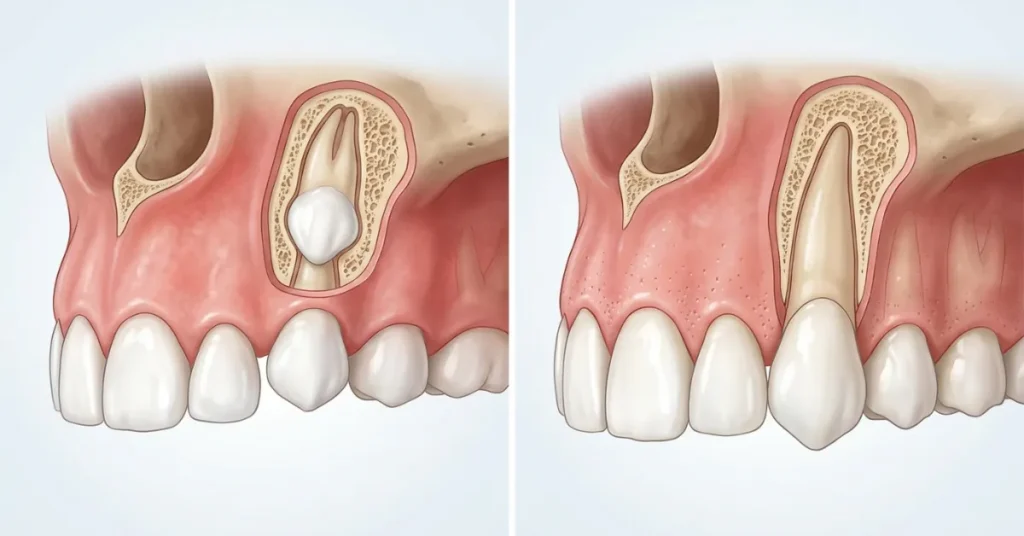
Permanent canines erupt later, usually during childhood or early adolescence.
The current MSD Manual eruption table gives a general range of 9 to 13 years for permanent canines. Eruption timing varies considerably between individuals.
| Tooth | Typical eruption |
|---|---|
| Primary canines | About 16–24 months |
| Permanent canines | About 9–13 years |
These are general ranges, not strict deadlines. A child’s dentist can monitor tooth development and eruption during routine dental visits.
Why Do Eye Teeth Become Impacted?
One of the more significant problems involving upper canines is impaction.
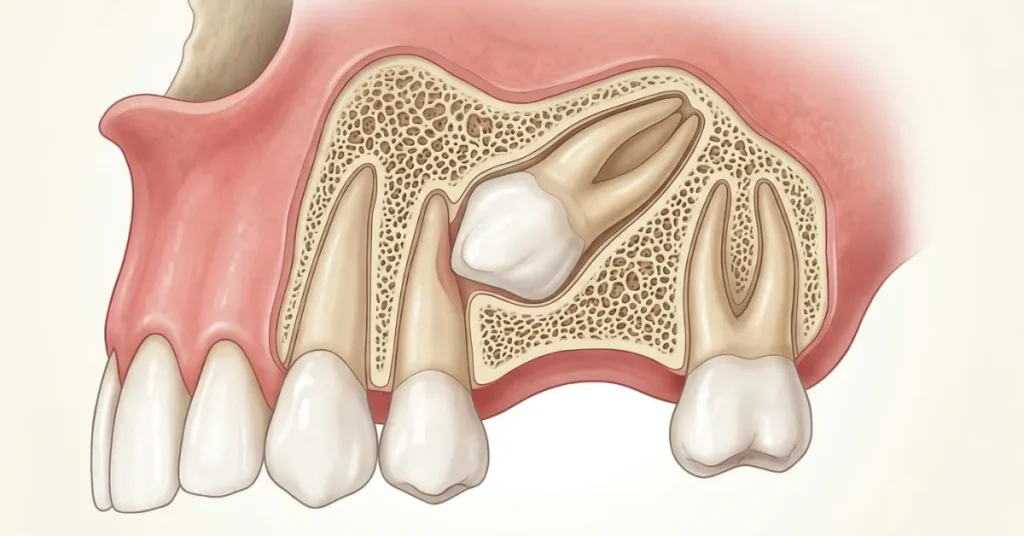
An impacted canine is a permanent tooth that fails to erupt normally and remains partly or completely trapped beneath the gum or bone.
Several factors can contribute to an impacted canine, including:
- Crowding
- Lack of space
- An abnormal eruption path
- Extra teeth blocking the path
- Abnormal development
- Problems involving neighboring teeth
The position of an upper canine can make eruption complicated because the tooth has to travel into its final position within the dental arch.
Is an impacted eye tooth serious?
It can be.
An impacted canine may remain trapped beneath the gum, fail to function normally, or affect the position of neighboring teeth.
A dentist may identify a possible impaction during a routine examination and use dental X-rays or other imaging to determine the tooth’s position.
Depending on the individual case, treatment may involve observation, orthodontic treatment, surgical exposure, or a combination of treatments.
Early evaluation can make treatment planning easier.
Why Does My Eye Tooth Hurt?
Pain in or around an eye tooth can have many possible causes.
| Possible cause | What may be happening |
|---|---|
| Tooth decay | Decay has damaged the tooth and may have reached deeper layers |
| Gum disease | The tissues supporting the tooth are inflamed |
| Dental infection | Bacteria have infected the pulp or tissues around the root |
| Cracked tooth | The tooth has been damaged by biting forces or trauma |
| Tooth sensitivity | Exposed dentin or another problem is causing sensitivity |
| Grinding or clenching | Repeated pressure is stressing the tooth |
| Trauma | A blow has injured the tooth |
| Impacted canine | The tooth is trapped beneath the gum or bone |
| Referred pain | Pain from nearby structures is being felt around the tooth |
Pain location alone cannot tell you exactly what is wrong.
If your eye tooth hurts repeatedly, becomes sensitive to hot or cold, hurts when you bite, or develops swelling, a dental examination can help determine the cause.
Can an Eye Tooth Infection Affect the Eye?
An infected eye tooth is not directly connected to the eye.
However, infections in the upper jaw can cause pain and swelling in nearby areas of the face.
That is why significant swelling should never be ignored.
Seek urgent professional care if tooth pain is accompanied by:
- Swelling around the face or eye
- Fever
- Rapidly increasing swelling
- Difficulty swallowing
- Difficulty breathing
- Severe or rapidly worsening pain
- Difficulty opening your mouth
These symptoms can indicate a more serious infection that requires prompt treatment.
How Are Eye Tooth Problems Treated?
Treatment depends on the cause of the problem and the condition of the tooth.
Filling
If decay has damaged the canine but the tooth remains structurally sound, a dentist may remove the decay and restore the tooth with a filling.
Root canal treatment
If decay or trauma has severely inflamed or infected the pulp, root canal treatment may be used to remove the diseased tissue and preserve the natural tooth.
Orthodontic treatment
If an eye tooth is crowded, displaced, or impacted, orthodontic treatment may help create space and guide the tooth toward its proper position.
Surgical exposure
Some impacted canines require a surgical procedure to uncover the tooth so orthodontic treatment can guide it into the dental arch.
Crown
A crown may be considered when a canine has been significantly weakened by decay, fracture, or previous dental treatment.
Extraction
Extraction may be necessary when a tooth cannot be predictably saved or when removal is the most appropriate treatment.
Because canines have important functional and aesthetic roles, preserving a healthy natural canine is generally preferred whenever it is practical and safe.
How to Keep Your Eye Teeth Healthy
Your eye teeth do not require a special cleaning routine. The same habits that protect your other natural teeth help protect your canines.
Brush twice a day
Brush twice daily with fluoride toothpaste and a soft-bristled toothbrush.
Clean the front, back, and biting surfaces of your canine and gently brush along the gumline.
Clean between your teeth
Floss or use another appropriate interdental cleaning method every day.
This removes plaque and food particles from areas a toothbrush cannot reach effectively.
Don’t use your teeth as tools
Avoid using your eye teeth to open packages, bite pens, tear plastic, or chew hard objects.
These habits can place unnecessary stress on the tooth and increase the risk of chips or cracks.
Protect your teeth during sports
If you participate in contact or high-impact sports, ask your dentist about an appropriate mouthguard.
Visit your dentist regularly
Routine dental examinations can identify cavities, gum problems, abnormal eruption, and other issues before they become more difficult to treat.
Why Are Eye Teeth Important to Your Smile?
Upper canines occupy an important position in the dental arch.
They sit between the front teeth and premolars, creating a transition between the anterior and posterior parts of the mouth.
Their position, shape, and color can therefore influence the appearance of your smile.
A displaced, missing, or severely damaged canine can affect both appearance and function.
That does not mean every canine has to look identical. Healthy teeth naturally differ in size, shape, and position from person to person.
Can You Lose an Eye Tooth?
Yes.
A permanent eye tooth can be lost because of severe decay, advanced periodontal disease, trauma, or other dental problems.
Losing a canine does not mean you will lose your eyesight.
However, because canines have important functional and aesthetic roles, losing one can affect the way the teeth meet and the appearance of the smile.
Depending on the situation, a dentist may discuss options such as:
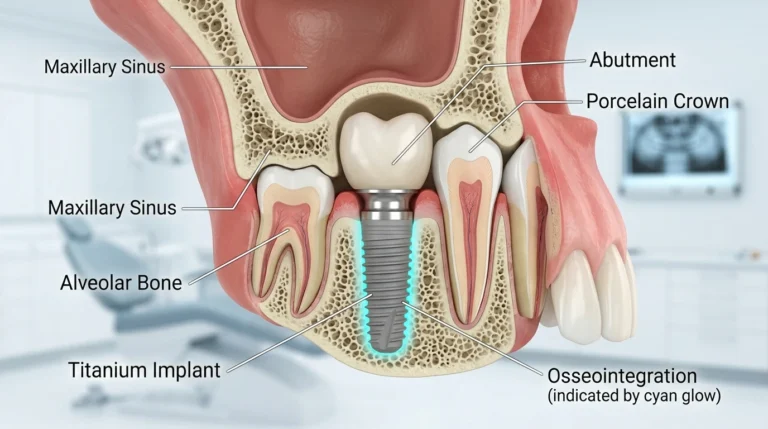
- Dental implants
- Dental bridges
- Orthodontic treatment
- Other restorative solutions
The appropriate option depends on factors such as oral health, bone condition, bite, age, and the condition of neighboring teeth.
The Eye Tooth and Eyesight Myth
The unusual name has created an equally unusual myth: that eye teeth are somehow connected to eyesight.
They are not.
There is no special “eye tooth nerve” that controls vision.
The upper canine and eye are separate structures. Treating or removing an eye tooth does not inherently cause blindness.
The myth likely became easier to believe because the tooth is located near the eye region and because pain from the upper jaw can sometimes be felt elsewhere in the face.
In simple terms:
The eye tooth is near the eye, but it is not connected to your eyesight.
Why Do People Say “I’d Give My Eye Teeth”?
The phrase “I’d give my eye teeth” is an old English expression meaning that someone would give up something valuable to get something they strongly desire.
For example:
“I’d give my eye teeth for that car.”
The speaker is not literally offering to remove their canines. The phrase uses the eye teeth as an example of something valuable and difficult to sacrifice.
The expression also shows how familiar the term eye tooth became in everyday English.
Frequently Asked Question:
Why is it called an eye tooth?
It is called an eye tooth because the upper canine is positioned near the eye region. The name refers to its location, not to any direct connection between the tooth and the eye.
Are eye teeth and canine teeth the same?
Yes. An eye tooth is another name for a canine tooth, particularly the upper canine located between the lateral incisor and first premolar.
Is an eye tooth connected to the eye?
No. The upper canine is not directly connected to the eye by a special nerve and does not control eyesight.
Which tooth is the eye tooth?
The eye tooth usually refers to the upper canine. It is the pointed tooth located between the lateral incisor and first premolar on each side of the upper jaw.
Why does my eye tooth hurt?
Eye tooth pain can result from tooth decay, infection, gum disease, trauma, sensitivity, grinding, or an impacted canine.
At what age do eye teeth come in?
Primary canines generally erupt around 16 to 24 months, while permanent canines usually erupt between about 9 and 13 years.
Can an eye tooth become impacted?
Yes. An upper canine can become trapped beneath the gum or bone instead of erupting normally. A dentist can use an examination and dental X-rays to determine its position and recommend appropriate treatment.
Key Takeaways
- An eye tooth is another name for an upper canine tooth.
- The name comes from the tooth’s position near the eye region, not from a connection to eyesight.
- The upper canine sits between the lateral incisor and first premolar.
- Canines help with biting, tearing food, and guiding certain jaw movements.
- Canines have particularly strong roots compared with other teeth.
- Primary canines generally erupt around 16 to 24 months.
- Permanent canines generally erupt around 9 to 13 years.
- An impacted canine can interfere with normal eruption and may require dental or orthodontic evaluation.
- Eye tooth pain can have several causes, including decay, infection, trauma, gum disease, and impaction.
- There is no special nerve connecting an eye tooth to your eyesight.
- Regular brushing, interdental cleaning, dental checkups, and protection from trauma can help keep your canines healthy.
The Bottom Line
So, why is it called an eye tooth?
Because the upper canine sits near the eye region. People gave it the descriptive name eye tooth centuries ago, and historical sources trace the English term back to the 1570s.
The name does not mean the tooth controls your eyesight or shares a special nerve with your eye.
It is simply an old name for an important tooth: your upper canine.