Mesiodens Tooth: Avoid This Common Removal Mistake
A mesiodens tooth can silently block permanent teeth. Learn the signs, when extraction is urgent, and real costs ($130 to $600).
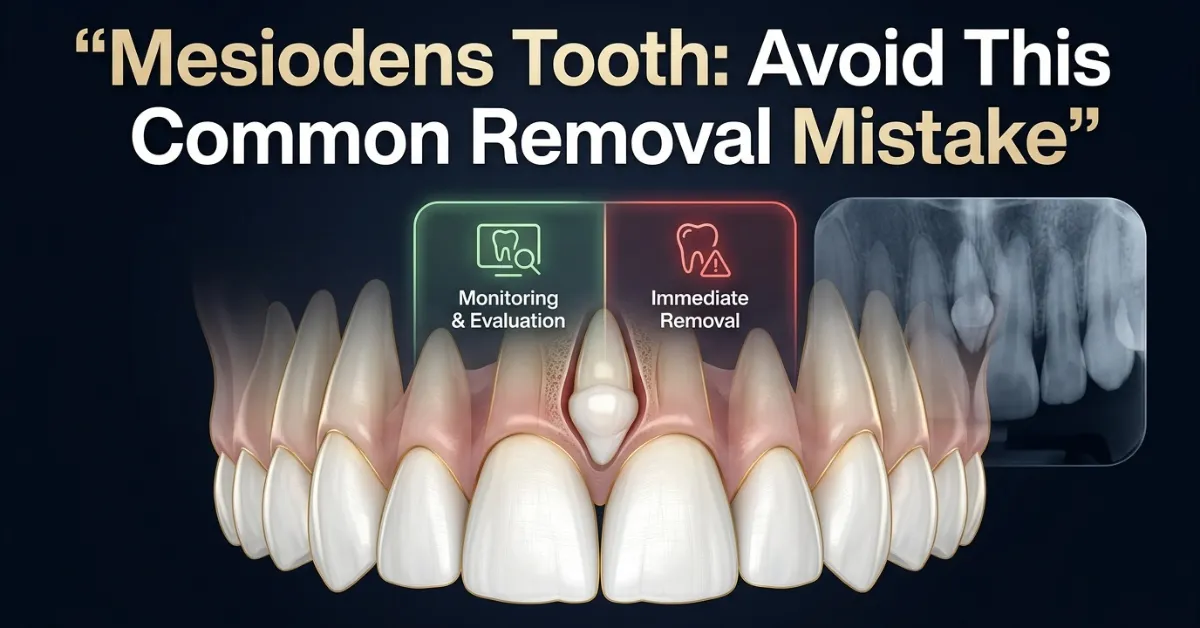
A mesiodens tooth is a small, usually cone-shaped extra tooth that grows between your two upper front teeth. It doesn’t belong to the normal set of teeth, and in most cases a dentist finds it on an X-ray long before anyone sees it in the mouth. It’s the single most common type of extra tooth, and while it sounds alarming, it’s rarely an emergency. What matters is catching it at the right time.
This guide walks through what a mesiodens actually looks like, why it forms, which problems it can cause, and how dentists decide between watching it and removing it. It also covers the parts most articles skip: what recovery actually feels like day by day, how baby-tooth cases differ from permanent-tooth cases, and what the procedure realistically costs in the United States.
What Is a Mesiodens?
The word “mesiodens” comes from “mesio,” meaning middle, and “dens,” meaning tooth. Dentists use it specifically for a supernumerary (extra) tooth that develops in the midline of the upper jaw, right between the two central incisors. It’s a type of hyperdontia, the broader term for having more teeth than normal.
Most people have 20 baby teeth and 32 adult teeth. A mesiodens adds one more to that count, usually in the upper arch. It can appear alone or, less often, in a pair, in which case dentists call the plural form “mesiodentes.” Studies estimate it affects somewhere between 0.15% and 1.9% of the population, and it shows up about twice as often in boys as in girls.
What Does a Mesiodens Look Like?
Because most mesiodens teeth stay buried under the gum, you usually won’t see one directly. What you’ll notice instead are the effects it has on the teeth around it. A few signs worth watching for at home:
- A gap (diastema) opening up between the two front teeth
- One or both permanent front teeth taking longer than usual to come in, especially past age 7
- A baby tooth that stays in place well past when it should have fallen out
- A small, peg-shaped tooth poking through the gum near the midline, if it does erupt
- Front teeth coming in rotated, tipped, or pushed off center
If a mesiodens does erupt into the mouth, it’s typically smaller than a normal incisor and comes to more of a point. That’s the classic conical shape, and it’s the most common form by far.
What Causes a Mesiodens?
Dentists still don’t know the exact cause, but two leading theories explain most cases. One is that the tissue responsible for forming teeth, called the dental lamina, produces one extra tooth bud than it should. The other is that a single tooth bud splits in two during early development, a process called dichotomy, resulting in two teeth where there should be one.
Is a Mesiodens Hereditary?
Genetics appears to play a real role. It’s common to see a mesiodens run through several generations of the same family, and twins or siblings frequently share the trait. If a parent had one, it’s worth mentioning that to your child’s dentist so they know to check early.
Syndromes Linked to Mesiodens
A mesiodens shows up more often alongside certain inherited conditions, including cleft lip and palate, Gardner’s syndrome, and cleidocranial dysplasia. Having a mesiodens doesn’t mean a child has one of these conditions. Most kids with an extra front tooth are otherwise completely healthy, and the connection only becomes relevant if other symptoms are present too.
How Common Is a Mesiodens?
A mesiodens is rare in the strict sense, affecting under 2% of people, but it’s still the most frequently seen type of extra tooth in dental practice. About 4 out of 5 cases occur in the upper jaw rather than the lower jaw, and roughly 1 in 5 people who have one end up with a second mesiodens as well. Only around 1 in 4 ever actually erupt through the gum; the rest stay hidden and are found only on X-ray.
Mesiodens vs. Other Supernumerary Teeth
“Supernumerary tooth” is the umbrella term for any extra tooth, and a mesiodens is only one type. Dentists also see paramolars (extra teeth next to the molars) and distomolars (extra teeth behind the last molar), but these are far less common. If your dentist mentions a supernumerary tooth without the word mesiodens attached, ask where it’s located. Only the ones sitting between your two front teeth are technically mesiodens, and location changes both the treatment and the urgency.
Types of Mesiodens
Not every mesiodens looks the same, and the shape affects how it’s treated.
- Conical. Small and cone-shaped, tapering to a point. This is the type most likely to erupt on its own and the one you’re most likely to notice.
- Tuberculate. Barrel-shaped with several small bumps (tubercles) on the surface. These almost never erupt and usually need surgical removal.
- Molariform. Shaped more like a small molar, with a fully formed root. This is the rarest form.
- Supplemental. Looks like a normal-sized incisor rather than a stunted extra tooth. This type is less common at the midline than the other three.
Problems a Mesiodens Can Cause
A mesiodens doesn’t have a natural place in the mouth, so its presence tends to crowd or interfere with whatever teeth sit next to it.
Delayed or Blocked Tooth Eruption
This is the number one reason dentists go looking for a mesiodens in the first place. If a child’s permanent front teeth haven’t started coming in by around age 7 or 8, or one side comes in but the other doesn’t, an extra tooth blocking the path is often the cause. Interference with eruption happens in roughly a quarter to half of all mesiodens cases.
Crowding, Rotation, and Gaps (Diastema)
Three teeth trying to fit into space meant for two forces something to give. That usually means the front teeth get pushed apart, rotated, or tipped out of alignment. Alignment problems show up in somewhere between a quarter and nearly two-thirds of cases, depending on the study.
Root Damage and Resorption
Less commonly, the extra tooth crowds the developing roots of the neighboring incisors, which can cause an abnormal curve in the root (dilaceration) or, rarely, cause the root structure to dissolve (resorption).
Cyst Formation
When a mesiodens stays impacted under the gum for years, it can occasionally trigger a fluid-filled sac called a dentigerous cyst. Small cysts usually cause no symptoms, but larger ones can cause swelling or push nearby teeth further out of position.
Eruption in the Nasal Cavity (Rare)
In unusual cases, an inverted mesiodens grows upward instead of downward and erupts into the nasal cavity rather than the mouth. This is uncommon but can cause nasal obstruction or recurring nasal irritation, and it typically needs an ear, nose, and throat specialist working alongside the dentist.
How Is a Mesiodens Diagnosed?
Because 3 out of 4 mesiodens teeth never erupt, X-rays do almost all of the diagnostic work. A routine periapical X-ray of the front teeth, taken during a normal checkup, is often enough to spot one. If the tooth is harder to locate, a dentist may order a panoramic X-ray that captures the whole jaw, or a CBCT scan, which builds a 3D image and shows exactly how close the extra tooth sits to the roots of the neighboring incisors.
A simple example: a 7-year-old comes in because their right front tooth erupted months ago but the left one hasn’t moved. A periapical X-ray shows a small conical tooth sitting directly in the path of the unerupted incisor. That single X-ray usually settles the diagnosis in one visit.
Do All Mesiodens Need to Be Removed? Wait-and-Watch vs. Extraction
Not every mesiodens comes out right away, and the right timing depends on age and position.
Watch and monitor when:
- The child is very young and the tooth is still deeply buried
- It isn’t blocking eruption or crowding the neighboring teeth
- The roots of the permanent incisors are still forming, since surgery at this stage carries a higher risk of damaging them
Remove sooner when:
- It’s clearly blocking a permanent tooth from erupting
- It has already caused crowding, rotation, or a widening gap
- X-rays show a cyst forming around it
- The child has entered mixed dentition and the surrounding roots are mostly formed (generally around ages 9 to 10), which is often considered the ideal removal window
If your dentist recommends waiting, that’s not the same as ignoring it. It means periodic X-rays to track whether the situation is changing.
How Is a Mesiodens Removed?
Removal method depends entirely on whether the tooth has erupted.
- Simple extraction. If the mesiodens has already come through the gum, a dentist can usually grip and remove it directly, the same way any other loose or accessible tooth is pulled. No incision is needed.
- Surgical extraction. Since roughly 75% to 80% of mesiodens teeth stay impacted, most cases require an oral surgeon to open the gum, remove a small amount of bone if necessary, and extract the tooth, then close the site with stitches.
Local anesthetic numbs the area for both approaches, and many pediatric cases use sedation to keep a child calm and comfortable throughout.
What to Expect During Recovery
Recovery depends on which type of extraction was done.
- Day 1 (simple extraction): Mild soreness, maybe a little swelling. Most kids are back to normal activity by the next day, and often the same afternoon.
- Day 1 to 2 (surgical extraction): Expect swelling, some bruising, and tenderness around the site. Soft foods and rest for a day or two are typical.
- Days 3 to 7: Swelling should be going down steadily. Stitches, if used, are usually dissolvable or removed at a short follow-up visit.
- Weeks to months after: This is where patience matters. If the permanent incisors were being blocked, they don’t always start moving right away. Dentists typically wait 6 to 12 months, tracking progress with periodic X-rays, before deciding whether the tooth needs help erupting.
Will My Child Need Braces After Removal?
Often, yes, but not always. If the mesiodens caused real crowding, rotation, or a gap before it was removed, the surrounding teeth usually need orthodontic guidance to settle into their correct positions. If it’s caught and removed early, before it’s done much damage, some children’s teeth align on their own as they continue to grow. In cases where a blocked tooth still won’t erupt on its own months after extraction, a dentist may recommend a minor procedure to expose it and attach a bracket that gently pulls it into place.
How Much Does Mesiodens Removal Cost?
Costs vary by location and complexity, but general ranges in the U.S. look like this:
- Simple extraction (already erupted): roughly $100 to $250
- Surgical extraction (impacted): roughly $180 to $400
- Deeply embedded or complex cases: $600 or more, sometimes requiring a hospital or specialist setting
Many dental insurance plans cover extraction when it’s classified as medically necessary, which a mesiodens usually qualifies for since it interferes with normal tooth development. Before scheduling, call your insurance provider and ask specifically whether supernumerary tooth extraction is covered under your plan’s oral surgery benefit, since this varies more than routine extractions do.
Mesiodens in Adults
Most mesiodens cases are caught in childhood, but it’s entirely possible to reach adulthood without knowing you have one, especially if it never erupted and childhood X-rays didn’t capture that part of the jaw. If your front teeth have an unexplained gap, sit at an odd angle, or never fully aligned even after childhood orthodontics, it’s worth asking your dentist to check specifically for a retained mesiodens. Treatment as an adult is the same in principle: extraction if it’s causing problems, with orthodontic follow-up often needed to correct alignment that’s had years to set in.
Mesiodens in Baby Teeth vs. Permanent Teeth
A mesiodens is far more common in the permanent dentition, but it can occur in baby teeth too, and the approach is different. A baby-tooth mesiodens that isn’t interfering with anything is often just left alone, since it will eventually be shed along with the rest of the primary teeth. If it’s causing crowding or has an unusual shape, a dentist may reshape it cosmetically rather than pull it, since removing a baby tooth too early can sometimes affect the timing of what comes in after it. The bigger concern is always the permanent mesiodens sitting underneath, which is why an X-ray at this stage matters even if the visible baby tooth issue looks minor.
FAQ
Does a mesiodens need to be removed?
Not always immediately. If it’s not blocking eruption, causing crowding, or showing signs of a cyst, a dentist may monitor it with periodic X-rays instead of removing it right away. Once it starts affecting neighboring teeth, extraction is often recommended.
Is it painful to have a mesiodens removed?
No, not during the procedure itself. Local anesthetic numbs the area, and some pediatric patients may also receive sedation. Afterward, discomfort depends on how surgical the extraction was. Simple extractions usually cause minimal soreness, while surgical removals can involve a few days of tenderness and swelling.
How much does mesiodens removal cost?
The cost varies depending on whether the tooth is erupted or impacted and how difficult the removal is. Deeply embedded cases generally cost more. Dental insurance may cover some or all of the extraction when it is considered medically necessary.
Is a mesiodens hereditary?
It can be. Family history appears to play a role in some cases, and mesiodens can occur in multiple members of the same family. However, having a family member with a mesiodens does not mean someone will definitely develop one.
Can adults have a mesiodens without knowing it?
Yes. An unerupted mesiodens can sometimes remain unnoticed into adulthood, particularly if it does not cause obvious symptoms. It may only be discovered during a dental X-ray taken for another reason.
Will braces be needed after mesiodens removal?
Not necessarily. Orthodontic treatment may be recommended if the mesiodens caused crowding, spacing, or tooth rotation. When a mesiodens is detected and removed early, nearby teeth may sometimes erupt or align normally without braces.
How common is a mesiodens?
Mesiodens are relatively rare, affecting a small percentage of people. They are, however, the most common type of supernumerary tooth, meaning an extra tooth that develops in addition to the normal number of teeth.
Key Takeaways
- A mesiodens tooth is an extra tooth that grows between the two upper front teeth, and it’s the most common type of supernumerary tooth.
- Most stay hidden under the gum and are found on routine dental X-rays, not by looking in the mirror.
- The biggest risk is blocking or displacing the permanent front teeth, which is why dentists usually recommend removal once it starts interfering with eruption or alignment.
- Timing matters. Removing it too early or too late both carry risks, so your dentist will weigh the child’s stage of dental development before scheduling extraction.
- Costs generally range from $100 to $400 for straightforward cases, and many insurance plans cover it as medically necessary.
- See a dentist promptly if you notice a gap forming between the front teeth, delayed eruption, or a retained baby tooth. Early diagnosis keeps treatment simpler.
This article is for educational purposes and is based on general dental information. It does not replace professional diagnosis or treatment. For personalized advice about a mesiodens, consult a qualified dentist.