Tooth 33: Avoid This Common US Chart Mistake
Tooth 33 is the lower left canine in the FDI system, US charts call it 22. Get the exact number, meaning, and conversion chart.
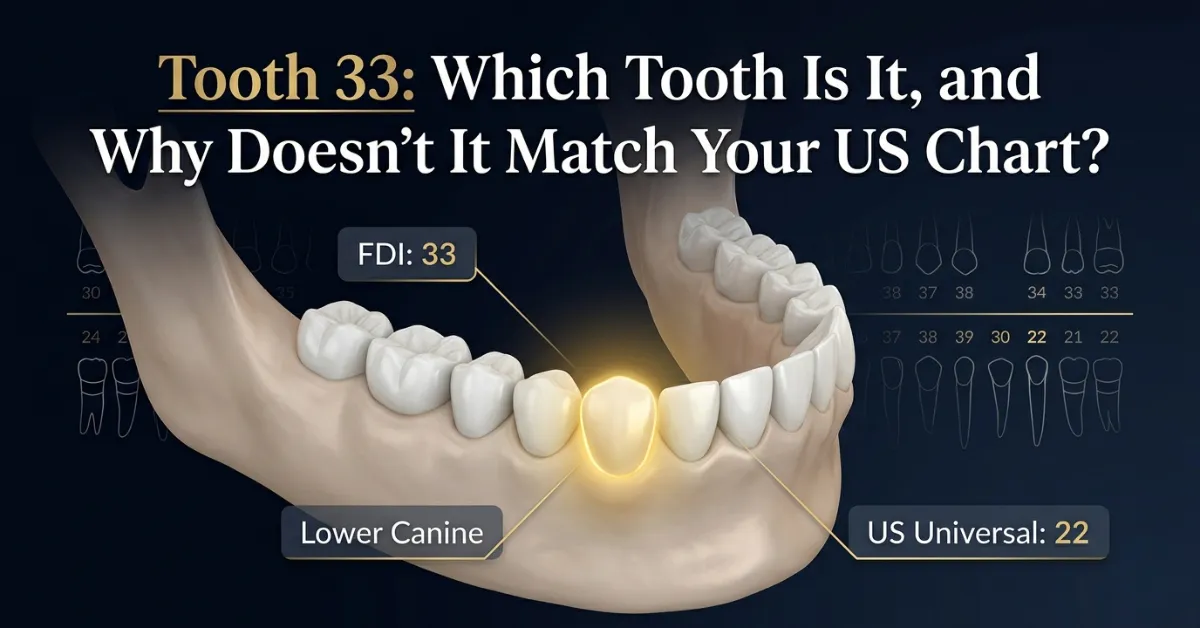
Tooth 33 is the lower left canine, the pointed “eye tooth” on the bottom jaw, but only in the FDI international numbering system. If you’re in the United States and your chart uses the Universal Numbering System, there’s no tooth 33 at all. That tooth is called number 22 instead.
If you’ve been staring at a treatment plan, an old dental record, or a chart from software you don’t recognize and you can’t find a “33” anywhere on the American diagram you’re used to, you’re not missing anything. Two different counting systems are colliding, and that mismatch is the actual reason this term shows up in searches from US patients.
The Quick Answer: Tooth 33 Is the Lower Left Canine (FDI System)
In the FDI World Dental Federation notation, used across Europe, much of Asia, and in most international dental software, every tooth gets a two-digit code. The first digit is the quadrant (1 through 4), and the second is the position within that quadrant, counted from the front of the mouth outward. Tooth 33 breaks down as quadrant 3 (lower left), position 3 (the third tooth from the midline), which lands exactly on the canine.
That canine sits right where the lower jaw curves, between the lateral incisor and the first premolar. It’s the tooth most people picture when they think of a “fang” or “eye tooth,” and it’s usually the last tooth in the front section to lose its baby-tooth predecessor.
Why American Charts Don’t Show a “Tooth 33”
I’ve pulled up patient records where a US office had photocopied an international referral, and the front desk staff genuinely had to stop and cross-reference which tooth “33” meant before scheduling the procedure. It’s a more common mix-up than most people expect, because three separate systems are in daily use worldwide and only one of them is standard in US dental offices.
FDI System vs. Universal Numbering System vs. Palmer Notation
The United States uses the Universal Numbering System almost exclusively. It counts straight through from 1 to 32, starting at the upper right third molar (wisdom tooth), moving across the top to the upper left, dropping down to the lower left, and finishing back at the lower right third molar. There’s no quadrant reset. Number 32 is the highest tooth number that exists in a normal adult mouth under this system.
FDI notation resets at every quadrant instead. That’s why the same physical tooth carries a completely different number depending on which system generated the chart. The lower left canine is “33” under FDI and “22” under Universal, and they’re the exact same tooth.
Palmer notation, the third system, uses quadrant symbols (like an L-shaped bracket) plus a number 1 through 8, rather than a plain two-digit code, so you won’t typically see a bare “33” in Palmer notation at all. If a document you’re holding shows “33,” it’s FDI, not Palmer.
You’ll usually run into an FDI-numbered chart in the US in a few specific situations: dental records imported from a provider outside the US, treatment plans from dental-tourism clinics, some international charting or imaging software defaults, and insurance paperwork tied to a foreign policy.
FDI-to-Universal Conversion Table
Use this to translate any FDI-numbered chart into the numbers your US dentist will actually use.
| Tooth (plain language) | FDI Number | US Universal Number |
|---|---|---|
| Lower left third molar (wisdom tooth) | 38 | 17 |
| Lower left second molar | 37 | 18 |
| Lower left first molar | 36 | 19 |
| Lower left second premolar | 35 | 20 |
| Lower left first premolar | 34 | 21 |
| Lower left canine | 33 | 22 |
| Lower left lateral incisor | 32 | 23 |
| Lower left central incisor | 31 | 24 |
If you only remember one row, remember this one: FDI 33 equals Universal 22.
What Tooth 33 Actually Does (Anatomy and Function)
Canines exist for one job above the others: tearing. Where incisors slice and molars grind, the canine’s single pointed cusp is built to puncture and hold food while the jaw applies leverage. It’s also the tooth most responsible for guiding your bite when you move your jaw side to side, a function dentists call canine guidance, because its long root anchors it well enough to take that lateral load without the back teeth grinding against each other.
That long root is the tooth’s defining anatomical feature. Lower canines typically have the longest, single-strongest root of any tooth in the mandibular arch, often extending noticeably deeper into the jawbone than the incisors next to it. That’s useful for stability, but it also changes how a dentist approaches this tooth clinically.
Common Problems With the Lower Left Canine
Because of that long, firmly anchored root, this tooth behaves a little differently than its neighbors when something goes wrong.
- Slower, more resistant orthodontic movement. Orthodontists often need extra time or anchorage when repositioning a lower canine compared to moving an incisor, precisely because the root is longer and more deeply set.
- Gum recession at this spot. The lower canine sits at a point in the arch where the jawbone is thinner, so recession and root exposure show up here more often than on flatter sections of the arch.
- More involved extractions. When a lower canine does need to come out, whether from severe decay, trauma, or crowding, the same long root that makes it stable also makes extraction more demanding than pulling a single-rooted incisor, and it’s more likely to be referred to an oral surgeon rather than handled in a routine appointment.
- Wear from bite guidance. Because this tooth absorbs lateral bite forces, it can show more visible edge wear over the years in patients who grind or clench, compared to teeth that don’t carry that guidance role.
The Other Meaning: Do You Have 33 Teeth? (Supernumerary Teeth)
A second, unrelated question sometimes hides behind this exact same search: not “which tooth is numbered 33,” but “why does my mouth have 33 teeth instead of the normal 32.” That’s a real, separate dental situation called a supernumerary tooth, meaning one extra tooth beyond the standard adult count.
Supernumerary teeth are relatively uncommon, affecting well under 5% of people, and they show up most often in the upper front region rather than near the lower canines. Dentists classify them by where they sit: a mesiodens appears between the upper central incisors, a paramolar sits beside a molar, and a distomolar sits just behind the last molar. Genetics plays a real role here, family history raises the odds, and certain syndromes are associated with a higher rate of extra teeth.
An extra tooth isn’t automatically a problem. What matters is whether it’s crowding neighboring teeth, blocking eruption of a permanent tooth, or sitting at an angle that traps plaque. That’s a judgment call your dentist makes from an X-ray, not something you can determine from the outside.
How to Find Your Real Tooth Number
If you want to know your own tooth’s number with certainty rather than working from a chart someone else generated, the fastest path is simply to ask your dentist which system they use before you look anything up. Most US offices will default to Universal numbering without saying so, so a quick “is this Universal or FDI” question on your next visit removes the guesswork permanently and it takes about five seconds to ask.
FAQ:
What tooth is number 33?
Under the FDI international numbering system, tooth 33 is the lower left canine. Under the US Universal Numbering System, there is no tooth 33; the equivalent tooth is number 22.
How do you tell tooth 33 apart from 43?
Both are canines, but tooth 33 is on the lower left side of the mouth, while tooth 43 is on the lower right. In FDI notation, the first digit (3 or 4) identifies the quadrant.
Is it OK to have 33 teeth?
Having 33 teeth means you may have one supernumerary (extra) tooth beyond the normal adult count of 32. It isn’t automatically harmful, but a dentist should evaluate it, often with an X-ray, to check for crowding or problems with normal tooth eruption.
What is the difference between FDI and Universal tooth numbering?
The FDI system uses a two-digit code, with the first digit identifying the quadrant and the second identifying the tooth. The US Universal system numbers permanent teeth from 1 to 32 in sequence. Therefore, the same physical tooth can have different numbers in each system.
What is tooth 22 in the Universal system?
Tooth 22 in the US Universal Numbering System is the lower left canine. It is the same physical tooth that is labeled tooth 33 under the FDI numbering system.
Why does my dental paperwork show a number above 32?
A number above 32 may indicate that your dental record uses the FDI or another numbering system rather than the US Universal system. In some cases, numbers above 32 may also be used by dental software to document a supernumerary (extra) tooth.
Key Takeaways
- Tooth 33 is the lower left canine, but that number only applies under the FDI international system, not the US Universal system most American dentists use.
- If you’re working from a US chart, the same tooth is called number 22.
- A “33” showing up on American paperwork almost always traces back to an imported record, international software default, or a note about an extra (supernumerary) tooth, not a normal US chart entry.
- The lower left canine has an unusually long, strong root, which explains why it plays a big role in bite guidance and why extractions or orthodontic movement on this tooth tend to take more effort than on neighboring teeth.
- If you’re ever unsure which system a chart is using, just ask your dentist. It’s a one-question fix.
This article is for educational purposes and is based on general dental information. It does not replace professional diagnosis or treatment. For personalized advice about tooth 33 or your dental numbering, consult a qualified dentist.