Black Lines on Teeth: Causes, Fixes and When to Worry
See exactly what causes black lines on teeth, which ones clear up with one cleaning, and which need a dentist within days.
A black line on your tooth is almost always one of three things: hardened tartar sitting at the gumline, a surface stain caught in a groove or crack, or the early edge of a cavity. You can’t tell which one for certain by looking in the mirror, but you can narrow it down fast, and that’s what this guide walks you through, along with what it actually costs to fix and what to avoid doing at home.
What Are Black Lines on Teeth, Exactly?
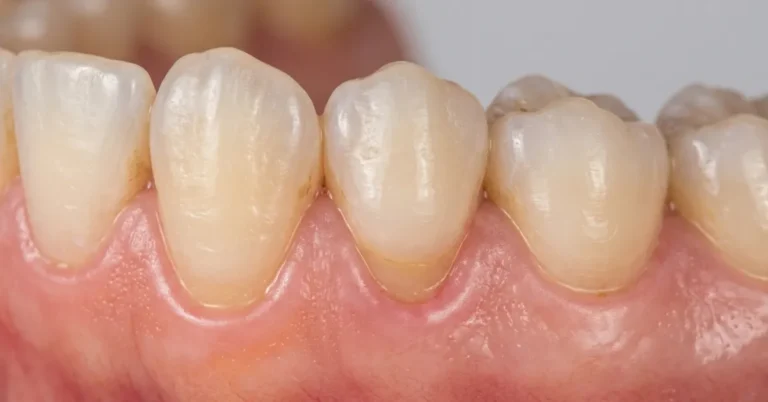
Black lines are thin, dark streaks that show up most often at the gumline, in the natural grooves of your back molars, or as fine vertical marks on your front teeth. They range from light brown to true black, and they can show up on one tooth or several at once. Some feel completely smooth when you run your tongue over them. Others feel slightly rough or sticky, which is actually a useful clue, and we’ll get to that.
The reason black lines are so confusing is that four or five completely different dental issues can all produce the same visual result. A stain from red wine and a stain from early decay can look nearly identical to the naked eye. That’s not a knock on your ability to self-diagnose. It’s genuinely hard, even for dentists, without a closer look and sometimes an x-ray.
Causes of Black Lines on Teeth
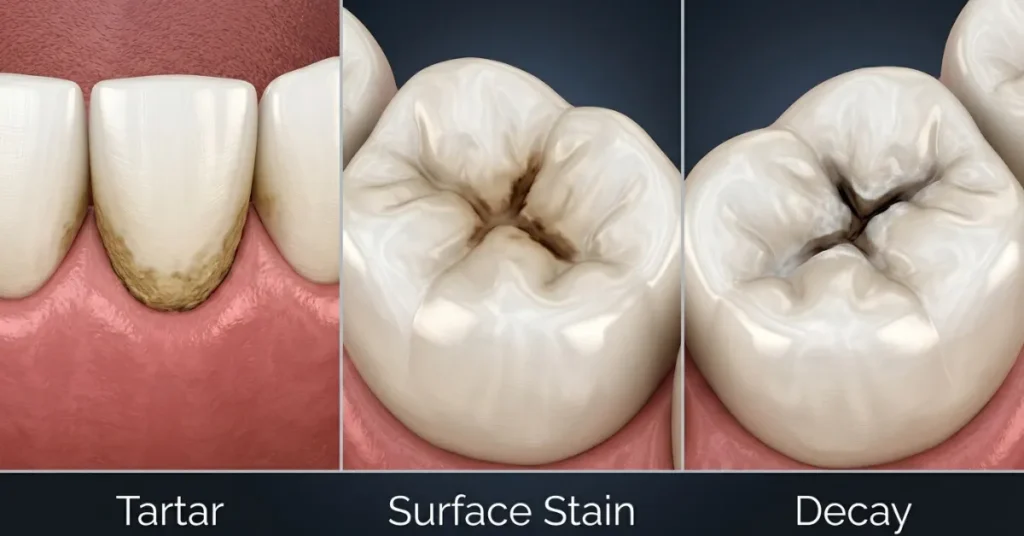
Tartar (Calculus) Buildup Along the Gumline
This is the single most common cause. Plaque that isn’t fully brushed or flossed away hardens into tartar within about 24 to 72 hours. Tartar starts out yellowish, but it’s porous, so it soaks up pigment from coffee, tea, and food the same way a sponge does, eventually turning brown or black. It builds up fastest right where your gums meet your teeth, an area a toothbrush tends to miss.
Tartar below the gumline (subgingival tartar) darkens even faster than the tartar you can see, partly because it sits in contact with blood proteins in the surrounding gum tissue. That’s why a black line right at the gum edge is often tartar rather than a stain sitting on top of clean enamel.
You cannot remove tartar with brushing, no matter how hard you scrub. It has to be scraped off by a dentist or hygienist.
Surface Stains From Coffee, Tea, Wine and Tobacco
Enamel isn’t perfectly smooth. It has microscopic pits and grooves, and dark pigments from coffee, black tea, red wine, dark berries, soy sauce, and tobacco settle into those grooves and build up over months or years. These stains sit on the outer surface only. They’re purely cosmetic, they don’t damage the tooth, and a professional cleaning or whitening treatment usually removes them completely.
One detail worth knowing: liquid iron supplements are a surprisingly common cause of dark line staining, especially in people taking them for anemia. If your black lines showed up around the same time you started an iron supplement, that’s worth mentioning to your dentist.
Tooth Decay (Cavities) in a Groove or Pit
Your molars have natural pits and fissures that trap food and bacteria, making them the most decay-prone surfaces in your mouth. Early decay often starts as a faint white or light brown spot, then darkens as it progresses and picks up staining from food. By the time it looks like a distinct black line sitting in a groove, the enamel has usually already started breaking down.
Decay-related black lines are more likely to come with a warning sign: sensitivity to sweet, hot, or cold. A tartar stain rarely hurts. A cavity often does, at least once it’s progressed past the surface.
Craze Lines (Harmless Hairline Cracks)
Craze lines are tiny, shallow cracks limited to the outer enamel layer, most common on front teeth. They come from years of normal biting and chewing, grinding, or the occasional habit of chewing on ice or pen caps. The crack itself isn’t dark. What happens is that coffee, tea, or tobacco staining seeps into the crack over time and makes it visible as a fine black or grey vertical line.
Craze lines don’t threaten the tooth structurally and don’t need treatment unless the appearance bothers you, in which case whitening or bonding can fade them.
Old Fillings, Crowns and Exposed Metal Margins
If you have an older crown, particularly a porcelain-fused-to-metal (PFM) crown, a thin metal band sits under the porcelain at the base. As gums naturally recede with age, that metal edge can become exposed and show up as a dark gray or black line right at the gumline, even though the tooth underneath is perfectly healthy. This is a cosmetic issue caused by the restoration, not the tooth, and modern all-ceramic or zirconia crowns don’t have this problem.
Old amalgam (silver) fillings can leak or corrode at the edges over years, creating a similar dark margin around the filling.
Gum Recession Exposing the Root Surface
When gums pull back, whether from aggressive brushing, grinding, periodontal disease, or age, the root surface underneath becomes visible. Root surface is naturally darker than the white enamel above it, so the exposed area can look like a dark or yellowish line running along the base of the tooth even though nothing is decayed.
Bacterial Pigmentation (“Black Line Stain”)
Certain chromogenic (color-producing) bacteria in the mouth create a thin black line along the gumline as a byproduct of their normal activity. It shows up more often in children than adults and is not a sign of poor hygiene or decay. It typically needs a professional cleaning to remove and can return until the child’s oral bacteria naturally shift, usually by the teenage years.
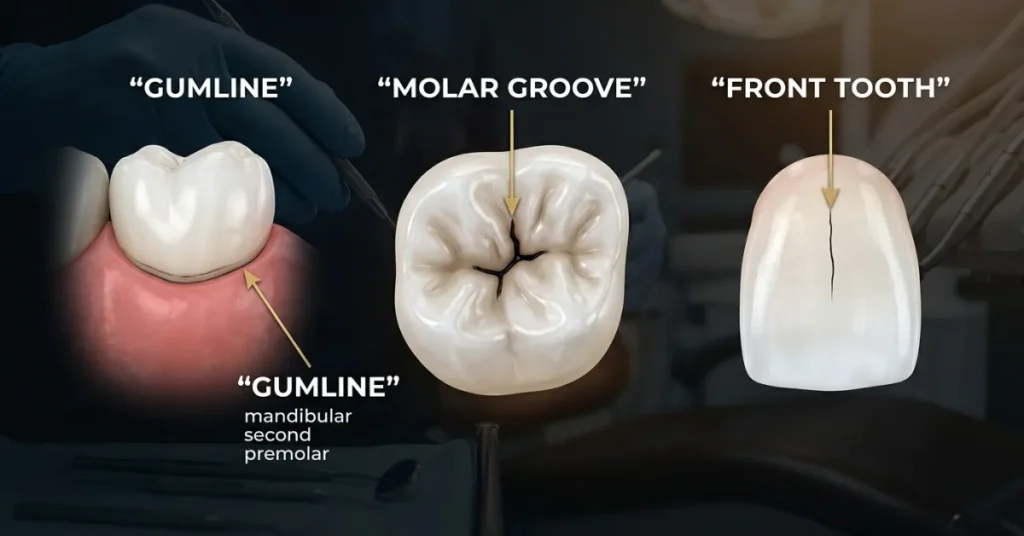
Where the Line Sits Tells You a Lot
Gap-fill, not covered by competitors.
Location is one of the fastest ways to narrow down what you’re looking at, and no dental blog currently walks through it this way. Here’s a rough guide:
| Where you see it | Most likely cause |
|---|---|
| Thin line right at the gum edge, front teeth | Tartar buildup, or an exposed crown margin if you have an old crown there |
| Dark line in the deep groove of a back molar | Surface stain caught in a fissure, or early decay |
| Fine vertical line, usually front teeth | Craze line (harmless enamel crack) |
| Line running along the base of the tooth, root looks exposed | Gum recession |
| Whole tooth looks slightly grey or dark, not just a line | Possible nerve damage from old trauma, needs a dentist soon |
This isn’t a diagnosis. It’s a way to walk into your appointment already knowing which question to ask.
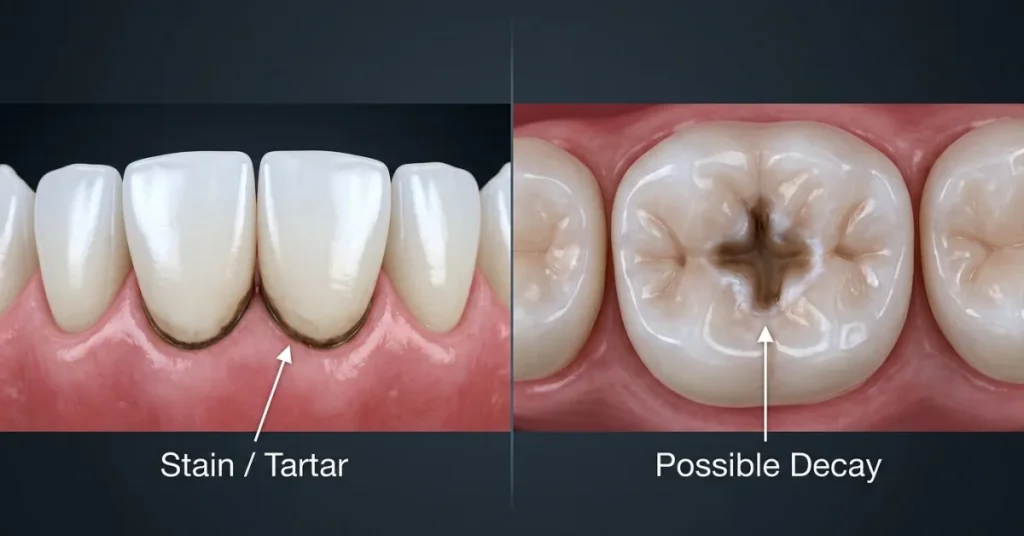
Black Line vs. Cavity: A Quick Self-Check
Gap-fill, not covered by competitors.
You can’t confirm a cavity without an exam and often an x-ray, but these signs shift the odds meaningfully:
Leans toward stain or tartar:
- Feels completely smooth when you run your tongue over it
- No sensitivity to hot, cold, or sweets
- Has been the same size and color for months
- Sits right at the gumline rather than deep in a groove
Leans toward decay:
- Feels slightly rough, sticky, or soft when you press a fingernail against it
- Sensitivity to sweets, hot, or cold, even mild
- Sitting in a deep pit or groove on a molar’s chewing surface
- Has visibly grown or darkened over a few weeks
A dental explorer (the small metal pick your hygienist uses) can feel the difference between hard, stained enamel and softened decay in seconds, which is why a five-minute exam settles this far better than staring in a mirror ever will.
Is a Black Line on Your Teeth Serious?
Most of the time, no. Tartar, surface stains, craze lines, and exposed crown margins are cosmetic issues that don’t threaten the tooth. But a few situations do warrant faster attention: sensitivity or pain alongside the line, the line growing or darkening over a matter of weeks, bleeding or swollen gums nearby, or a whole tooth that’s darkened rather than just a thin line. Any of those point toward decay, gum disease, or nerve damage, all of which get more expensive and more invasive the longer they’re left alone.
How Dentists Diagnose the Cause
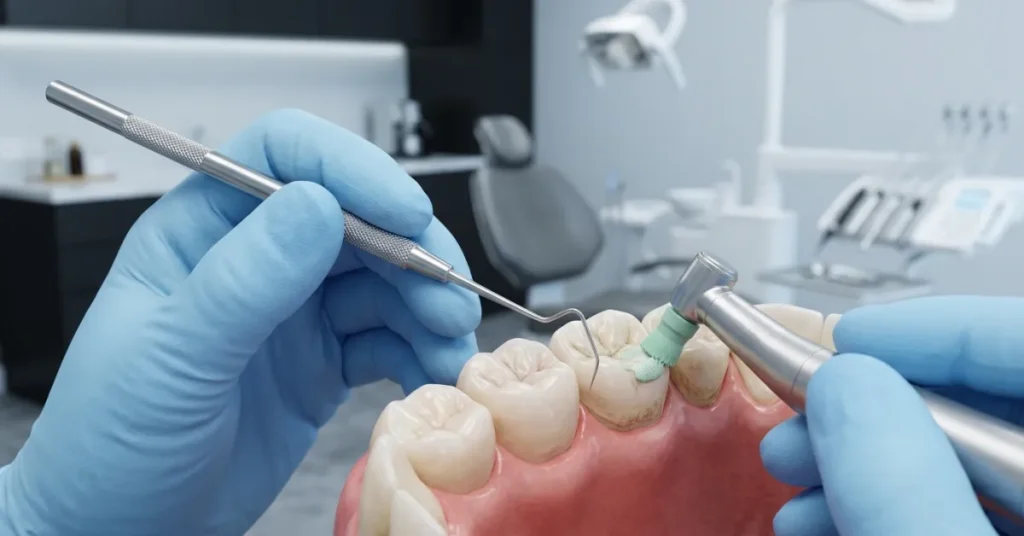
A dentist typically uses three steps to figure out what’s actually going on. First, a visual exam checking the line’s location, color, and shape. Second, a tactile check with a dental explorer, since stained enamel feels hard while decay tends to feel slightly soft or sticky. Third, an x-ray if decay is suspected, since that’s the only way to see whether it has spread past the enamel into the dentin underneath. This whole process usually takes less time than the cleaning itself.
How to Remove Black Lines on Teeth
The fix depends entirely on the cause, which is why “just whiten it” doesn’t work for everything.
- Tartar buildup: Professional scaling. A hygienist removes it in one visit; it cannot be brushed away at home.
- Surface stains: Professional cleaning and polishing, or teeth whitening for stains that don’t fully lift with a cleaning alone.
- Craze lines: Whitening to lighten the stain inside the crack, or cosmetic bonding for lines prominent enough to bother you.
- Cavities: The decayed portion is removed and a tooth-colored filling placed. Caught early, this is a routine, single-visit procedure.
- Old fillings or crowns: Replacement with a modern ceramic or zirconia restoration that doesn’t show a metal margin.
- Gum recession: Gum grafting or another periodontal procedure if the recession is significant enough to need it.
How Much Does It Cost to Fix a Black Line on a Tooth?
Gap-fill, not covered by competitors.
Rough US ranges, since none of the currently ranking pages mention pricing at all:
- Professional cleaning (scaling): often fully covered by dental insurance as a routine cleaning; without insurance, typically $75 to $200.
- In-office teeth whitening: $300 to $800 per session; take-home trays run $150 to $400.
- Composite filling for a small cavity: $150 to $400 per tooth, depending on size and location.
- Dental bonding for a craze line: $150 to $600 per tooth.
- Replacing an old crown: $1,000 to $2,500 per tooth, largely uninsured unless the old crown has actually failed.
If cost is a concern, say so at the appointment. A cleaning to rule out anything serious is inexpensive and often covered twice a year under most US dental plans, which makes it the cheapest way to get a real answer instead of guessing.
What Not to Do at Home
Gap-fill, not covered by competitors.
- Don’t scrub aggressively with a hard-bristled brush. It won’t remove tartar (tartar is bonded to the tooth) and can wear down enamel or irritate your gums, making the line more visible over time, not less.
- Don’t pick at it with a fingernail or sharp object. If it’s early decay, this can chip already-weakened enamel.
- Don’t rely on whitening strips for a line at the gumline. Whitening lifts surface pigment on enamel; it does nothing to hardened tartar and can irritate exposed root surfaces if gum recession is involved.
- Don’t assume baking soda paste is safe long-term. Used occasionally it’s fine, but daily abrasive scrubbing wears enamel thinner, which can eventually make discoloration look worse.
How to Prevent Black Lines From Coming Back
Brush twice daily with fluoride toothpaste, paying deliberate attention to the gumline, since that’s where tartar forms fastest and where most brushing falls short. Floss daily; a toothbrush physically cannot clean between teeth. Book a cleaning every six months so any plaque that hardens into tartar gets removed before it has time to stain. If you drink a lot of coffee, tea, or red wine, rinse with water afterward, since pigment causes far less staining when it doesn’t sit on the enamel for hours. An electric toothbrush also does a noticeably better job at the gumline than a manual one for most people.
Black Lines on a Child’s Teeth
If your child has a thin black line along the gumline and you’ve ruled out an obvious cavity, it’s very likely the chromogenic bacteria pigmentation described above, sometimes just called “black line stain.” It looks alarming against a child’s teeth but it isn’t decay and it isn’t caused by poor brushing. A dentist can polish it off in a routine cleaning, and it may come back a few times before the child’s oral bacteria shift naturally as they get older. It’s worth a dental visit to confirm it’s this and not early decay, since the two can look similar to a parent.
FAQ
Can I brush away a black line on my tooth?
If it’s a very new, light surface stain, brushing might fade it slightly. If it’s tartar, a craze line, or decay, brushing won’t remove it, and scrubbing harder can damage your gums without fixing anything.
Are black lines on teeth normal?
They’re common, but “common” doesn’t mean “ignore it.” Any new or changing line deserves a dental check to rule out decay or gum disease, even if it turns out to be harmless.
Do black lines on teeth mean the tooth is dead?
Not usually. A dead (non-vital) tooth typically shows up as the whole tooth darkening after significant trauma, not just a thin line. Most causes of black lines, including stains, tartar, and craze lines, have nothing to do with the tooth’s nerve.
Why does my child have black lines on their teeth?
Most often it’s black line stain from chromogenic bacteria, which is not decay and is not caused by poor hygiene. A dentist can clean it off, though it may return periodically until the teenage years.
How do dentists remove black lines from teeth?
It depends on the cause: scaling for tartar, polishing or whitening for surface stains, bonding or whitening for craze lines, a filling for decay, and crown or filling replacement for old restorations showing a metal margin.
Is a black line on a tooth always a cavity?
No. Tartar and surface staining can cause black lines, while decay is another possibility. Because these causes can look similar, a dental examination is the most reliable way to tell them apart.
Key Takeaways
Black lines on teeth almost always trace back to one of five things: tartar at the gumline, surface staining, a craze line, decay in a groove, or an old restoration showing its edge. Location and feel give you a strong hint (smooth and painless leans cosmetic, rough and sensitive leans decay), but only a dentist with an explorer and, if needed, an x-ray can confirm it. A cleaning is the cheapest, fastest way to find out, often costs nothing out of pocket if you have insurance, and either removes the problem outright or catches a cavity while it’s still a simple filling instead of something bigger.
This article is for informational and educational purposes only and is based on general dental information. It does not replace professional dental advice, diagnosis, or treatment. If you have a new, changing, painful, or persistent black line on a tooth, consult a dentist for an accurate evaluation.