What Is Tooth Letter E in Primary Teeth? Full Guide
What is tooth letter E in primary teeth? It’s the upper right central incisor, erupting age 8-12 months. See its exact spot and numbering chart.
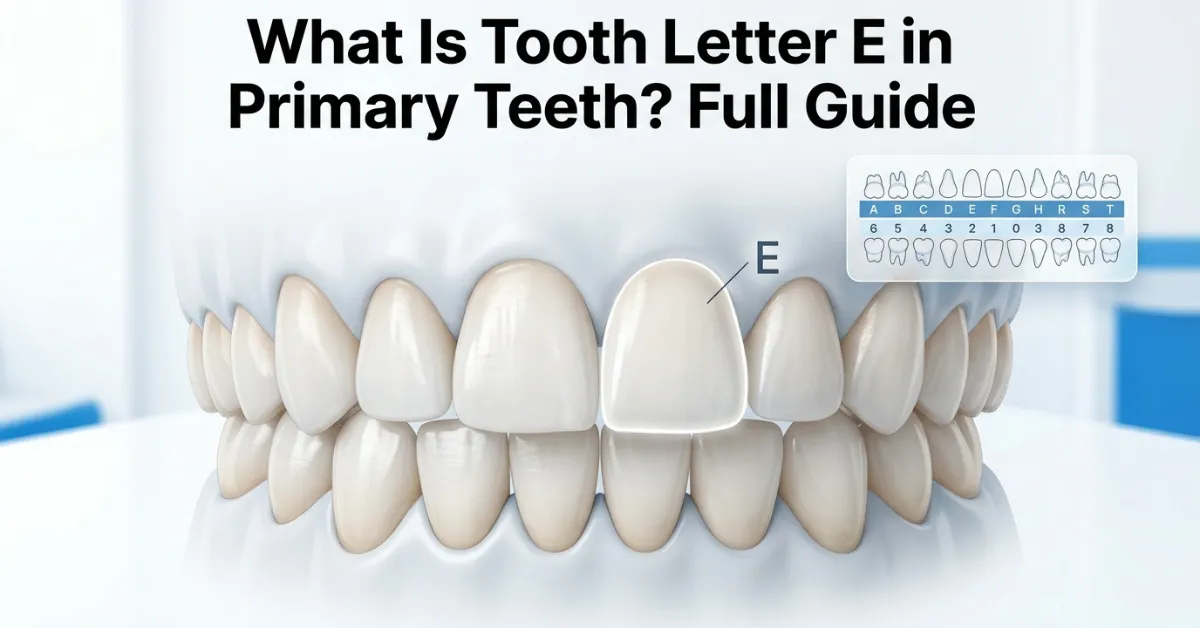
So what is tooth letter E in primary teeth? In the Universal Numbering System used by dentists across the United States, tooth E refers to the primary maxillary right central incisor. That’s the front tooth at the top of your child’s mouth, sitting just to the right of the two front teeth’s midline, on the side facing you when your child smiles at you directly.
If your child’s dentist mentioned “tooth E” during a checkup and you nodded along without really knowing what it meant, you’re not alone. Dental charts label the 20 baby teeth with letters A through T instead of numbers, and unless you work in a dental office, that system means nothing at first glance. I’ve sat in the pediatric dentist’s chair with my own kid and watched the hygienist point at a chart calling out letters like she was reading a secret code. She wasn’t. There’s a clear logic behind it, and once you see it, you won’t forget it.
Where Is Tooth E Located?
Picture your child’s upper jaw. Now picture the two front teeth, the ones that show up first in every baby photo around six to eight months of age. Those two teeth are the maxillary central incisors. The one on your child’s right side, which appears on your left as you look at them, is tooth E. Its twin on the other side of the midline is tooth F.
Dentists chart from the patient’s perspective, not the viewer’s. So when a chart says “tooth E,” it means the tooth is on the right side of your child’s mouth, not the right side of the image you’re looking at. This trips up a lot of parents the first time they see a dental chart on paper.
Tooth E Across the Three Numbering Systems
Dental offices in the U.S. mostly use the Universal Numbering System for primary teeth, but you might also run into Palmer Notation or the FDI (ISO 3950) system, especially if you’ve switched providers or pulled records from an orthodontist. Here’s how tooth E maps across all three:
| System | Designation for This Tooth | Notes |
|---|---|---|
| Universal Numbering System | E | Standard in most U.S. general and pediatric dental offices |
| Palmer Notation | A (upper right quadrant) | Uses quadrant symbols plus a letter A through E per quadrant; this “A” is not the same tooth as Universal “A” |
| FDI (ISO 3950) | 51 | Common internationally and in some specialty practices |
This is the biggest source of confusion parents run into. Palmer notation also uses the letters A through E, but it restarts the count in each of the four quadrants, so Palmer’s “A” in the upper right quadrant is the same physical tooth as Universal’s “E.” If you’re comparing records from two different offices and the letters don’t match, this is usually why. Ask the office which system they use before assuming a discrepancy is an error.
When Does Tooth E Erupt and Fall Out?
Tooth E, the upper central incisor, typically erupts between 8 and 12 months of age, though some kids get there a little earlier or later without anything being wrong. Wide ranges are normal here. My daughter’s upper centrals came in at 10 months; her younger brother didn’t get his until closer to 13 months, and both were perfectly healthy.
On the shedding side, tooth E generally loosens and falls out between ages 6 and 7, making room for its permanent successor, the maxillary right central incisor. Lower front teeth usually go first in the shedding sequence, so if tooth E is still hanging on after the bottom teeth have already fallen, that’s typically within normal timing, not a red flag.
Why Baby Teeth Use Letters, Not Numbers
Permanent teeth get numbers 1 through 32 under the Universal system. Baby teeth get letters A through T instead, and that’s intentional. It keeps the two dentitions visually distinct on a chart so nobody mistakes a note about a permanent tooth for one about a primary tooth, which matters a lot during the mixed dentition years between roughly ages 6 and 12, when a child has both types of teeth in their mouth at once.
The letter sequence runs A through J across the upper arch, starting at the upper right second molar and moving left, then K through T across the lower arch, moving back from left to right. Tooth E lands where it does because it’s the fifth tooth counted along that upper arch path, the second of the two upper central incisors.
What Tooth E Does and Why It Matters
Central incisors like tooth E have a flat, straight biting edge built for one main job: shearing off small pieces of food when your child bites down. They’re also the teeth doing the most visual work in a smile, so damage to tooth E from a fall or a hard bite on something like a fork or a toy tends to worry parents more than a chipped molar would.
Because it’s a single-rooted tooth with one root canal, tooth E is relatively straightforward for a pediatric dentist to treat if it’s injured or decayed, compared to a molar with multiple roots and canals. Still, baby teeth do more than chew. Tooth E and its neighbors hold space for the permanent teeth developing underneath and guide them into the correct position, which is part of why dentists watch primary incisors closely even though they’re temporary.
FAQ
What tooth is letter E on a dental chart?
Tooth E is the primary upper right central incisor, one of the two top front teeth, located just to the right of the midline from the patient’s point of view.
How many primary teeth are labeled with letters?
All 20 primary teeth are labeled with letters, running from A through T across the upper and lower arches.
What age does tooth E come in and fall out?
Tooth E usually erupts between 8 and 12 months and falls out between ages 6 and 7.
What’s the difference between the Universal and Palmer tooth numbering systems?
The Universal system runs A through T straight across all 20 primary teeth. Palmer notation restarts at A through E in each of the four quadrants, so the same physical tooth can have a different letter depending on which system a chart uses.
Why do baby teeth use letters instead of numbers?
Letters keep primary teeth visually distinct from permanent teeth, which are numbered 1 through 32. This distinction matters most during the mixed dentition years when a child has both types of teeth at once.
Key Takeaways
Tooth E is the primary upper right central incisor, one of your child’s top front teeth. It typically erupts around 8 to 12 months and sheds around age 6 to 7. Under Palmer notation it’s labeled “A” in the upper right quadrant instead, and under FDI notation it’s tooth 51, so the letter alone only tells you something if you know which system the chart is using. If your child’s dentist ever calls out “tooth E” during a visit, you now know exactly where to look.
This article is for general educational and informational purposes only and is not a substitute for professional dental advice, diagnosis, or treatment. Tooth eruption and shedding times can vary between children. If you have concerns about your child’s teeth, consult a qualified pediatric dentist or dental professional.