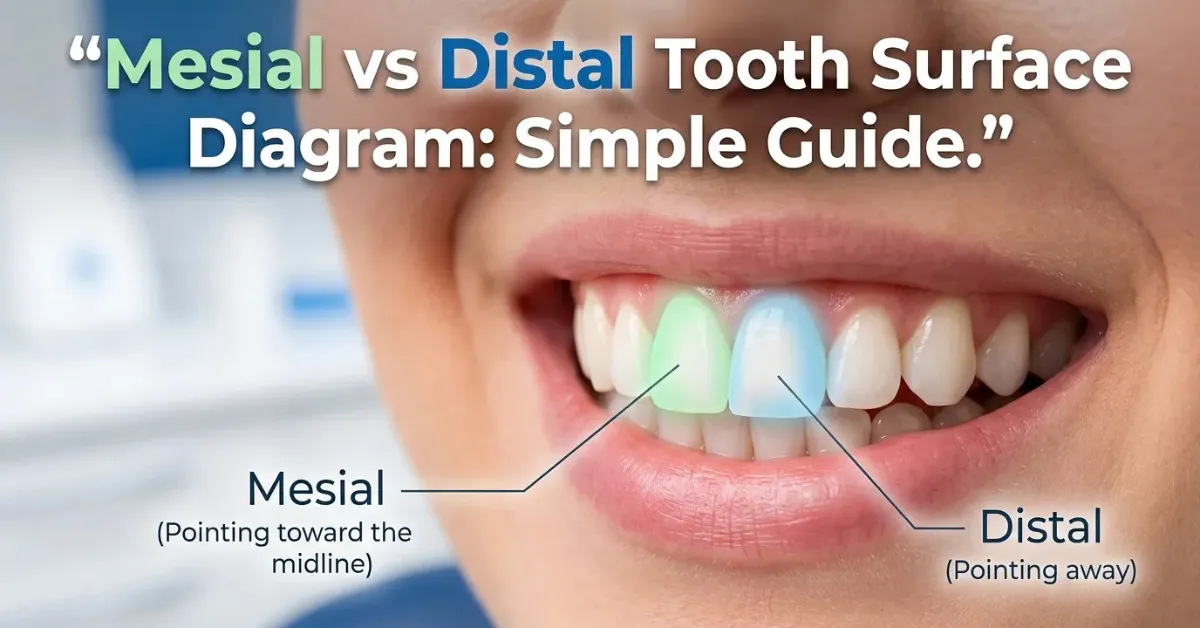
Mesial vs Distal Tooth Surface Diagram: Simple Guide
A labeled mesial vs distal tooth surface diagram for every tooth type, plus the 3-second trick to tell them apart while flossing.
Mesial means the tooth surface facing toward the midline of your mouth, and distal means the surface facing away from it, toward the back of the jaw. The breakdown below marks both surfaces on a full arch and on a single molar, so you can see exactly where each one sits.
Mesial and Distal, Tooth by Tooth
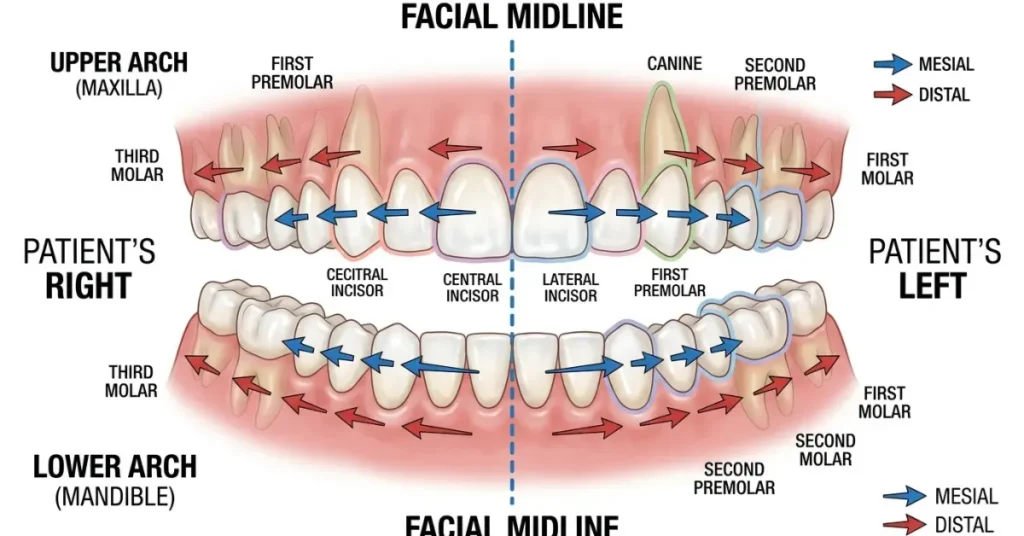
Picture your teeth as a curved row, with an invisible line splitting your face into a left half and a right half. That line is the midline, and it runs right between your two upper front teeth and your two lower front teeth.
- Mesial surface: the side of each tooth that points toward that midline.
- Distal surface: the side of each tooth that points away from the midline, toward your last molar.
| Tooth type | Mesial surface points | Distal surface points |
|---|---|---|
| Front incisor | Toward the opposite front tooth, almost meeting it at the midline | Toward the canine next to it |
| Canine | Toward the lateral incisor in front of it | Toward the first premolar behind it |
| Premolar | Toward the tooth closer to the front of the mouth | Toward the tooth closer to the back |
| Molar | Toward the front of the arch | Toward the throat, further back than any other surface on that tooth |
Notice the pattern. On every tooth, from the front incisor to the last molar, mesial always means closer to the midline and distal always means further from it. You never have to memorize this separately for each tooth. Once you find the midline, both terms fall into place.
What Mesial and Distal Mean, in Plain English
Dentists did not invent these words to sound complicated. Mesial comes from a root meaning middle, and distal comes from a root related to distance. If a hygienist tells you there is a small cavity on the mesial of tooth number 14, she means the decay sits on the side of that upper left first molar that faces forward, toward the front teeth, not on the side facing your throat.
Here is a real scenario that shows why the distinction matters. Say a dentist finds decay on the mesial surface of your lower right second molar. That surface faces the tooth in front of it, so the filling will sit between two teeth, right where floss normally passes. If the same cavity were on the distal surface instead, it would face the very back of your mouth, an area with no neighboring tooth on that side and much harder to see without a mirror. Same tooth, same size cavity, completely different location and completely different difficulty for the dentist to treat and for you to keep clean afterward.
The Full Tooth Surface Map
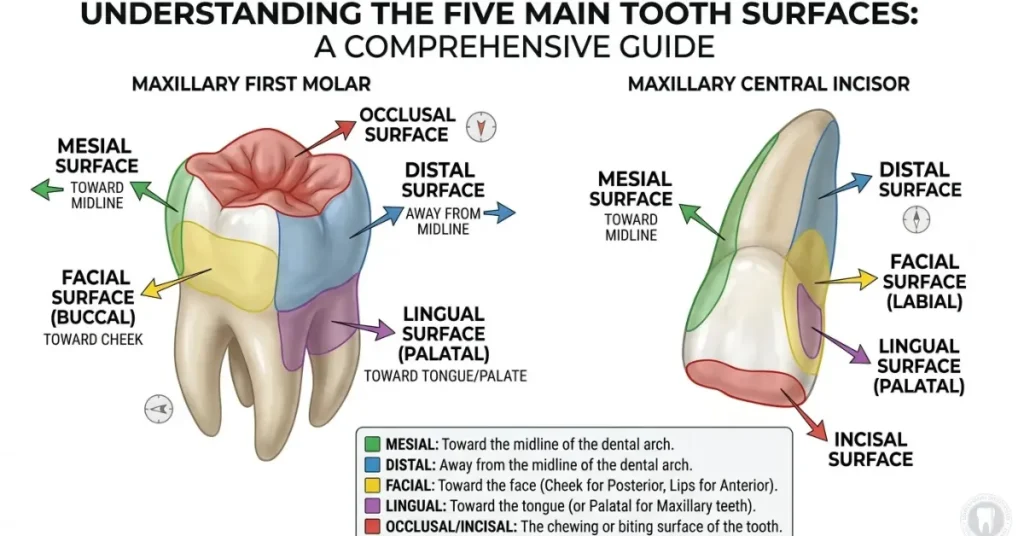
Mesial and distal are only two of the five surfaces every tooth has. Knowing all five makes the mesial vs distal distinction click faster.
| Surface | Common name | Where it faces |
|---|---|---|
| Mesial | Front-facing side | Toward the midline of the mouth |
| Distal | Back-facing side | Away from the midline, toward the last molar |
| Buccal (labial on front teeth) | Cheek side | Toward the cheeks or lips |
| Lingual (palatal on upper teeth) | Tongue side | Toward the tongue or roof of the mouth |
| Occlusal (incisal on front teeth) | Biting surface | Straight up or down, where teeth meet when you bite |
Dentists combine these into short codes on your chart. A filling marked MOD covers the mesial, occlusal, and distal surfaces in one restoration. A note that just says D means the work is limited to the distal surface alone.
How to Find Mesial vs Distal on Any Tooth
You do not need X-ray vision to work this out in your own mouth. Try this with a hand mirror.
- Find your midline first. Look at your two upper front teeth. The seam between them is the midline for the entire upper arch. Your lower front teeth have a matching seam for the lower arch.
- Pick any tooth and ask which side faces that seam. That side is the mesial surface, no matter whether the tooth is a front incisor or a back molar.
- The opposite side, facing your last molar, is the distal surface.
The logic holds for upper and lower teeth, and for both the left and right sides of your mouth. It even holds for your very last molar, whose distal surface faces nothing but soft tissue since there is no tooth further back.
One practical wrinkle: on a back tooth, the mesial surface actually touches the distal surface of the tooth sitting in front of it. That contact point is exactly where plaque builds up fastest and where floss needs to go.
Reading a Real Dental Chart: What “#14-MOD” Means
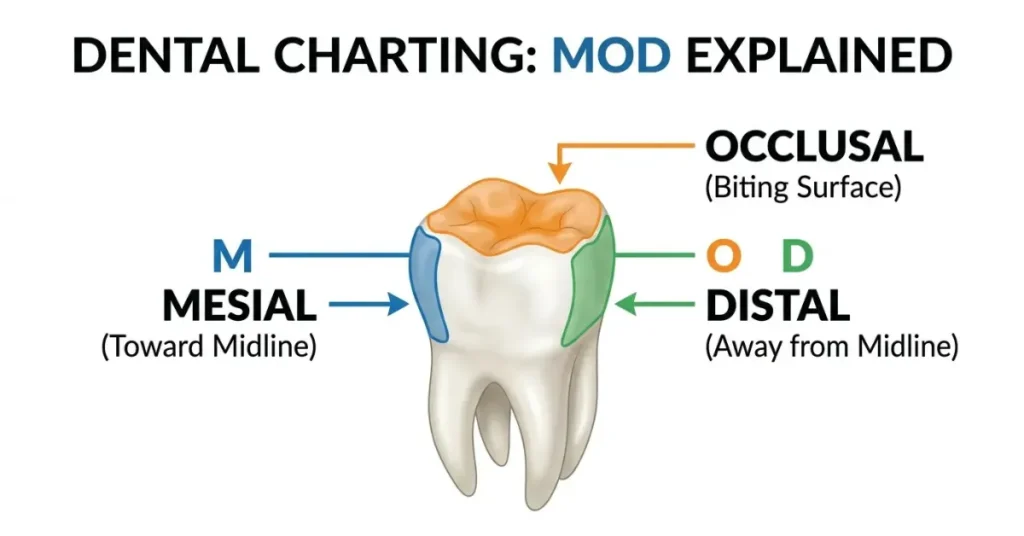
A note like “#3-MOD” tells you two things at a glance: which tooth (number 3, using the Universal Numbering System that runs from 1 to 32), and which surfaces were treated (mesial, occlusal, and distal, all in one filling).
- M on its own: work limited to the mesial surface.
- D on its own: work limited to the distal surface.
- MO or DO: mesial-occlusal or distal-occlusal, meaning the filling wraps from the biting surface down onto one side surface.
- MOD: the filling covers three surfaces, usually because decay spread across the whole biting area.
Memory Tricks That Actually Stick
- Mesial rhymes with middle. Both point toward the center of the arch. If a surface faces the middle of your smile, it is mesial.
- Distal sounds like distant. A distal surface is always the one furthest from that center point, closer to the back of your jaw.
- For back teeth: your mesial surface is the one that touches the tooth in front of you as you trace your tongue forward along the gumline. Reverse direction, and you are tracing distal surfaces instead.
Why These Two Surfaces Matter for Your Oral Health
These are the tightest, hardest to reach spots in your mouth, and where most interproximal cavities and early gum disease start.
When you floss, you clean exactly two surfaces per gap: the distal surface of the tooth in front and the mesial surface of the tooth behind. A common mistake is sliding the floss straight up and down without curving it, which skips most of the actual surface and only wipes the top of the contact point. Curve the floss into a C shape against one tooth, slide it gently below the gumline, then repeat against the neighboring surface before moving on.
Bitewing X-rays exist mainly to catch decay on mesial and distal surfaces before you can feel it, since these surfaces sit in direct contact with the next tooth and cannot be seen or probed with a mirror. Small mesial or distal cavities can grow for months without symptoms, and by the time you feel pain, decay has often reached the nerve.
Mesial vs Distal in Baby Teeth and Orthodontics
The same terms apply to primary, or baby, teeth, using a separate lettering system (A through T) instead of the 1 to 32 numbering used for adult teeth.
Orthodontists lean on mesial and distal heavily, since tooth movement is described almost entirely in those directions. “Mesialization” means shifting a tooth toward the midline, often to close a gap left by an extraction. “Distalization” means shifting a tooth backward, a common early step in braces or Invisalign when there is not enough room in the arch and the back molars need to move toward the throat first to create space.
FAQ
What does mesial mean on a tooth?
The mesial surface is the side of a tooth closest to the midline of the dental arch. The midline is the imaginary line between the two front central incisors.
What does distal mean on a tooth?
The distal surface is the side of a tooth farthest from the midline of the dental arch. On back teeth, it generally faces toward the back of the mouth.
What is the difference between mesial and distal?
Mesial means toward the midline, while distal means away from the midline. On adjacent teeth, the distal surface of one tooth can face the mesial surface of the tooth next to it.
How do you remember which side is mesial and distal?
Think “mesial = middle” and “distal = distant.” Find the midline of your dental arch first. The side of a tooth facing the midline is mesial, while the opposite side is distal.
Is mesial the front or back of a tooth?
Mesial does not literally mean front or back. It means toward the midline of the dental arch. On a molar, the mesial surface faces toward the teeth closer to the front, while the distal surface faces farther toward the back.
Key Takeaways
Mesial and distal describe direction, not fixed positions. Mesial always points toward the midline. Distal always points away from it. That rule holds for every tooth, upper or lower, left or right, whether you’re reading your own chart or your orthodontist is talking about distalizing your molars.