How to Memorize Tooth Numbers Easily (3-Step Method)
How to memorize tooth numbers easily with one shortcut: split your mouth into four 8-tooth quadrants instead of learning 32 numbers one by one.
If you’ve ever sat in the chair and heard your dentist call out “watch #30” like it’s a lottery number, here’s the short answer: tooth numbers aren’t random at all, and there’s a genuinely easy way to memorize them. They follow a clockwise path around your mouth, starting at your upper right wisdom tooth and ending at your lower right wisdom tooth. Once you see that path, memorizing all 32 numbers takes about ten minutes, not ten study sessions.
I taught this to a dental assisting student last year who’d been stuck flipping between a printed chart and her patient notes for weeks. She wasn’t bad at memorizing, she just hadn’t been shown that the system breaks into four identical 8-tooth blocks instead of one long string of 32. Once that clicked, she stopped needing the chart within a single afternoon.
This guide walks through that same shortcut, plus the quadrant trick, a simple direction mnemonic, and a 60-second self-test so you can check that it actually stuck.
What the Tooth Numbering System Actually Is (and Why It’s Not Random)
In the United States, almost every dentist uses the Universal Numbering System, the one the American Dental Association adopted as the national standard. It assigns a single number, 1 through 32, to each permanent tooth in an adult mouth. No tooth shares a number, and the order never changes from patient to patient.
The whole system moves in one continuous loop:
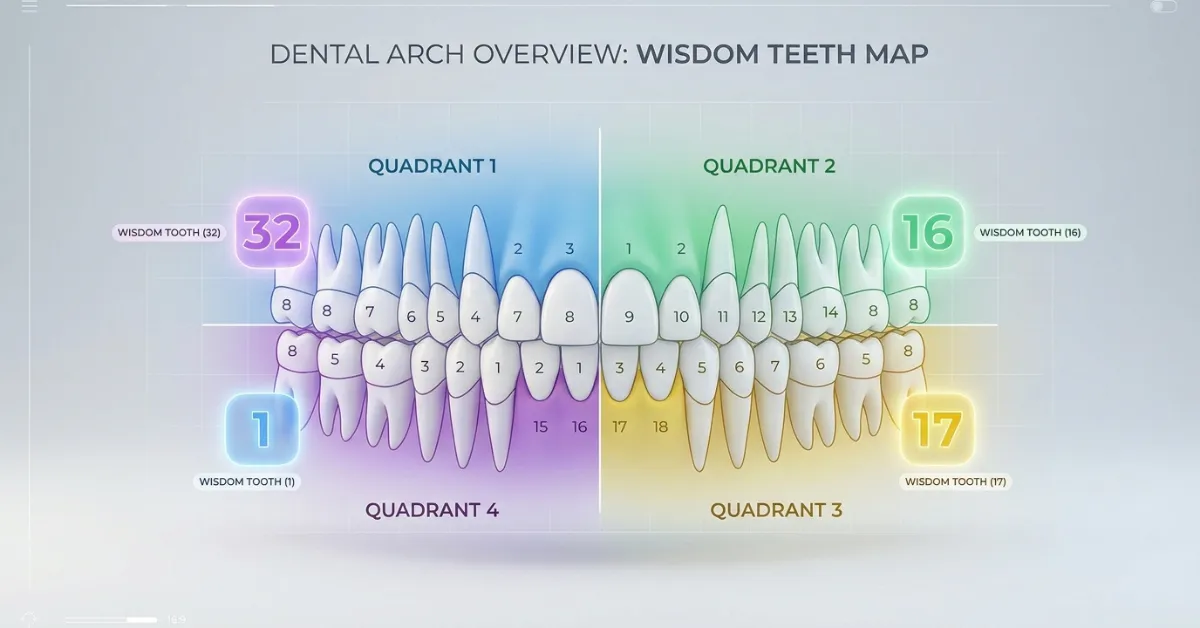
- Start at the back right of your upper jaw (tooth #1, your upper right wisdom tooth).
- Move left across the top row to your upper left wisdom tooth (#16).
- Drop straight down to the lower jaw.
- Move right across the bottom row, back to where you started, ending at #32, your lower right wisdom tooth.
That’s it. One path, one direction, no branching. The reason people struggle isn’t the logic, it’s that they try to memorize 32 individual data points instead of one repeating shape.
How to Memorize Tooth Numbers Easily: The 3-Step Method
Instead of memorizing “#1 is here, #2 is here, #3 is here” all the way to 32, work through it in this order:
- Learn the four corners first. Just four numbers: 1, 16, 17, 32. These are your four wisdom teeth, and they mark the start and end of each arch. Once these are automatic, the rest of the chart has fixed boundaries instead of feeling open-ended.
- Learn the direction rule, not the numbers. Top row goes right to left. Bottom row goes left to right. That’s the only rule that matters, everything else is just counting from 1 to 8 twice.
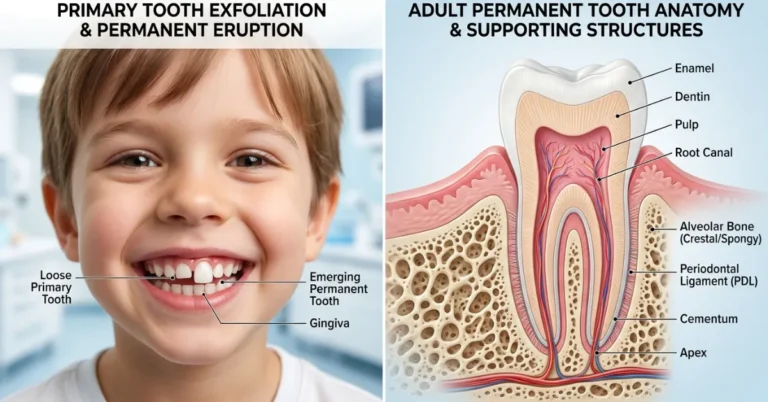
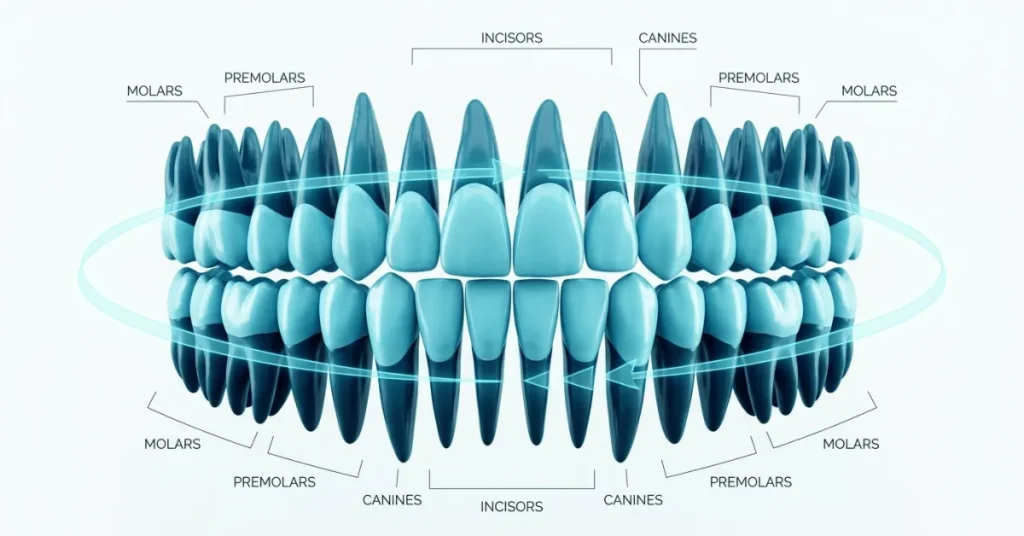
- Learn the tooth types inside one quadrant, then repeat. Each 8-tooth block follows the identical pattern: 2 incisors, 1 canine, 2 premolars, 3 molars. Learn that pattern once and it applies to all four quadrants without extra memorization.
Most people try to do all three at once, which is why the chart feels overwhelming. Separating them into three short passes is what actually makes it stick.
Break It Into 4 Quadrants of 8 (the Easiest Mental Shortcut)
Here’s the shortcut that does the heaviest lifting: you’re not memorizing 32 numbers, you’re memorizing one 8-number sequence and repeating it four times.
- Quadrant 1 (upper right): 1–8
- Quadrant 2 (upper left): 9–16
- Quadrant 3 (lower left): 17–24
- Quadrant 4 (lower right): 25–32
Inside every single quadrant, the tooth order is the same:
- Third molar (wisdom tooth)
- Second molar
- First molar
- Second premolar
- First premolar
- Canine
- Lateral incisor
- Central incisor
Then it mirrors back out toward the next wisdom tooth. Once you know that an 8-tooth block always goes molar, molar, molar, premolar, premolar, canine, incisor, incisor, you can rebuild any quadrant from memory, in either direction, without ever staring at a chart.
A Simple Mnemonic for the Direction
If you keep forgetting which way the numbers move, use this: “Right starts it, left flips it.”
- The count always starts on the patient’s upper right.
- Every time you finish a row, you flip down and reverse which side you’re moving toward.
Say it out loud twice while tracing your finger across an actual tooth chart image, and the direction becomes muscle memory faster than reading the rule on its own.
Memorizing Tooth Types Inside Each Quadrant
A quick way to lock in the incisor-canine-premolar-molar order is to think of it as moving from “cutting tools” to “grinding tools” as you go from the front of the mouth to the back.
- Incisors (front, flat and thin) are built for cutting, like scissors.
- Canines (pointed) are built for tearing, like a knife tip.
- Premolars (flat-ish with ridges) start the crushing work.
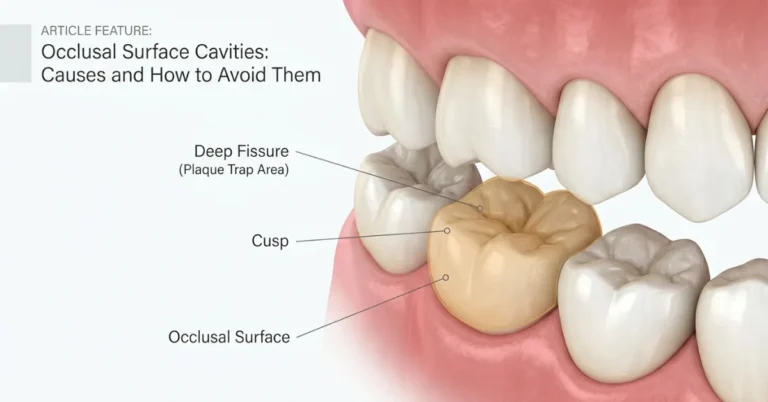
- Molars (broad and flat, farthest back) finish the grinding.
That “cut, tear, crush, grind” order from front to back matches the number order exactly, whether you’re counting 1 to 8, 9 to 16, 17 to 24, or 25 to 32. Learn the shape logic once and you’ll never need to memorize it as an arbitrary list again.
Worked Example: What Is Tooth #19?
Let’s put the quadrant method to use with a number a dentist might actually say out loud.
- 19 falls in the 17–24 range, so it’s in Quadrant 3, the lower left.
- Quadrant 3 starts at 17 (third molar) and counts inward: 17, 18, 19.
- Using the fixed 8-tooth order (molar, molar, molar, premolar…), position 3 in that sequence is the first molar.
So tooth #19 is your lower left first molar. You just found that using two facts, the quadrant range and the 8-tooth order, instead of counting on your fingers from 1.
Wisdom Teeth Are the Easiest Numbers to Remember (Start Here)
If you only remember four numbers today, make them these: 1, 16, 17, and 32. Those are your four wisdom teeth (third molars), and they sit at the farthest back corner of each quadrant. Since they’re also the four “corner markers” of the whole numbering system, memorizing them first gives you fixed anchor points to count from in either direction. If any of yours have been removed, which is common, the numbers themselves don’t shift or get reused. Your chart just skips them.
Baby Teeth Use Letters, Not Numbers (A–T)
Children have 20 primary (baby) teeth instead of 32, and the Universal system swaps numbers for letters to keep the two charts visually distinct. The logic is identical to the adult system, just shorter:
- Start at the upper right, back tooth, with the letter A.
- Move left across the top to J.
- Drop down to the lower left, starting at K.
- Move right across the bottom, ending at T.
Same clockwise loop, same direction rule, just 20 stops instead of 32.
FDI and Palmer Notation, Explained the Same Easy Way
If you’re studying for dental school or work with international patients, you’ll run into two other systems. The quadrant logic you already learned makes both of these easy, because they’re built on the exact same four-quadrant idea, just with different labels.
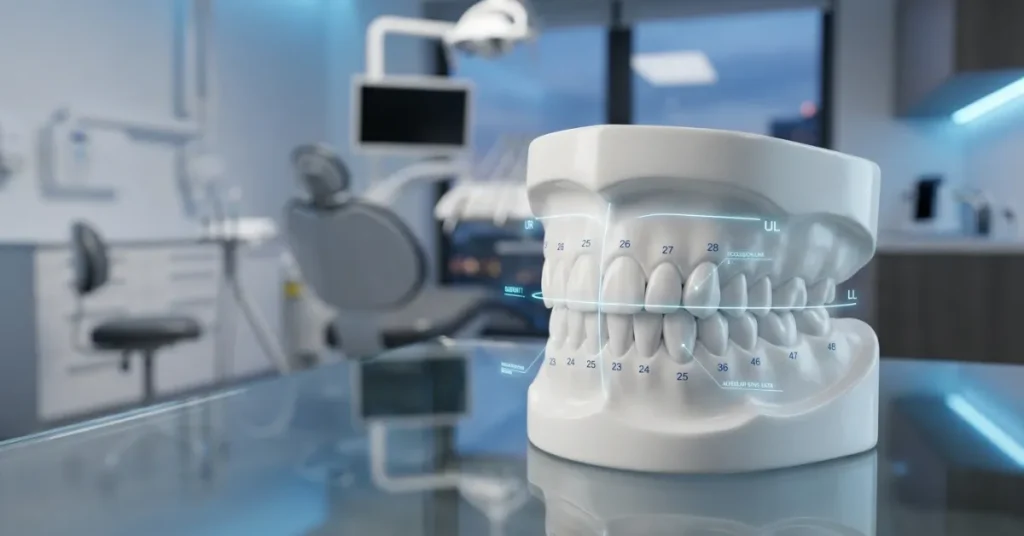
FDI notation (ISO 3950), used internationally, gives every tooth a two-digit code. The first digit is the quadrant (1 for upper right, 2 for upper left, 3 for lower left, 4 for lower right), and the second digit is the position from the center, 1 through 8. So “tooth 24” in FDI isn’t your 24th tooth, it’s quadrant 2, position 4. Read it as two separate facts, not one number, and it stops being confusing.
Palmer notation, common among orthodontists, uses a bracket symbol to show the quadrant and a number 1 to 8 for position, similar to FDI but drawn as a grid symbol rather than typed digits.
Once you’ve internalized “quadrant plus position,” all three systems are the same idea wearing different labels.
Practice Drill: Test Yourself in 60 Seconds
Cover the sections above and answer these without looking:
- Which four numbers mark your wisdom teeth?
- If a tooth number is 9, which quadrant is it in, and what type of tooth is it?
- Which direction does the top row count, right to left or left to right?
- What are the four tooth types in order from the back of a quadrant to the front?
If you can answer all four in under a minute, the system has stuck. If you stumble on one, that’s your signal for which of the three steps above to review, not a reason to start over from the top.
FAQ
What is the Universal tooth numbering system?
The Universal tooth numbering system is the tooth identification method commonly used in the United States. It assigns permanent teeth numbers 1 through 32, starting with the patient’s upper-right third molar and continuing around the dental arches to the lower-right third molar.
How do dentists number teeth?
In the Universal system, dentists start with tooth #1 at the patient’s upper-right third molar, continue across the upper arch to #16, then move to #17 at the lower-left third molar and continue across the lower arch to #32.
What tooth numbers are wisdom teeth?
In the Universal tooth numbering system, wisdom teeth are #1, #16, #17, and #32. These are the four permanent third molars, located at the back of each quadrant of the mouth.
How are baby teeth numbered?
In the Universal system, primary or baby teeth are identified with capital letters A through T instead of numbers. The 20 letters follow the same general arch sequence used for the permanent teeth.
What is the difference between Universal, FDI, and Palmer tooth numbering?
Universal uses numbers 1 through 32 for permanent teeth, FDI uses a two-digit quadrant-and-position system, and Palmer uses a quadrant symbol with a number from 1 to 8. All three systems identify the same teeth using different notation methods.
Why do dentists use tooth numbers instead of tooth names?
Tooth numbers provide a short and standardized way to identify individual teeth in dental charts, treatment notes, referrals, and other records. They make it easier for dental professionals to communicate about a specific tooth without repeatedly writing its full name.“`
Conclusion / Key Takeaways
- Tooth numbers aren’t random. They follow one clockwise loop around four 8-tooth quadrants.
- Learn the four corner numbers first: 1, 16, 17, 32 (your wisdom teeth).
- Learn the direction rule: top row right to left, bottom row left to right.
- Learn the 8-tooth order once (molar, molar, molar, premolar, premolar, canine, incisor, incisor) and it applies to every quadrant.
- FDI and Palmer notation use the same quadrant logic with different labels, so you don’t need to relearn anything from scratch.
- Test yourself with the 60-second drill above instead of just re-reading the chart, active recall is what actually makes it permanent.