What Is a Jaw Bone? The Complete Anatomy Guide
What is a jaw bone? The jaw consists of two bones, the mandible and maxilla, that hold your teeth and shape your face.
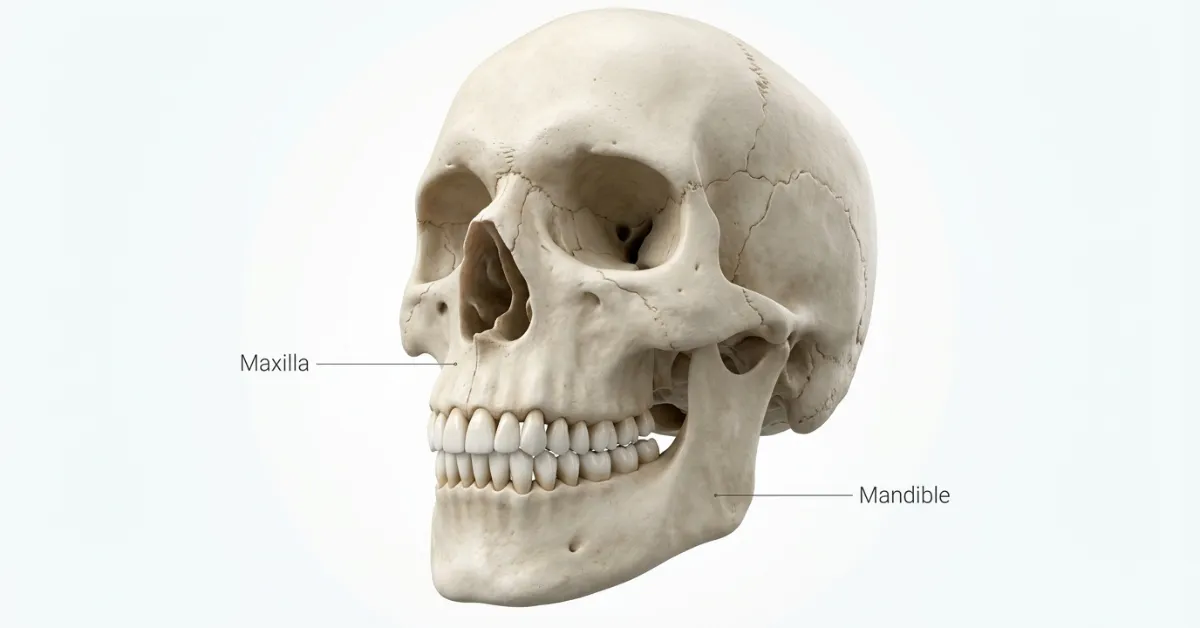
A jaw bone is the bone that forms the framework of your mouth and anchors your teeth in place. Most people picture the lower jaw when they hear the term, but “jaw bone” technically covers two separate bones working as a pair: the mandible below and the maxilla above.
I once had a dentist trace the outline of my own jaw on an x-ray and point out something I’d never noticed: my lower jaw was a single, solid piece of bone, while my upper jaw was actually fused from two halves that met at a seam down the middle of my palate. That small detail is the kind of thing that makes the anatomy click, and it’s exactly what most jaw bone explainers skip over.
What Is a Jaw Bone? (Quick Definition)
In plain terms, a jaw bone is any bone that forms part of the mouth’s frame and holds a row of teeth. Humans have two: the mandible (lower jaw) and the maxilla (upper jaw). The mandible is the only bone in your entire skull that moves on its own, which is why it gets most of the attention when people search for “jaw bone.” The maxilla is fixed in place and does double duty, shaping your upper teeth row, the floor of your nose, and part of your eye sockets.
Together, these two bones do three jobs every single day: they let you bite and chew food, they shape the sounds you make when you talk, and they give your face its structure. Lose either one, or lose bone density in either one, and all three of those functions start to suffer.
The Two Bones That Make Up Your Jaw
The Mandible (Lower Jaw)
The mandible is the largest and strongest bone in your face. It’s shaped roughly like a horseshoe, curving forward to form your chin and back on both sides to connect with your skull. That connection point, called the temporomandibular joint, or TMJ, sits just in front of each ear and acts like a hinge combined with a sliding track. It’s what lets your lower jaw drop open, swing side to side, and glide forward, all motions your upper jaw simply can’t do.
A newborn’s lower jaw actually starts as two separate halves. They fuse into one solid piece within the first year of life, which is part of why the mandible ends up so dense and durable in adults.
The Maxilla (Upper Jaw)
The maxilla never moves. It’s cemented into the middle of your face and fused to several neighboring skull bones, so when you chew, your upper teeth act as a stationary anvil while your lower teeth do the moving. Unlike the mandible, the maxilla stays split into a left and right half your entire life, joined at a visible seam that runs along the roof of your mouth.
Beyond holding your upper teeth, the maxilla forms the bony floor of your nasal cavity, part of the bottom of your eye sockets, and the hard palate, the firm front section of the roof of your mouth that your tongue presses against when you say sounds like “t” and “d.”
Mandible vs. Maxilla at a Glance
| Feature | Mandible (Lower Jaw) | Maxilla (Upper Jaw) |
|---|---|---|
| Movement | Moves freely at the TMJ | Fixed, does not move |
| Structure | One fused, horseshoe-shaped bone | Two halves fused at a midline suture |
| Size | Largest, strongest bone in the face | Second-largest facial bone |
| Also forms | Chin | Nasal floor, part of eye sockets, hard palate |
| Common problems | Fractures, TMJ disorders | Sinus issues, cleft palate |
What Is the Jaw Bone Made Of?
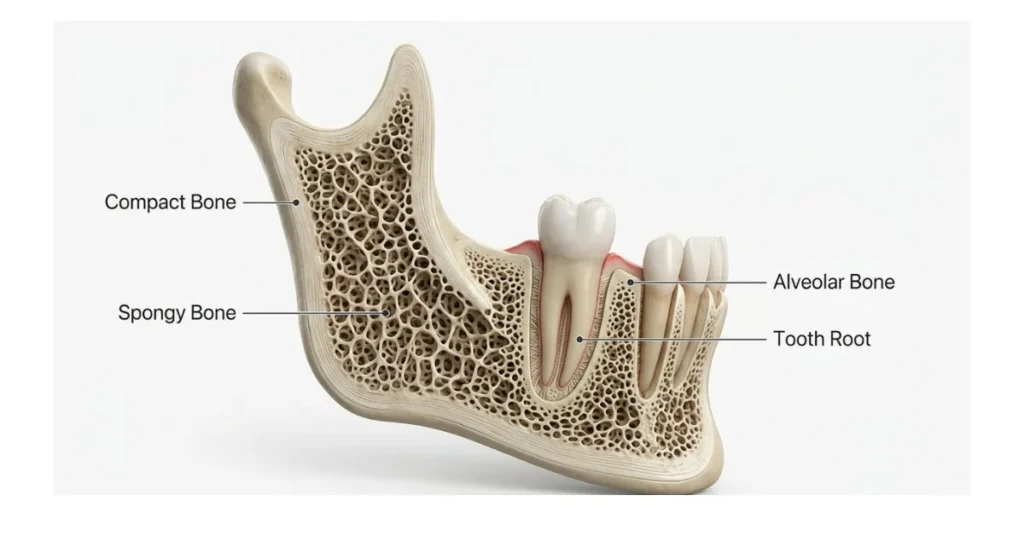
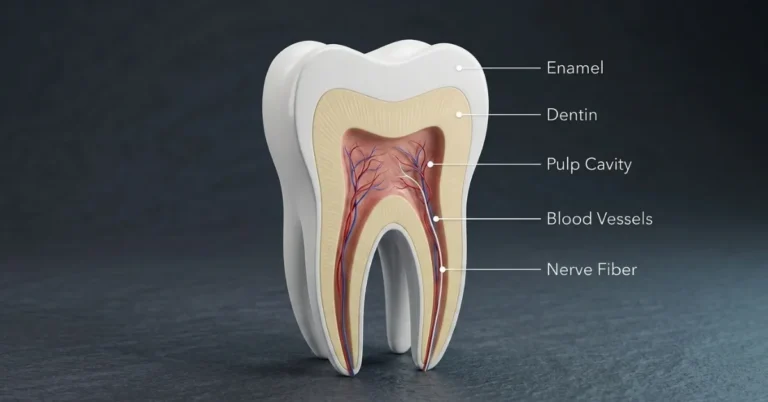
Like every bone in your body, a jaw bone has two layers. The outer shell is compact bone, a dense, hard layer that gives the mandible and maxilla their strength and protects the nerves and blood vessels running through them. Underneath that shell is spongy bone, a lighter, honeycomb-like layer that houses your tooth sockets and gives the jaw a small amount of give so it can absorb the daily impact of chewing.
This layered design matters more than it sounds. It’s the reason a healthy jaw bone can handle roughly 150 to 250 pounds of biting force at the back molars without cracking, and it’s also why bone loss (something we’ll get to below) shows up first in the spongy inner layer before it ever affects the outer shell.
Key Parts of the Mandible You Should Know
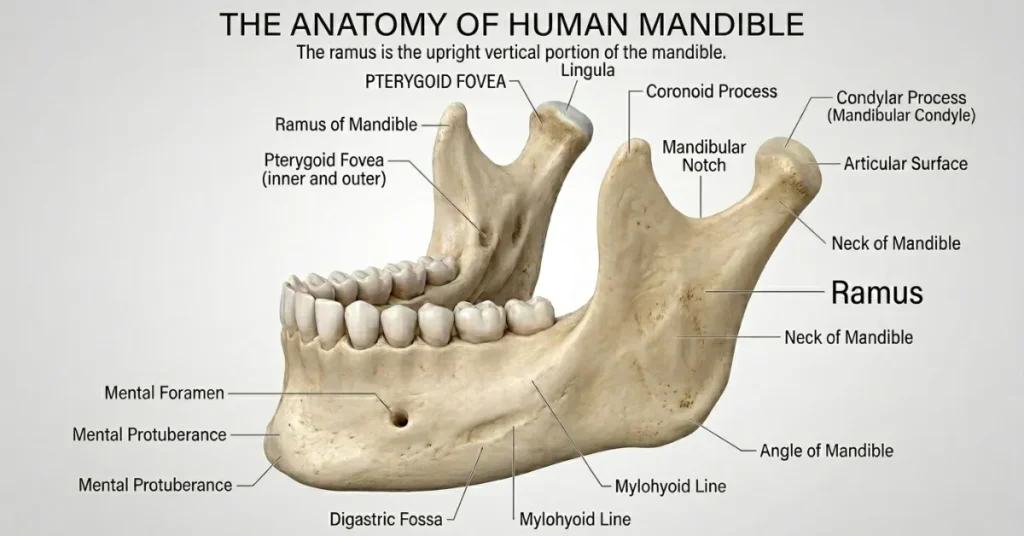
If you’ve ever had a dentist mention one of these terms and wondered what it meant, here’s the plain-English version:
- Body: the horizontal, horseshoe-shaped front section that holds your lower teeth
- Ramus: the vertical section on each side that angles upward toward your ear
- Condyle: the rounded knob at the top of the ramus that fits into the TMJ socket
- Coronoid process: a pointed projection just in front of the condyle where a major chewing muscle attaches
- Alveolar bone: the ridge along the top of the body that actually surrounds and holds each tooth root
- Mental foramen: a small opening on the front of the jaw that a nerve passes through, which is why dentists numb this exact spot for lower jaw procedures
How Your Jaw Bone Actually Works
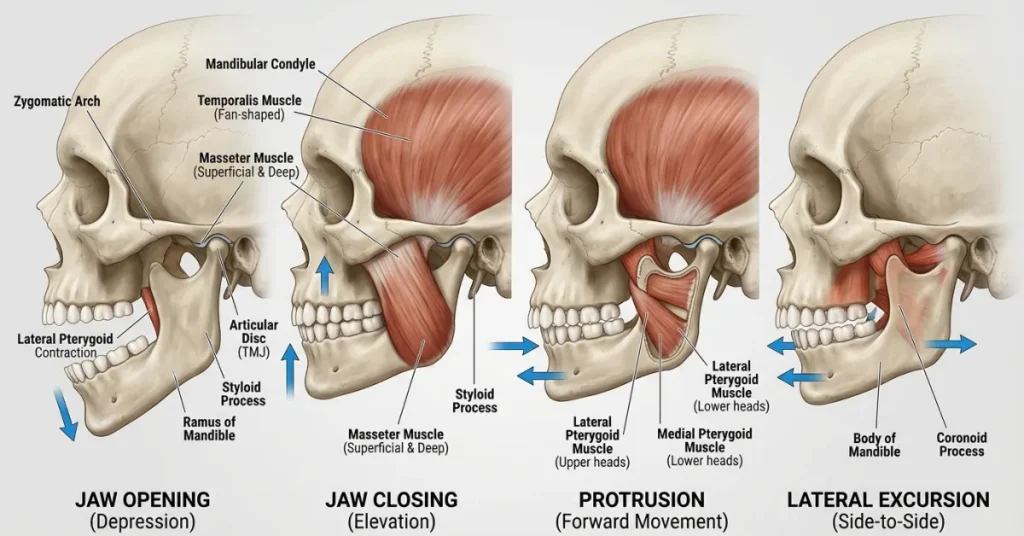
Chewing isn’t just the mandible moving up and down. Four separate muscle pairs, the masseter, temporalis, and two pterygoid muscles, pull the mandible in different directions so it can crush food, grind it side to side, and then reset. The masseter alone is one of the strongest muscles in the human body relative to its size, which is why a jaw clench can generate serious force.
Speech works the same system in reverse. Small, precise movements of the mandible, combined with your tongue pressing against the fixed maxilla and palate, shape airflow into consonants and vowels. That’s also why a jaw injury or TMJ disorder doesn’t just cause pain when you eat, it can noticeably change how clearly you speak.
What Happens When Jaw Bone Density Drops
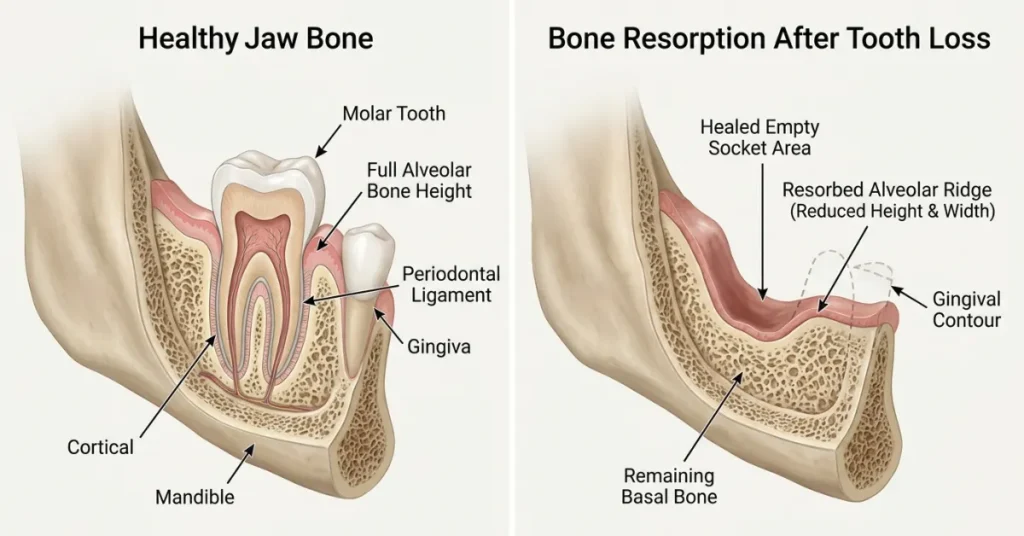
Your jaw bone isn’t static. Like the rest of your skeleton, it constantly rebuilds itself, and the pressure from a tooth root chewing every day is actually part of what signals the bone to stay dense in that spot.
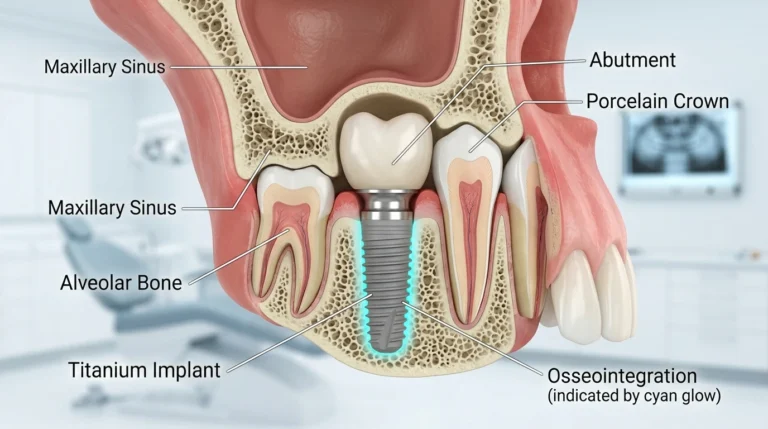
Pull a tooth out, through decay, injury, or extraction, and that signal disappears. The jaw bone in that area starts to resorb, meaning the body slowly breaks it down since it’s no longer “needed.” Left alone for a year or two, this can noticeably shrink the ridge of bone in that spot, which is exactly why dentists push people toward a same-day bridge, partial, or implant rather than leaving a gap. Periodontal disease and osteoporosis speed up the same process, which is why long-term gum disease often leads to a visibly sunken lower face over time, not just loose teeth.
The good news: this process is largely preventable. Replacing a missing tooth quickly, especially with a dental implant that transmits chewing pressure into the bone the same way a natural root does, keeps that density signal active.
Common Jaw Bone Problems
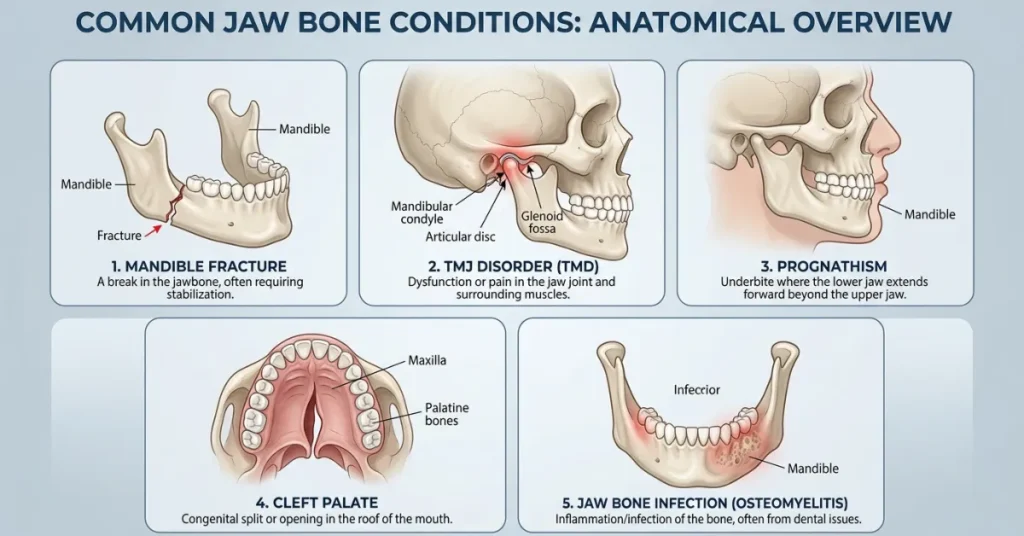
- Fractures: the mandible accounts for a large share of all facial fractures, usually from car accidents, falls, sports impacts, or assaults, and typically shows up as sudden pain when biting, a bite that feels “off,” or visible swelling
- TMJ disorders: pain, clicking, or a locked jaw at the joint itself, often tied to teeth grinding, stress, or arthritis
- Prognathism: a jaw, usually the mandible, that protrudes noticeably farther than the other, which can be inherited
- Cleft palate: a gap in the maxilla’s midline suture that forms before birth and affects feeding, speech, and ear health
- Osteomyelitis: a bone infection that can follow a severe dental infection or jaw surgery
How to Keep Your Jaw Bone Healthy
- Replace missing teeth promptly instead of leaving a gap, since chewing pressure is what keeps the bone dense
- Treat gum disease early, before it reaches the bone underneath your teeth
- Wear a night guard if you grind your teeth, to protect both the TMJ and the bone itself
- Get enough calcium and vitamin D, the same nutrients that support the rest of your skeleton
- Wear a mouthguard for contact sports, since a single hard impact is the most common cause of a mandible fracture
FAQ
What is a jaw bone?
A jaw bone is one of two bones that form the jaw: the mandible (lower jaw) and maxilla (upper jaw). They support your teeth and help with chewing and speaking.
Is the jaw bone one bone or two?
The jaw has two main bones: the mandible and maxilla. The mandible forms the lower jaw, while the maxilla forms the upper jaw.
What is the jaw bone called?
The lower jaw bone is called the mandible, while the upper jaw bone is called the maxilla. Together, they form the human jaw.
Where is the jaw bone located?
The jaw bones are located in the lower part of the face. The mandible forms the lower jaw, and the maxilla forms the upper jaw.
What is the difference between the mandible and maxilla?
The mandible is the movable lower jaw, while the maxilla is the fixed upper jaw. Both bones hold teeth and contribute to facial structure.
Key Takeaways
A jaw bone is one of two bones, the mandible below and the maxilla above, that frame your mouth and hold your teeth in place. The mandible is the only bone in your skull that moves, making it responsible for most of what people notice about jaw function: chewing, talking, and facial expression. The maxilla stays fixed but does just as much structural work, shaping your upper teeth, nasal floor, and palate.
Both bones are living tissue, not static scaffolding. They respond to the pressure of chewing and the presence of tooth roots, which is exactly why a missing tooth left untreated can lead to real bone loss over time. Understanding that connection is the single most useful thing to take from this topic, whether you’re just curious about anatomy or trying to make a decision about a dental implant.