When Do Deciduous Teeth Fall Out? Age-by-Age Guide for Parents
When do deciduous teeth fall out? Most children start losing them around age 6, with the process usually ending by ages 12 or 13.
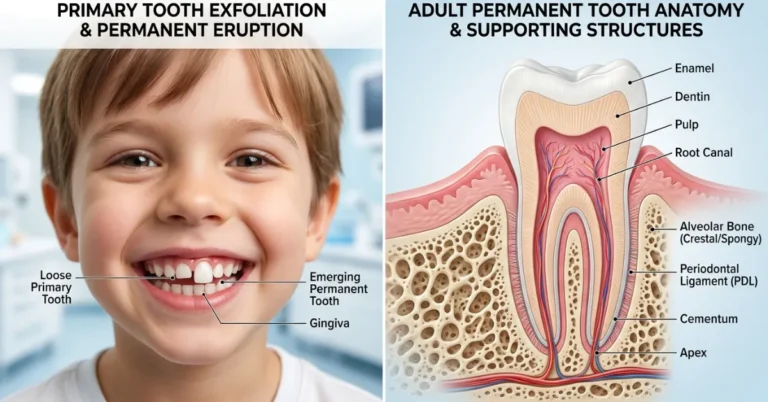
If your child just wiggled loose their first tooth, you’re probably wondering whether this is right on schedule or a little early. Most kids lose their first baby tooth somewhere between the ages of 5 and 7, with 6 being the average age for baby teeth to fall out. It’s one of those milestones that feels like it happens overnight but is actually the result of a process that started years earlier, when the permanent tooth underneath began pushing on the baby tooth’s root.
I’ve watched this play out with my own kids, and no two went through it the same way. My oldest lost her first tooth at 5 and a half, eating an apple at the kitchen table. My youngest held onto every single baby tooth until well past his sixth birthday, and his dentist told us that was just as normal. That range is the part most parents don’t hear about until they’re already worried.
When Do Baby Teeth Start Falling Out?
Around age 6, the roots of a baby tooth begin to dissolve as the permanent tooth underneath prepares to erupt. This process is called resorption, and once enough of the root has dissolved, the tooth loosens and eventually falls out on its own.
Some children start this process as early as 4, others not until closer to 7. Neither extreme is automatically a problem. What matters more than the exact age is the pattern: teeth loosening gradually, one or two at a time, following the same order shown on a typical tooth eruption chart.
The Order Baby Teeth Fall Out In
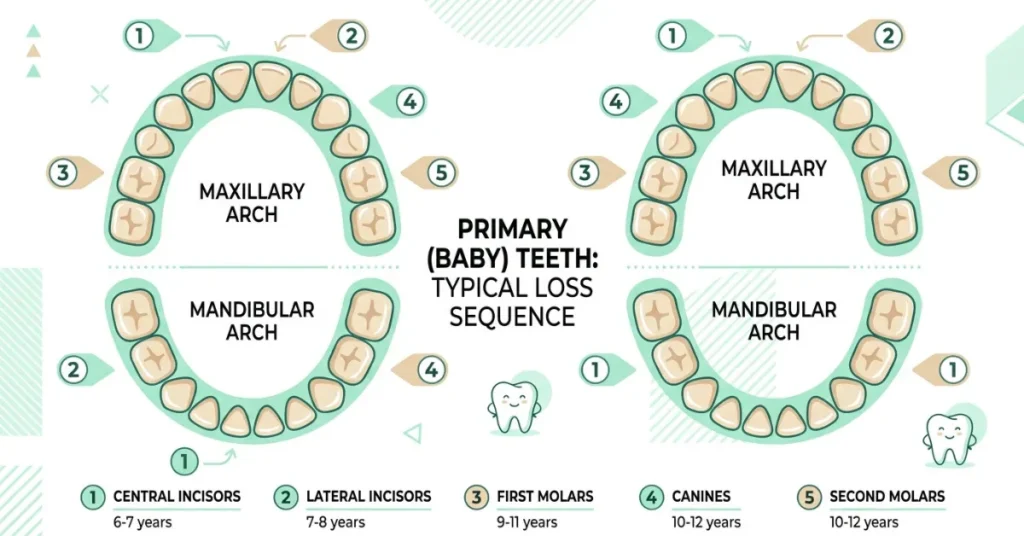
Baby teeth almost always fall out in the same order they came in. That means the two bottom front teeth, the lower central incisors, are usually first to go, typically between ages 6 and 7. After that, the process generally follows this sequence:
- Lower and upper central incisors (bottom and top front teeth)
- Upper and lower lateral incisors (next to the front teeth)
- First molars
- Canines (the pointy teeth)
- Second molars
This order isn’t a strict rule. Some kids lose a canine before a first molar, or lose an upper tooth before its lower match. As long as teeth are loosening and coming out gradually rather than all at once, the order itself is nothing to worry about.
Baby Tooth Loss Chart by Age
| Tooth | Typical age of loss |
|---|---|
| Central incisors | 6-7 years |
| Lateral incisors | 7-8 years |
| First molars | 9-11 years |
| Canines | 9-12 years |
| Second molars | 10-12 years |
This timeline lines up closely with the permanent teeth eruption schedule dentists use as a general reference. By around age 12 or 13, most children have lost all 20 of their baby teeth and have a full set of permanent teeth in their place, aside from wisdom teeth, which show up much later, usually between 17 and 21.
What If the Baby Tooth Won’t Fall Out? (Shark Teeth)
Sometimes a permanent tooth starts coming in behind a baby tooth that hasn’t loosened yet, creating what dentists call “shark teeth,” a nod to the way sharks grow multiple rows of teeth. It’s startling to see, but it’s genuinely common, especially in kids between 5 and 7 losing their front teeth, and again around age 11 when the back molars come in.
This happens when the baby tooth’s root doesn’t dissolve on schedule, so the permanent tooth has to find another path in. In most cases, the pressure from the new tooth combined with normal chewing and wiggling will loosen the baby tooth within a couple of months and it falls out on its own, letting the permanent tooth settle into place.
If the baby tooth is still solid two months after you first notice the second row, or if the permanent tooth is more than halfway in and the baby tooth isn’t budging, it’s worth having a pediatric dentist take a look. Sometimes the fix is as simple as an extraction to give the adult tooth room.
How to Help a Loose Tooth Along Safely
It’s tempting to want to speed things up, especially if a loose tooth is bothering your child. A few things actually help, and a few things you should avoid:
- Encourage your child to wiggle the tooth gently with a clean finger or their tongue several times a day
- Let them eat slightly firmer foods, like a raw carrot or an apple, which can naturally work a loose tooth free
- Avoid pulling, twisting, or tying string around a tooth that isn’t ready. If it resists more than light pressure, the root likely hasn’t finished dissolving, and forcing it can cause unnecessary pain or bleeding
- A little wobble and a little blood when it finally comes out is normal; persistent bleeding that doesn’t stop after gentle gauze pressure for 10 minutes is not, and is worth a call to the dentist
What If Teeth Fall Out Too Early or Too Late?
Losing a baby tooth well before age 5, especially from something other than an accident, can sometimes mean the permanent tooth won’t be ready to erupt for years, and the gap may need to be held open with a space maintainer so surrounding teeth don’t drift into it.
On the other end, a child who hasn’t lost any teeth by age 7 or 8 isn’t necessarily behind. Some kids fall outside the typical teeth development timeline by a year or two in either direction and still turn out completely fine. It only becomes a conversation for the dentist if there’s no movement at all by 8, or if x-rays are needed to check whether the permanent teeth are developing normally underneath.
What If My Child Swallows a Tooth?
This happens more often than you’d think, usually with a molar that comes loose while eating. In almost every case, it’s harmless. A tooth passes through the digestive system the same way any small, hard object would, and there’s no need to check stool or panic about it. Just keep an eye out over the next day or two for any unusual stomach discomfort, and mention it at their next dental visit so it’s noted, though it rarely changes anything about their care.
When to Call a Pediatric Dentist
Most of this process needs no intervention at all. Call a pediatric dentist if you notice:
- A baby tooth lost due to injury rather than natural loosening
- A permanent tooth that’s more than halfway erupted with the baby tooth still firmly in place
- Bleeding that doesn’t stop within 10 minutes of gentle pressure
- No teeth lost at all by age 8
- Visible signs of infection, like swelling or a bad taste near the gum
FAQ
What age do kids start losing teeth?
Most children lose their first baby tooth around age 6, though anywhere from 5 to 7 is within the normal range.
Do all baby teeth fall out?
Yes. All 20 baby teeth are eventually shed and replaced by permanent teeth, usually by around age 12 or 13.
What is the last baby tooth to fall out?
The second molars are typically among the last baby teeth to fall out, usually between ages 10 and 12.
Is it normal for a 4-year-old to lose a tooth?
It’s earlier than usual but not necessarily abnormal, especially if the tooth was loosened by an accident. If it happens without an injury, ask a dentist about it.
What happens if a baby tooth is not replaced?
If a permanent tooth is congenitally missing, the baby tooth can sometimes remain in place for years. A dentist can confirm this with an X-ray and advise on care.
Key Takeaways
Losing baby teeth follows a predictable order but a flexible timeline. Six is the average age to start, but 5 to 7 is all normal, and the process wraps up by around age 13. Watch for teeth loosening gradually rather than an exact birthday, and save the worry for the specific situations that actually warrant it: injury, prolonged bleeding, a stubborn tooth behind a new one, or no movement at all by age 8.