Slight Periodontitis: Signs, Causes and How to Stop It Early
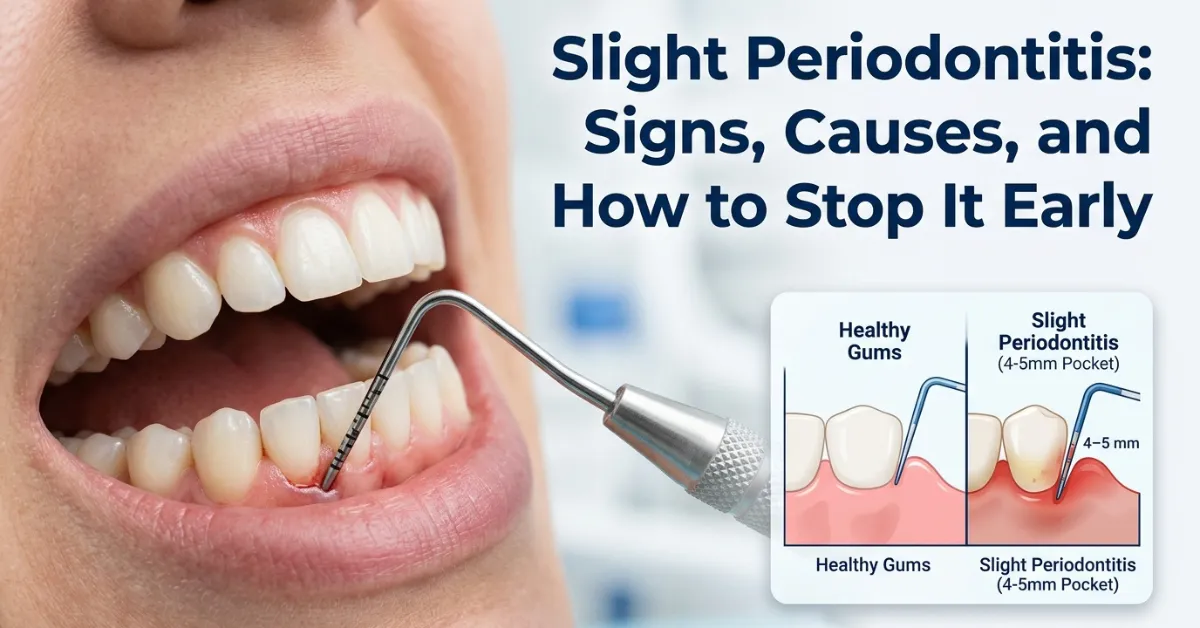
Slight periodontitis means early gum and bone damage, usually 4-5mm pockets. Catch it now and a deep cleaning can stop it, no surgery needed.
What Is Slight Periodontitis?
Slight periodontitis, sometimes called mild or early periodontitis, is the point where gum disease stops being just gum irritation and starts actually damaging the structures that hold your teeth in place. Up until this stage, you were dealing with gingivitis: red, puffy, maybe bleeding gums, but no real structural damage yet. Slight periodontitis is what happens when that inflammation goes unchecked long enough for bacteria to work their way under the gumline and start breaking down the ligament and a small amount of bone around the tooth root.
I’ve seen patients get genuinely confused at this diagnosis because it doesn’t feel dramatically different from gingivitis. Gums might still just look a bit puffy. That’s exactly what makes this stage tricky: it’s the first stage where real, technically irreversible damage is happening, but the outward signs barely change from what came before it.
How Slight Periodontitis Differs From Gingivitis
The line between the two comes down to one thing: attachment loss. Gingivitis is inflammation confined to the soft tissue. Your gums might bleed when you floss, but the fibers and bone anchoring your tooth are untouched, and a good cleaning plus a few weeks of consistent brushing can fully reverse it.
Slight periodontitis crosses that line. Bacteria have reached the periodontal ligament, the tissue connecting tooth to bone, and started to loosen it. A small amount of the supporting bone has usually started to thin as well. It’s still a small amount of damage, and it’s still very manageable, but it’s damage that a toothbrush alone can no longer undo.
Signs and Symptoms to Watch For
Slight periodontitis often hides in plain sight because the symptoms overlap so heavily with gingivitis. Watch for:
- Gums that bleed with brushing or flossing, not just heavy pressure
- Redness or puffiness along the gumline that doesn’t fully calm down
- Gums that look like they’re starting to pull slightly away from the teeth
- Mild tenderness, though usually without real pain
- Occasional bad breath that mouthwash doesn’t fully fix
None of these on their own are alarming. Together, and persisting for more than a couple of weeks despite decent brushing habits, they’re worth a dental visit specifically to check for pocket depth, not just a routine cleaning.
Pocket Depth: What the Numbers Actually Mean
This is the one number your dentist or hygienist will actually measure, and it’s the clearest way to understand where you stand. A periodontal probe measures the space between your gum and tooth in millimeters at several points around each tooth.
- 1 to 3mm: Healthy. No periodontitis.
- 4 to 5mm: Slight (mild) periodontitis. Early attachment and bone loss have started.
- 5 to 7mm: Moderate periodontitis. More significant damage, more bone loss visible on X-ray.
- 7mm or deeper: Advanced periodontitis. Teeth may become loose.
A single 4mm reading on one tooth, on its own, isn’t automatically a diagnosis. Dentists look at the pattern across the whole mouth, plus bleeding on probing and X-ray findings, before calling it slight periodontitis rather than just an isolated inflamed spot.
Is Slight Periodontitis Reversible?
Here’s the direct answer, because most pages talk around this: the tissue and bone loss itself is not reversible. Once the periodontal ligament and a sliver of bone are gone, they don’t grow back on their own. What is very achievable at this stage is stopping it in its tracks. With a proper deep cleaning and consistent home care, slight periodontitis can be fully controlled, pocket depths can shrink back toward normal, and it’s realistic to never progress to moderate or advanced disease.
That’s the practical distinction worth understanding. You’re not “curing” it back to a pristine baseline, but you are very likely stopping it permanently if you act now instead of waiting.
How It’s Diagnosed
Diagnosis isn’t guesswork, and it isn’t based on how your gums look alone. A dentist or hygienist typically checks three things together:
- Probing depth at multiple points around each tooth, using a periodontal probe.
- Bleeding on probing, which signals active inflammation rather than old scar tissue.
- X-rays, to check for early bone loss around the roots that isn’t visible just by looking in your mouth.
Slight periodontitis is usually confirmed when probing depths sit in that 4-5mm range at multiple sites, combined with bleeding and the earliest signs of bone changes on imaging. This is also why an annual or twice-yearly check that includes actual probing, not just a visual look and polish, matters more than people assume.
Treatment Options and What They Cost
The standard, first-line treatment is scaling and root planing (SRP), commonly called a deep cleaning. It’s done in two parts: scaling removes plaque and hardened tartar from below the gumline, and root planing smooths the tooth root so bacteria have a harder time reattaching and the gum tissue can reattach more snugly.
On cost, national averages typically fall between $185 and $450 per quadrant of the mouth, with a full-mouth deep cleaning often landing somewhere between $700 and $1,800 before insurance. Most dental plans cover 50 to 80 percent of this once the deductible is met, which usually brings out-of-pocket cost down to a few hundred dollars total. It’s almost always billed as a basic or major procedure rather than cosmetic, which is worth confirming with your specific plan.
After SRP, most dentists schedule a follow-up around four to six weeks later to re-measure pocket depth and confirm the tissue is healing and tightening back up. If depths don’t respond as expected, that’s when a referral to a periodontist for more targeted care comes in, though at the slight stage that’s the exception rather than the rule.
What Happens If You Don’t Treat It
Slight periodontitis doesn’t stay slight if it’s ignored. The bacteria causing it don’t go away on their own, and the pockets they’re living in only get deeper over time as more attachment breaks down. Left alone, it typically progresses to moderate periodontitis, with pocket depths in the 5 to 7mm range and more noticeable bone loss on X-ray, and from there toward advanced disease, where tooth mobility and eventual tooth loss become real possibilities.
The timeline varies a lot person to person depending on genetics, smoking status, diabetes control, and home care consistency, so there’s no fixed “you have six months” answer. What is consistent is the direction: untreated periodontitis moves one way, and it’s not toward improvement.
Preventing Slight Periodontitis From Progressing
Once you’re diagnosed, the goal shifts from “avoid gum disease” to “keep this exact stage from advancing.” That comes down to a handful of concrete habits:
- Brush twice daily for two minutes with a soft-bristled brush, angled slightly toward the gumline where plaque actually accumulates.
- Floss once daily, actually curving the floss around each tooth rather than just snapping it through the contact point.
- Consider an antimicrobial or fluoride mouth rinse if your dentist recommends one for your specific case.
- Keep periodontal maintenance visits every three to four months instead of the standard six, at least until pocket depths stabilize.
- Quit smoking if applicable. It’s one of the single biggest accelerants of periodontal disease progression and one of the biggest blockers of healing after treatment.
- Manage blood sugar closely if you have diabetes, since the relationship between the two conditions runs in both directions.
None of this is complicated, but consistency is what actually moves the needle. A single great week of flossing after a scary dentist visit doesn’t offset months of skipping it.
FAQ
Is slight periodontitis reversible?
The bone and tissue loss itself isn’t reversible, but the disease process can be fully stopped with scaling and root planing plus consistent home care, and pocket depths often shrink back close to normal.
What is the difference between mild and moderate periodontitis?
Mild (slight) periodontitis involves pocket depths of about 4 to 5mm with early attachment and bone loss. Moderate periodontitis involves deeper pockets, typically 5 to 7mm, with more noticeable bone loss on X-ray and more pronounced symptoms.
How many millimeters is slight periodontitis?
Pocket depths of roughly 4 to 5mm, measured with a periodontal probe, generally indicate slight periodontitis when combined with bleeding on probing and early bone changes on X-ray.
Can you reverse periodontitis without surgery?
At the slight stage, yes. Non-surgical scaling and root planing is the standard first-line treatment and is effective for the vast majority of slight periodontitis cases. Surgery is generally reserved for moderate to advanced disease that doesn’t respond to non-surgical care.
Does insurance cover scaling and root planing?
Most dental insurance plans cover it as a basic or major procedure, typically at 50 to 80 percent after the deductible, though coverage details vary by plan.
What happens if slight periodontitis is left untreated?
It typically progresses to moderate and then advanced periodontitis over time, with deeper pockets, more bone loss, and eventually a real risk of tooth mobility and tooth loss.
Key Takeaways
Slight periodontitis is the earliest stage where gum disease starts causing real, technically permanent damage to the tissue and bone around your teeth, usually showing up as pocket depths of 4 to 5mm. It doesn’t look dramatically different from gingivitis, which is exactly why it gets missed. The good news is that at this stage, a straightforward deep cleaning and consistent home care are genuinely enough to stop it from progressing, and most people never move on to moderate or advanced disease if they act on it. The one thing that doesn’t work is waiting to see if it gets better on its own. It won’t.
One Comment