Toothache and Headache at the Same Time: Causes and Relief
Toothache and headache at the same time can mean dental infection, TMJ, sinusitis, or migraine. Learn the real causes, red flags, and how to get relief.
A toothache and headache happening at the same time is usually not a coincidence. In most cases, the two are connected through shared nerve pathways in your face and skull, most commonly the trigeminal nerve, or through an underlying condition such as a tooth infection, sinus infection, TMJ disorder, or a headache disorder that is being felt in your teeth instead of your head.
This isn’t a rare combination. Dental pain and head pain overlap often enough that dentists and doctors both see it regularly, and the cause can sit on either side of that line. Below is a breakdown of why the connection happens, the specific conditions that cause it, how to tell dental pain apart from sinus pain or migraine, and when the combination is serious enough to need same-day care.
Why a Toothache and Headache Happen Together
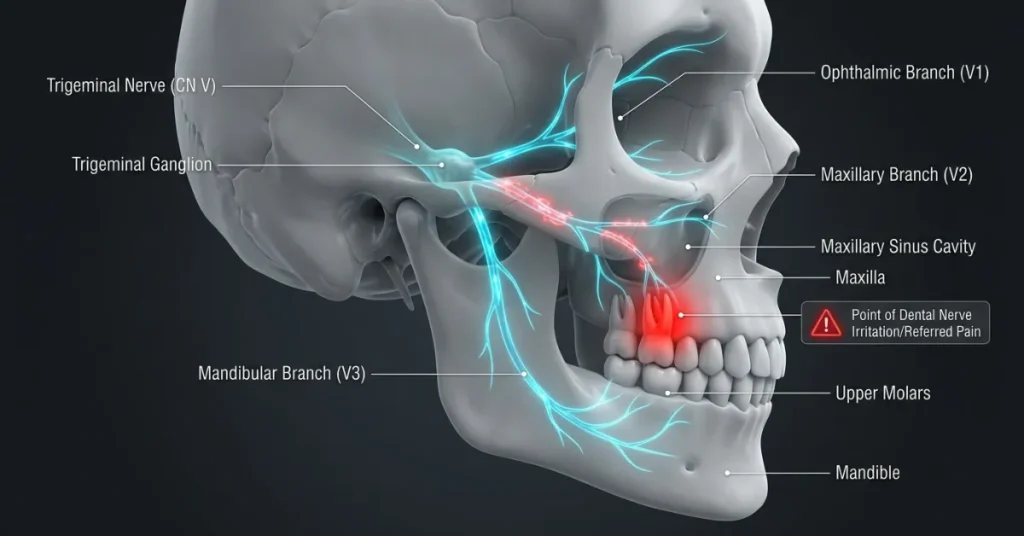
Your teeth, jaw, sinuses, and much of your face and scalp are all wired through the same nerve network. When something goes wrong in one area, the brain can struggle to pinpoint exactly where the signal is coming from, so pain shows up somewhere else too.
The trigeminal nerve connection
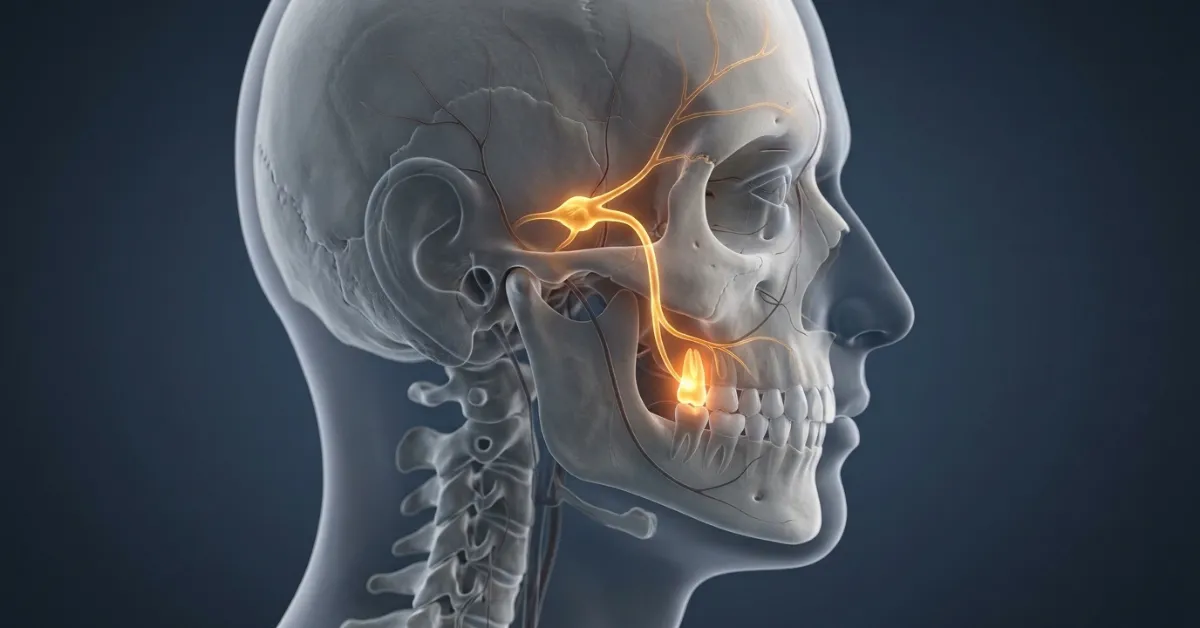
The trigeminal nerve is the main sensory nerve for your face, jaw, and teeth, and it also plays a role in headache disorders. It has three branches that cover your forehead and eyes, your cheeks and upper teeth, and your lower jaw and lower teeth. Because a single nerve carries sensation from your teeth all the way up into your head, irritation or infection at the tooth can travel along that same pathway and register as head pain, and irritation that starts in the head can just as easily be felt down in a tooth.
Referred pain, explained simply
Referred pain is when your brain feels pain in one location while the actual problem is somewhere else. A common example: an infected lower molar can send pain up through the jaw and into the temple or ear on the same side, so the person feels a “headache” that is really coming from the tooth. The nerve fibers around the tooth and the nerve fibers in that part of the head cross paths closely enough that the brain blends the two signals into one sensation.
It can work in reverse: headaches that cause tooth pain
Most articles on this topic only describe dental problems causing headaches, but the relationship goes both ways. Case reports in dental and neurology literature describe patients who went to a dentist for what felt like a toothache in a perfectly healthy tooth, sometimes even undergoing a root canal for it, before being correctly diagnosed with a headache disorder such as migraine, cluster headache, or a related condition. In these cases the pain signal from the headache is misread by the brain as tooth pain, because the same trigeminal pathway carries both.
This matters practically: if a tooth has already been checked by a dentist and shows no decay, infection, or fracture, but the pain keeps recurring in a pattern (same time of day, same triggers, comes with light sensitivity or nausea), a primary headache disorder is worth ruling out with a doctor rather than pursuing further dental treatment on a healthy tooth.
Common Causes of Toothache and Headache at the Same Time
| Cause | Type | Typical pattern |
|---|---|---|
| Tooth infection or abscess | Dental | Throbbing pain in one tooth, worsens with chewing or heat, may include facial swelling or fever |
| Tooth decay (untreated cavity) | Dental | Sharp pain with sweet, hot, or cold foods; dull ache that can radiate to the jaw and temple |
| Bruxism (teeth grinding or clenching) | Dental/muscular | Morning headache and jaw soreness, worn or flattened teeth, often stress-related |
| TMJ disorder | Joint/muscular | Jaw clicking or locking, pain in front of the ear that spreads to the temple, worse with chewing |
| Impacted wisdom tooth | Dental | Pressure and pain at the back of the jaw, swelling, headache from muscle tension around the jaw |
| Sinus infection (sinusitis) | Sinus | Pain in upper back teeth, pressure behind the cheeks and eyes, worse when bending forward, often with congestion |
| Migraine | Headache disorder | One-sided throbbing head pain, may include jaw or tooth pain, nausea, light and sound sensitivity |
| Cluster headache | Headache disorder | Severe one-sided pain around the eye or temple that can radiate to the upper teeth, comes in repeated attacks |
| Trigeminal neuralgia | Nerve disorder | Sudden, electric shock-like facial pain triggered by chewing, talking, or brushing teeth |
| Cavernous sinus thrombosis (rare) | Medical emergency | Severe headache with facial swelling, fever, vision changes, drooping eyelid; requires immediate care |
The first five causes on this list are dental in origin. Sinusitis sits in between, since the maxillary sinuses lie directly above the roots of your upper back teeth, so a sinus infection can genuinely feel like a toothache. The last four are neurological or vascular, meaning the head pain is the primary problem and the tooth sensation is either referred pain or, in the case of cavernous sinus thrombosis, a sign of a spreading infection that needs emergency treatment.
Toothache and Headache on One Side of the Face
When both symptoms show up on the same side, it narrows the likely cause. Dental pain from a single infected or decayed tooth is almost always one-sided, since it starts at one specific tooth and radiates outward along the nerve on that side. TMJ disorder is also typically worse on one side, matching whichever jaw joint is affected. Migraine and cluster headache are classically one-sided as well, which is exactly why they’re so often mistaken for a dental problem when tooth pain is part of the picture.
Two-sided or widespread pain points more toward causes like bruxism (which affects both sides of the jaw), sinus infection when both sinus cavities are involved, or a tension-type headache that happens to coincide with an unrelated toothache.
Dental Pain vs. Sinus Pain vs. Migraine: How to Tell Them Apart
Because these three causes account for most cases, this comparison can help you narrow things down before you decide who to call.
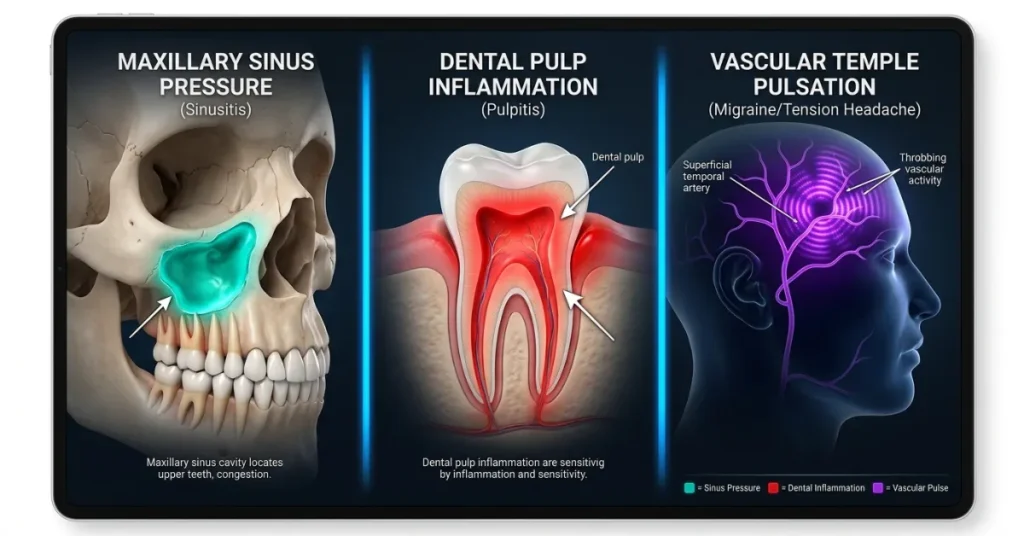
| Feature | Dental pain | Sinus pain | Migraine |
|---|---|---|---|
| What triggers it | Hot, cold, sweet foods, or chewing on the affected tooth | Bending forward, lying down, or pressing on the cheeks | Stress, certain foods, hormonal shifts, bright light, skipped meals |
| Where it’s felt | One specific tooth, spreading to the jaw and temple | Upper back teeth and cheeks, pressure behind the eyes and forehead | One side of the head, sometimes with jaw or tooth discomfort |
| What comes with it | Swelling, sensitivity to a specific tooth, sometimes a visible cavity or broken tooth | Nasal congestion, thick discharge, reduced sense of smell, fever | Nausea, sensitivity to light and sound, visual changes before the headache |
| What helps | Dental treatment (filling, root canal, antibiotics if infected) | Decongestants, saline rinse, and treating the underlying sinus infection | Migraine-specific medication, rest in a dark quiet room, addressing triggers |
If cold or heat sets off pain in one specific tooth, the cause is almost certainly dental. If the pain worsens when you lean forward and comes with a stuffy nose, sinusitis is the more likely explanation. If it’s one-sided, throbbing, and comes with nausea or light sensitivity, a headache disorder is more probable than a dental one, even if a tooth also aches.
Warning Signs That Need Immediate Care
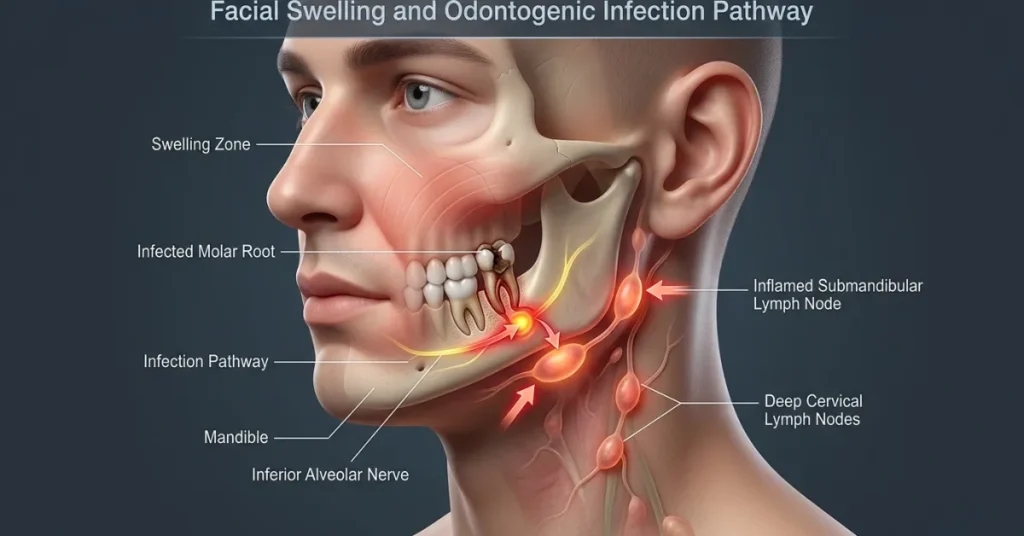
Most toothache-and-headache combinations are uncomfortable but not dangerous. A smaller number of cases are a sign that a dental infection is spreading beyond the tooth, which can become serious quickly. Seek same-day dental or emergency medical care if you notice any of the following:
- Facial or neck swelling, especially if it’s spreading or affecting one eye
- A fever, generally 100.4°F (38°C) or higher, along with tooth or facial pain
- Difficulty opening your mouth fully, swallowing, or breathing
- Vision changes, double vision, or a drooping eyelid
- Confusion, drowsiness, or a stiff neck
- Pain that is rapidly worsening rather than staying steady
These signs can indicate that an infection has spread into deeper tissues of the face or, in rare cases, toward the cavernous sinus behind the eyes, which is a medical emergency. Difficulty breathing or swallowing along with facial swelling can also signal Ludwig’s angina, a serious infection of the floor of the mouth that requires immediate emergency treatment. None of these situations should wait for a next-available dental appointment.
How to Relieve a Toothache and Headache at the Same Time

While you arrange to see a dentist or doctor, these steps can reduce discomfort in the meantime:
- Take an appropriate over-the-counter pain reliever. Ibuprofen or another NSAID can ease both inflammation and pain, which helps with dental pain and many headache types at once. Acetaminophen is a reasonable alternative if NSAIDs aren’t suitable for you. Follow the dosing on the package and don’t combine multiple pain relievers without checking with a pharmacist or doctor first.
- Apply a cold compress to the outside of your jaw or cheek for 15 to 20 minutes at a time if swelling or throbbing pain is present. A warm compress can help more if the pain feels like muscle tension, such as from bruxism or TMJ.
- Rinse with warm salt water (about half a teaspoon of salt in a cup of warm water) if a tooth or gum feels irritated. This won’t clear an infection but can reduce discomfort and keep the area clean.
- Avoid chewing on the affected side and skip very hot, cold, or sugary foods until you’re seen.
- Rest in a quiet, dim space if light or sound is making the pain worse, which points toward a headache-disorder component.
- Stay hydrated and keep a regular sleep schedule, since dehydration and poor sleep are common triggers for both tension headaches and migraine.
None of these steps treat the underlying cause. If the pain is from an infected tooth, only a dentist can address it, usually with drainage, a root canal, or antibiotics, and over-the-counter medication is only a bridge until then.
When to See a Dentist vs. a Doctor
If the tooth pain came first, or if you can point to a specific tooth that’s sensitive to temperature, pressure, or chewing, start with a dentist. That’s true even if the headache feels like the bigger problem, since treating the tooth often resolves the head pain too.
See a doctor first if there’s no clear dental trigger, the pain is clearly one-sided and throbbing with nausea or light sensitivity, you have nasal congestion or sinus pressure, or you’ve had similar headaches in the past that were never tooth-related. A doctor can also evaluate for TMJ disorder, though many dentists treat this as well, and either provider can refer you onward if needed.
If any of the warning signs listed above are present, skip the wait-and-see approach entirely and go to an emergency room or urgent care.
FAQ
Can a toothache cause a headache?
Yes. An infected, decayed, or abscessed tooth can trigger a headache through referred pain along the trigeminal nerve, which carries sensation from your teeth and jaw into your head and face.
Can a tooth infection cause a headache?
Yes. A spreading tooth infection can cause facial swelling, fever, and a worsening headache. These signs require prompt dental or medical treatment.
How can I tell if my toothache and headache are from a dental problem or a migraine?
Dental pain usually reacts to hot, cold, sweet foods, or chewing on one specific tooth. Migraine pain is typically one-sided and throbbing, often with nausea or sensitivity to light and sound.
Can wisdom teeth cause headaches?
Yes. An impacted or partially erupted wisdom tooth can cause pressure and inflammation at the back of the jaw, with pain that may radiate toward the temple or head.
Can TMJ cause both tooth pain and headaches?
Yes. TMJ disorder can strain the jaw joint and surrounding muscles, causing pain that feels like tooth pain as well as tension-type headaches.
What’s the best way to relieve a toothache and headache at the same time?
An NSAID such as ibuprofen may help with pain and inflammation for some people. A cold compress may help with swelling, while warmth can help with muscle tension. These measures only provide temporary relief; the underlying cause may still need dental treatment.
When should I go to the emergency room for a toothache and headache?
Seek emergency care immediately if you have facial or neck swelling, fever, trouble breathing or swallowing, vision changes, or a rapidly worsening headache. These can indicate a serious infection or another condition requiring urgent care.
Key Takeaways
A toothache and headache showing up together is usually explained by one of a short list of causes: a dental infection or decayed tooth, bruxism or TMJ disorder, a sinus infection, or a primary headache disorder like migraine or cluster headache that’s being felt in the teeth rather than the head. The trigeminal nerve is the shared pathway behind most of these cases, and the connection can run in either direction, tooth to head or head to tooth.
Start with a dentist if you can identify a specific tooth that reacts to temperature, pressure, or chewing. Start with a doctor if the pain is one-sided and throbbing, comes with nausea or light sensitivity, or involves nasal congestion. And treat facial swelling, fever, breathing or swallowing difficulty, or vision changes as reasons to seek care immediately rather than waiting it out.