Are Teeth Bones? The Surprising Truth Revealed
Medically reviewed for accuracy and based on current evidence-based dental research. This content is for educational purposes and does not replace professional dental advice.
Are teeth bones? No. They share minerals but differ in structure and healing. See the key differences and why it matters.
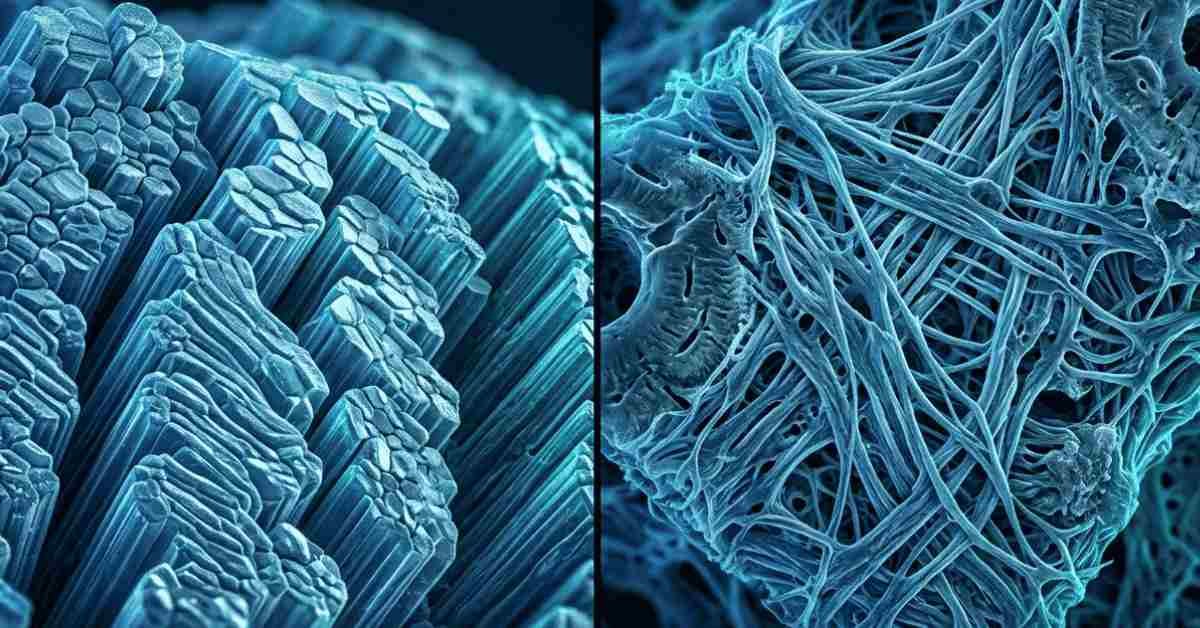
Are teeth bones? No, despite feeling hard and being anchored in your jaw, teeth are not classified as bones. Teeth are made of enamel, dentin, pulp, and cementum, while bones are living organs built from collagen, minerals, and marrow. The biggest difference is healing: bone constantly rebuilds itself through a process called remodeling, while tooth enamel has no living cells and cannot regenerate once damaged. Both do share key minerals, calcium and phosphate, which is why the confusion is so common in the first place, even among people who otherwise know their basic anatomy well. Understanding the real distinction matters because it changes how you should protect each one, and why a chipped tooth needs a dentist while a hairline bone fracture can often heal on its own with rest.
Quick Answer: Are Teeth Considered Bones?
No. Teeth are not bones. Bone is a living, vascularized organ that contains cells (osteoblasts and osteoclasts) capable of continuously breaking down and rebuilding tissue, a process known as bone remodeling. Enamel, the outer layer of a tooth, contains no living cells at all once the tooth erupts, so it cannot regenerate or self-repair the way bone does. Teeth and bones do share biological similarities, mainly their mineral content, which is why the mix-up is so common.
What Are Teeth Made Of?
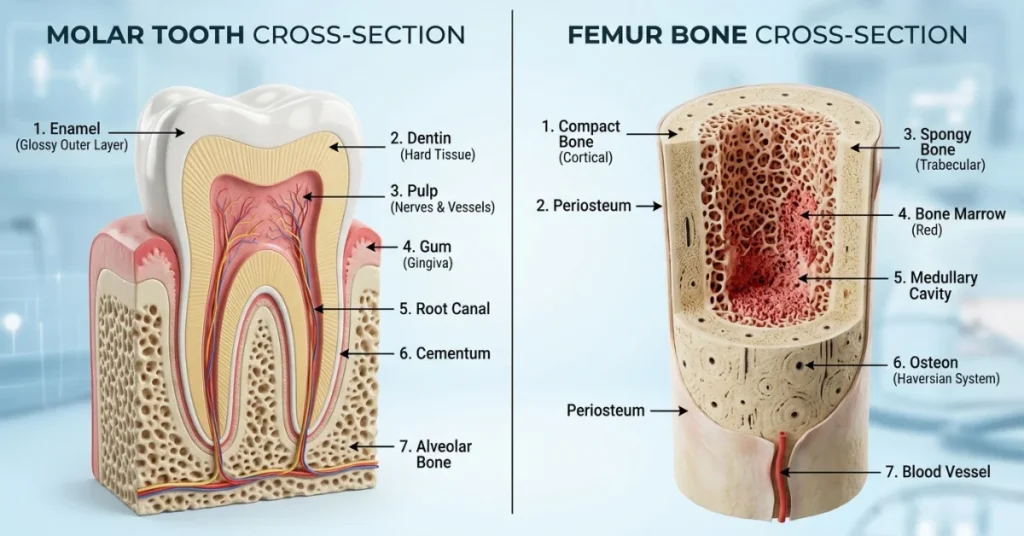
A tooth has four main layers:
- Enamel: the outer, visible layer, and the hardest substance in the human body. It’s about 96% mineral (mostly hydroxyapatite) and rates roughly 5 on the Mohs hardness scale, harder than steel, though more brittle.
- Dentin: the layer beneath enamel, softer and more porous, at roughly 70% mineral content. It supports the enamel and transmits sensation (which is why exposed dentin causes sensitivity).
- Pulp: the innermost, living core containing nerves, blood vessels, and connective tissue. It’s the only part of a tooth that’s genuinely alive in the same sense as bone tissue.
- Cementum: a thin, bone-like layer covering the tooth root that anchors it to the jaw via the periodontal ligament.
Only the pulp has living cells. Enamel, once formed, has no blood supply, no nerve endings, and no cells left to repair it: the cells that produce enamel (ameloblasts) die off before the tooth even breaks through the gumline.
What Are Bones Made Of?
Bone is a living organ, not just structural material. It’s composed of:
- Collagen: a flexible protein framework that gives bone its resilience and resistance to fracture.
- Mineral (mainly calcium phosphate): deposited onto the collagen matrix, giving bone its rigidity. Bone is roughly 65% mineral by weight, noticeably less mineralized than enamel.
- Living cells: osteoblasts (which build new bone), osteoclasts (which break down old or damaged bone), and osteocytes (which sense mechanical stress and micro-damage).
- Blood vessels and marrow: bone has its own blood supply and, in larger bones, houses marrow that produces blood cells.
This living structure is why bone can continuously remodel. According to the NIH, remodeling continues throughout life so that most of the adult skeleton is replaced about every 10 years. The pace isn’t uniform: dense cortical bone (the outer shell) turns over more slowly than porous cancellous bone found in the spine and pelvis, but the underlying mechanism is the same self-repair loop that teeth simply don’t have.
Teeth vs Bones: Key Differences at a Glance
| Tooth Enamel | Bone | |
|---|---|---|
| Mineral content | ~96% | ~65% |
| Mohs hardness | ~5 | ~3.5 |
| Living cells | None (after eruption) | Yes (osteoblasts, osteoclasts, osteocytes) |
| Blood supply | None | Yes |
| Self-healing | No, cannot regenerate | Yes, continuous remodeling |
| Primary function | Chewing, biting, protecting inner tooth layers | Structural support, protecting organs, mineral storage |
| Full renewal cycle | Never (once formed) | ~10 years for the full skeleton |
The pattern holds across tissue types: the more mineralized a tissue is, the harder and less able to repair itself it becomes. Bone trades some hardness for flexibility and living cells that let it heal after a fracture. Enamel trades that healing ability for maximum hardness, since it needs to withstand a lifetime of biting and chewing without the option to regrow.
Similarities Between Teeth and Bones
Teeth and bones aren’t unrelated. They share real biological common ground:
- Mineral composition. Both rely heavily on calcium and phosphate, primarily in the form of hydroxyapatite crystals.
- Developmental origin. Both form through a mineralization process where a soft organic matrix gradually hardens as minerals are deposited.
- Nutritional dependence. Both need adequate calcium, phosphorus, and vitamin D to develop and stay strong, and both are affected by conditions like poor nutrition or certain metabolic diseases.
- Structural role. Cementum, the layer anchoring a tooth root, is chemically similar to bone and connects to the jawbone via the periodontal ligament, giving teeth and bones a direct physical relationship even though they’re different tissue types.
Why Teeth Cannot Heal Like Bones
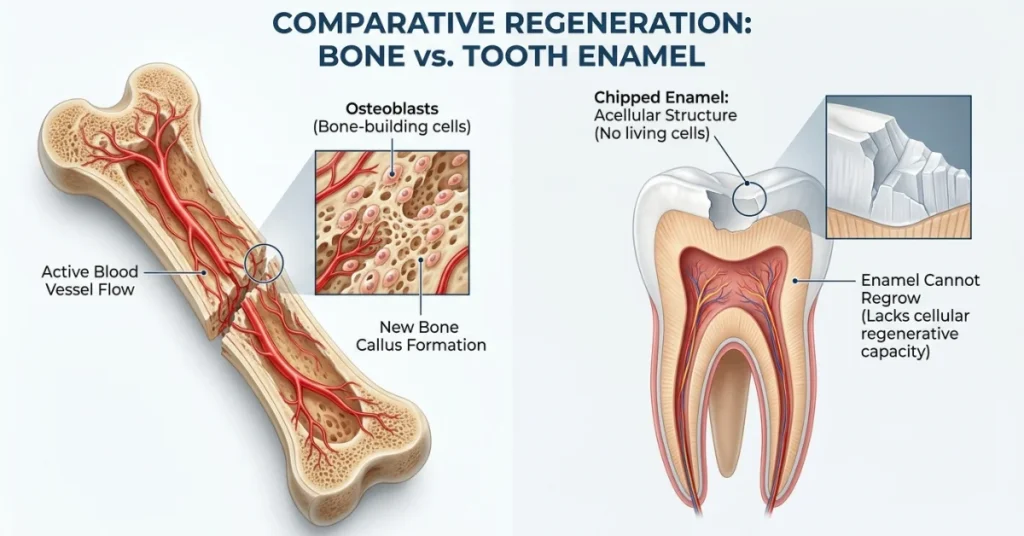
Bone heals because it’s alive: bone remodeling involves osteoclasts resorbing old or damaged bone and osteoblasts forming new bone in its place, a coordinated cycle that repairs fractures and micro-damage continuously. Enamel has none of this. There are no blood vessels delivering repair cells, no living cells left inside the enamel itself, and no mechanism to rebuild lost structure once it’s gone.
That’s not to say enamel is completely static. Saliva, fluoride, and calcium can support a limited process called remineralization, where minerals redeposit into microscopic, very early-stage enamel damage before it becomes a cavity. This is why fluoride toothpaste and treatments work, but it only addresses tiny surface-level demineralization. Once decay breaks through into an actual cavity, or enamel chips or cracks, the tooth cannot repair itself and needs a filling, crown, or other dental treatment. Bone, by contrast, can heal a genuine fracture on its own given time, alignment, and adequate nutrition.
How to Keep Both Teeth and Bones Strong
- Get enough calcium and vitamin D: through dairy, leafy greens, fortified foods, or sunlight exposure, since vitamin D is required to absorb calcium effectively.
- Maintain daily oral hygiene: brushing twice daily with fluoride toothpaste and flossing helps prevent the acid attacks that erode enamel, since enamel can’t repair itself once truly damaged.
- Exercise regularly, especially weight-bearing activity like walking, running, or resistance training, which signals bone-building cells to add density.
- Avoid tobacco and limit sugary, acidic foods and drinks: both damage enamel directly and are linked to lower bone density over time.
- Get regular dental and medical checkups, since early enamel demineralization and early bone density loss are both far easier to manage than damage that’s already advanced.
Common Tooth Problems Caused by Weak Oral Health
- Tooth decay and cavities: caused by acid-producing bacteria dissolving enamel minerals faster than saliva can replace them.
- Tooth sensitivity: often a sign that enamel has thinned enough to expose the dentin underneath.
- Cracked or chipped teeth: since enamel is hard but brittle, sudden impact or chronic grinding can fracture it the same way a diamond can chip despite being extremely hard.
- Gum disease: periodontal infection that can damage the cementum and ligament anchoring the tooth to the jawbone, eventually threatening tooth stability.
Myths and Facts About Teeth and Bones
Myth: Teeth are just another type of bone. Fact: They’re a different tissue entirely: teeth lack bone’s living cells, blood supply, and remodeling ability.
Myth: Teeth can heal themselves like bones do. Fact: Only very early, microscopic enamel demineralization can be reversed through remineralization. Actual cavities, chips, and fractures require dental treatment.
Myth: Hardness alone tells you how healthy a tissue is. Fact: Enamel is harder than bone specifically because it has no living cells to protect. Durability and self-repair are a trade-off, not a package deal.
Frequently Asked Questions
Are teeth made of bone or calcium?
Teeth are not bone. They contain calcium but are made of enamel, dentin, pulp, and cementum.
Why are teeth not considered bones?
Teeth lack living cells, blood vessels, and the ability to heal like bones.
Which is stronger, teeth or bones?
Tooth enamel is harder than bone, but bone is more flexible and can repair itself.
Can teeth heal like broken bones?
No. Damaged teeth cannot heal themselves and usually require dental treatment.
Do teeth have living cells?
Only the pulp contains living cells. Enamel has none.
Are teeth part of the skeletal system?
No. Teeth support the skeletal system but are not classified as bones.
What is the hardest substance in the human body?
Tooth enamel is the hardest substance in the human body.
Can a tooth grow back if it falls out?
No. Permanent teeth do not grow back once lost.
Do bones and teeth need the same nutrients?
Yes. Both need calcium, phosphorus, and vitamin D to stay strong.
Final Thoughts
Teeth and bones work closely together, literally, since tooth roots anchor into the jawbone, but they are biologically distinct tissues with very different capabilities. Bone is a living, self-repairing organ. Teeth, especially enamel, are remarkably hard but permanently fixed once formed, with no built-in way to heal serious damage. Knowing this difference is the practical reason to treat them differently: keep up bone-supporting habits like exercise and calcium intake for long-term skeletal health, and treat any enamel damage as something a dentist needs to address, since your body won’t fix it on its own.
Sources: NIH/NCBI: The Basics of Bone in Health and Disease (https://www.ncbi.nlm.nih.gov/books/NBK45504/); NIH/PMC: Cellular Mechanisms of Bone Remodeling (https://pmc.ncbi.nlm.nih.gov/articles/PMC3028072/); BBC Science Focus: Tooth Enamel Hardness (https://www.sciencefocus.com/the-human-body/how-hard-is-tooth-enamel-compared-to-other-materials)


One Comment