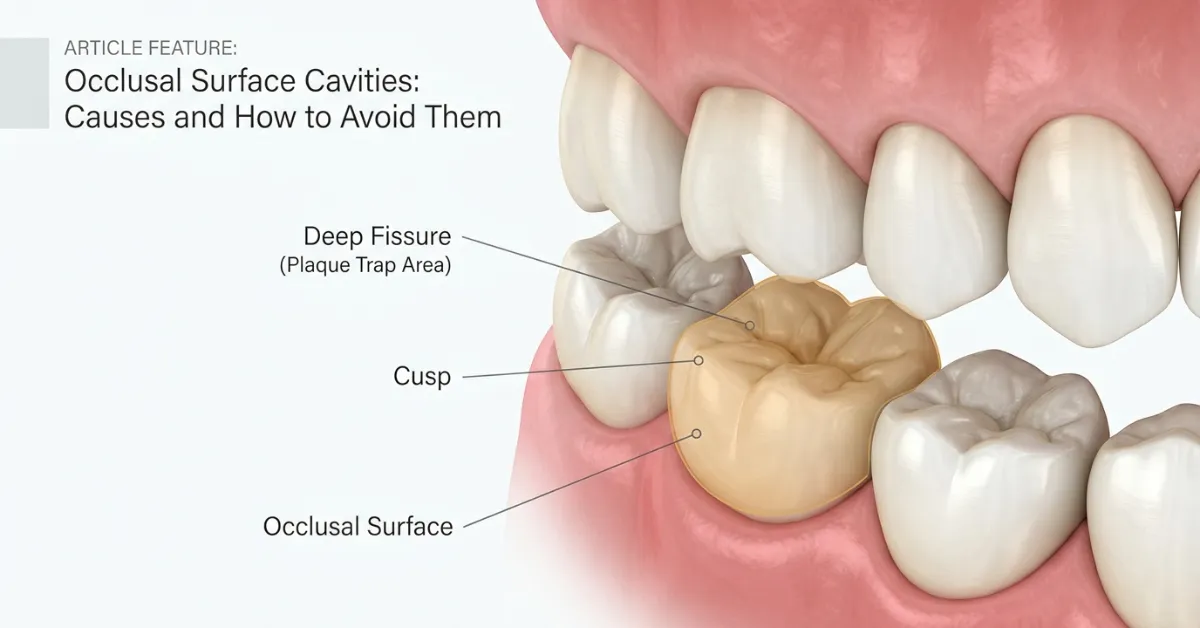
Occlusal Surface Cavities: Causes and How to Avoid Them
The occlusal surface is the chewing surface on your molars, and it’s where most cavities start. Here’s the anatomy and how to protect it.
Look at one of your back teeth in a mirror. The bumpy, grooved top you see is the occlusal surface, and it does more work than any other part of your mouth. It’s also, statistically, the part most likely to develop a cavity. If you’ve ever left a dental checkup with news of a “small spot” on a molar, there’s a good chance that spot was here.
This guide breaks down what the occlusal surface actually is, why it decays faster than the smooth sides of your teeth, and what you can do about it before a small spot becomes a filling.
What Is the Occlusal Surface?
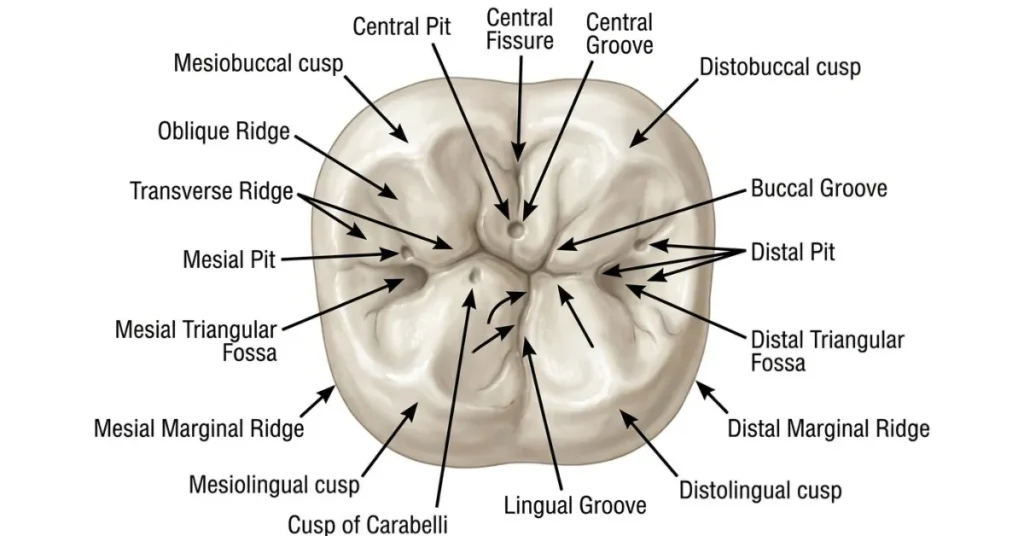
The occlusal surface is the flat, grooved top of your molars and premolars, the surface that meets your opposing teeth every time you bite or chew. Front teeth don’t have one; their equivalent edge is called the incisal edge. Occlusal surfaces exist only on posterior teeth, and their job is to grind and crush food before you swallow it.
Up close, this surface isn’t flat at all. It’s made of several distinct parts:
- Cusps are the raised points that do the actual crushing.
- Fossae are the shallow basins between cusps where food gets funneled.
- Grooves and fissures are the narrow channels connecting the fossae.
- Pits are small, deeper indentations, usually where grooves meet.
- Marginal ridges are the raised borders that keep food from sliding off the sides.
That terrain is the whole point. It’s what lets a molar grind a piece of food instead of just squashing it. It’s also why this surface needs more deliberate brushing than any other tooth surface. A flat surface rinses clean. A surface full of narrow grooves does not.
The Five Surfaces of a Tooth (Where Occlusal Fits)
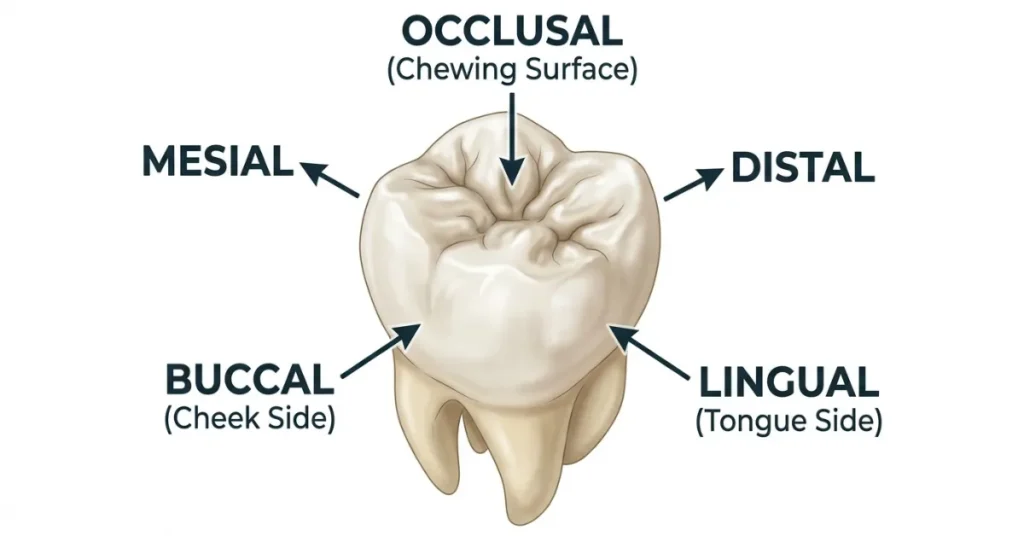
Every tooth has up to five distinct surfaces, and dentists refer to each one by name during exams, which is why you’ll sometimes hear terms you don’t recognize.
| Surface | Location | Found On |
|---|---|---|
| Occlusal | Chewing/biting surface, top of the tooth | Molars and premolars only |
| Incisal | Cutting edge (the occlusal equivalent) | Front teeth only |
| Mesial | Faces toward the midline of the mouth | All teeth |
| Distal | Faces away from the midline, toward the back | All teeth |
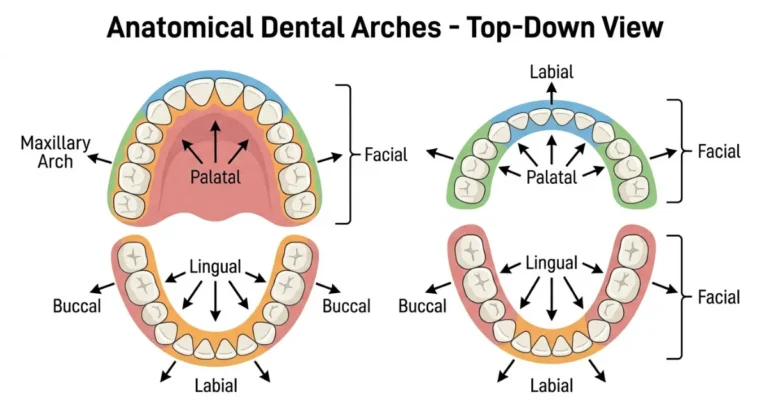
| Buccal/Facial | Faces the cheek or lips | All teeth |
| Lingual | Faces the tongue | All teeth |
Occlusal is the only surface with deep, complex grooves built into it by design. Every other surface is relatively smooth by comparison, and that structural difference explains almost everything else in this article.
Why the Occlusal Surface Decays Faster Than Other Surfaces
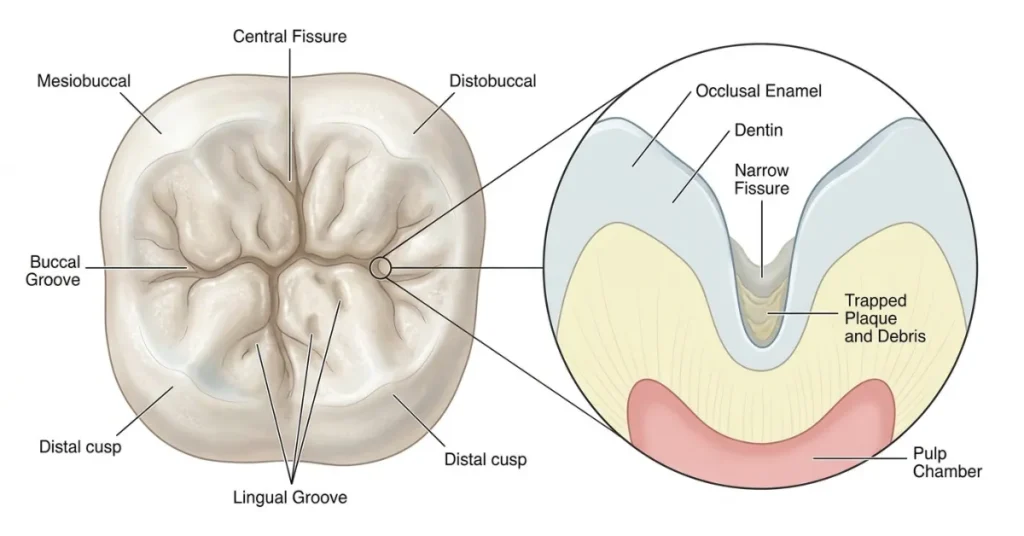
This is the part most guides skip. It isn’t just that grooves “trap food.” Fluoride, your single best defense against cavities, works by coating and remineralizing smooth enamel through direct contact. On a smooth surface like the buccal side of a tooth, saliva and fluoride toothpaste bathe the area evenly every time you brush.
An occlusal fissure can be narrower than a single toothbrush bristle. Food debris and bacteria settle into that channel, and fluoride simply can’t reach the bottom of it the same way it coats a flat surface. Dental researchers have documented that topical fluoride prevents cavities far more effectively on smooth surfaces than on occlusal ones, which is a major reason occlusal caries rates haven’t dropped nearly as much as smooth-surface caries rates have over the past few decades, even as overall cavity prevention has improved.
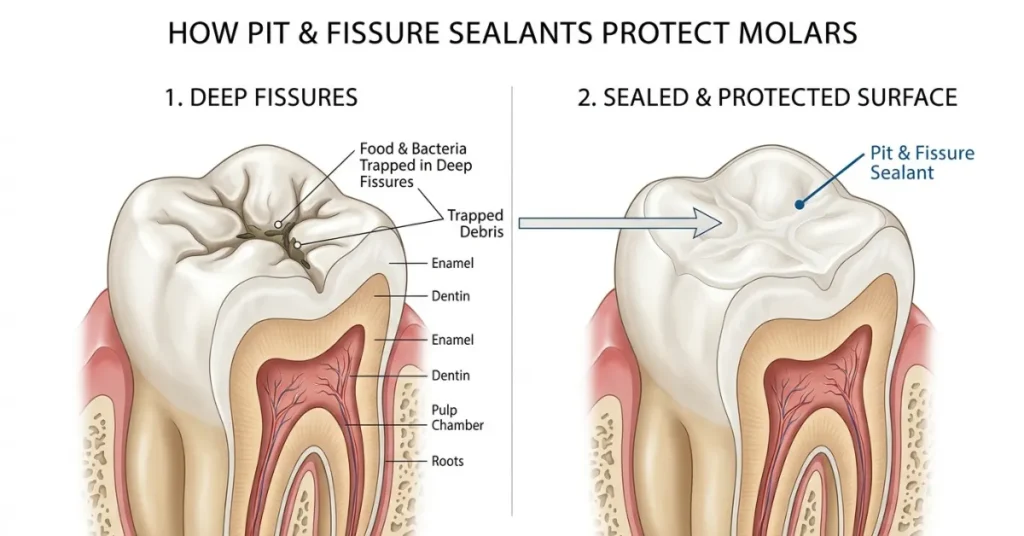
In practice, that means the surface doing the most chewing work is also the one your daily hygiene routine is least equipped to fully protect on its own, which is exactly why sealants exist.
Occlusal Surface vs. Occlusion: The Terms People Mix Up
These two words look related and get used interchangeably online, but they mean different things.
The occlusal surface is a physical location. It’s the chewing surface on one specific tooth.
Occlusion is an action. It refers to how your upper and lower teeth come together and fit when you bite down, across your whole mouth, not just one tooth.
So when a dentist talks about “occlusal surface decay,” they mean a cavity on that one grooved area of a specific molar. When they talk about “correcting your occlusion,” they mean adjusting how your entire bite meets, which might involve several teeth, orthodontics, or a night guard rather than a filling. Knowing the difference helps you understand your own treatment plan instead of nodding along.
Common Problems That Affect the Occlusal Surface
Pit and fissure cavities. The grooves described above are the single most common site for a new cavity in your entire mouth. Bacteria settle in, feed on sugars from food, and produce acid that eats into enamel, often with no pain until the decay has already reached the dentin underneath.
Attrition, or wear from grinding. Nighttime teeth grinding, known as bruxism, gradually flattens the cusps and ridges of the occlusal surface. Over months and years, this can wear enamel down enough to expose the softer dentin layer, which is more sensitive to hot, cold, and pressure.
Cracks and fractures. Biting down on something hard, ice, a popcorn kernel, or a pen cap, can crack the occlusal surface. Small cracks may cause sharp pain only when you bite in a specific spot, which makes them easy to dismiss until they worsen.
Malocclusion-related wear. If your bite is misaligned, certain teeth absorb more force than others every time you chew. That uneven load accelerates occlusal wear on the overloaded teeth specifically, not evenly across your mouth.
Enamel erosion from acid. Frequent exposure to acidic foods, sodas, or stomach acid from reflux softens enamel over time. Once enamel on the occlusal surface is softened, the surface becomes more porous and cavity-prone, and existing grooves get deeper as the surrounding enamel wears away faster than the enamel is naturally repaired.
The Eruption Window: Why New Molars Are at the Highest Risk
Here’s a detail that rarely makes it into consumer content but matters enormously for parents. Occlusal caries in a permanent molar typically doesn’t develop gradually over a decade. It tends to start within the first one to two years after that tooth erupts through the gum.
That’s because a newly erupted tooth’s enamel hasn’t finished maturing, and a molar coming in doesn’t sit flush with its neighbors right away, which makes it genuinely harder to clean well during that window. First permanent molars, which usually arrive around age six, and second permanent molars, which usually arrive around age twelve, are consistently the most cavity-affected teeth in the mouth for exactly this reason. This is also why dentists push sealants specifically around those two ages rather than waiting until a child is older. The protective window is narrow, and it closes.
How to Protect Your Occlusal Surfaces
Brush at an angle, not straight down. Point your bristles into the grooves at roughly a 45-degree angle rather than brushing straight across the chewing surface. A flat brushing motion glides over the fissures without actually reaching into them.
Get sealants, and don’t assume they’re only for kids. A dental sealant is a thin resin coating painted directly into the pits and fissures, physically blocking food and bacteria from settling in. They’re most commonly placed on children’s newly erupted molars, but cavity-prone adults benefit from them too, particularly on a tooth that’s never had a filling.
Keep up with routine exams. Occlusal decay is notoriously hard to catch by looking. Early lesions often hide beneath an intact enamel surface, which is why dentists rely on tactile checks, magnification, and bitewing X-rays rather than eyesight alone.
Address grinding if it’s happening. If you wake up with a sore jaw or a partner has mentioned you grind your teeth at night, ask about a custom night guard. It won’t stop the grinding, but it protects the occlusal surface from the friction that flattens it.
Watch acid exposure. Rinse with plain water after acidic foods or drinks rather than brushing immediately, since brushing right after an acid exposure can spread softened enamel rather than protect it. Give your saliva 20 to 30 minutes to neutralize the acid first.
What Happens During an Occlusal Adjustment
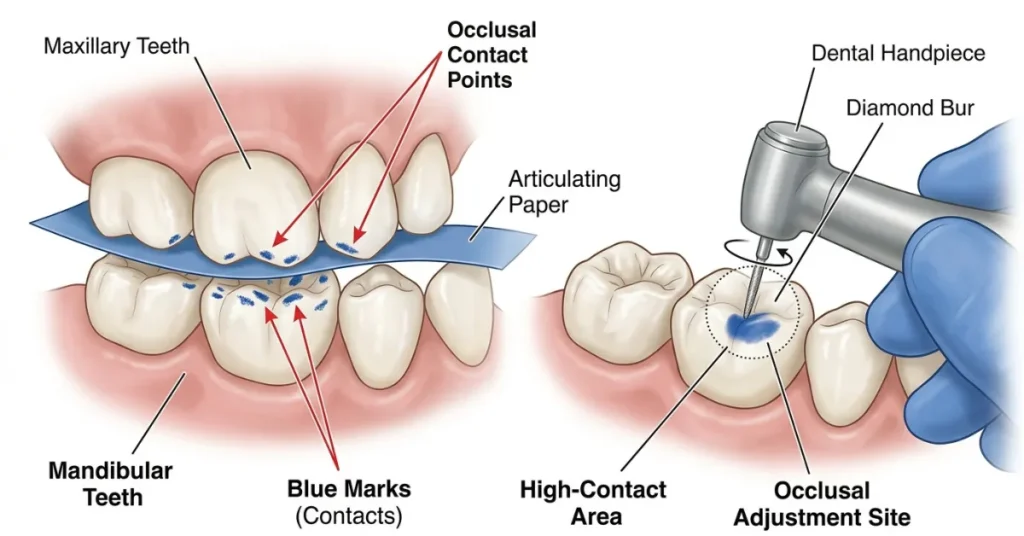
If a dentist tells you that you need an occlusal adjustment, here’s what that visit actually involves. First, the dentist checks your bite using thin colored articulating paper, which you bite down on so it marks the exact spots where your teeth are making first or heaviest contact. Those marked spots show where the pressure is uneven.
Using that map, the dentist selectively smooths tiny amounts of enamel from the high-contact points on the occlusal surface, a few microns at a time, then has you bite the paper again to recheck. This repeats until contact is distributed evenly across your bite instead of concentrated on one or two teeth. It’s a minor, usually painless procedure done without anesthesia, and its goal is to stop one overloaded tooth from taking damage that the rest of your bite should be sharing.
FAQ
What is an occlusal surface on a tooth?
The occlusal surface is the chewing or biting surface of a back tooth, such as a premolar or molar. It faces the opposing teeth and comes into contact with them when you bite and chew.
Which teeth have an occlusal surface?
Premolars and molars have occlusal surfaces. Front teeth, including incisors and canines, have an incisal edge instead of an occlusal surface.
What does occlusal mean in dentistry?
In dentistry, occlusal refers to the biting or chewing surfaces of the posterior teeth or to the contact between opposing upper and lower teeth.
What is the difference between occlusal and incisal?
Occlusal refers to the chewing surface of posterior teeth, including premolars and molars. Incisal refers to the cutting edge of anterior teeth, including incisors and canines.
What does O mean on a dental chart?
O stands for occlusal. On a dental chart, it indicates the chewing surface of a posterior tooth. For example, MOD means mesial, occlusal, and distal surfaces.
Key Takeaways
The occlusal surface is the grooved chewing surface on your molars and premolars, and its complex shape is exactly why it decays faster than any other tooth surface. Fluoride and brushing simply can’t reach the bottom of a narrow fissure as effectively as they reach a smooth surface, which is why sealants exist and why the first two years after a molar erupts matter so much. Angled brushing, sealants at the right age, regular exams, and managing grinding or acid exposure are the practical levers you actually control. If a dentist mentions an occlusal adjustment, it’s a routine, minor procedure aimed at spreading bite pressure evenly, not a sign of a serious problem. Catch changes on this surface early, since occlusal cavities are far easier to treat as a small filling than as a root canal

One Comment