How Long Does Bone Graft Take to Heal Before Implant
How long does bone graft take to heal before implant? Most cases need three to six months, though some take up to a year.
Most dental bone grafts need three to six months to heal before an implant can be placed, though the exact wait depends on the size of the graft, the material used, and where in the jaw it sits. Some small grafts are ready in ten to twelve weeks. Larger grafts, especially ones involving the sinus area, can take closer to nine or even twelve months to fully mature.
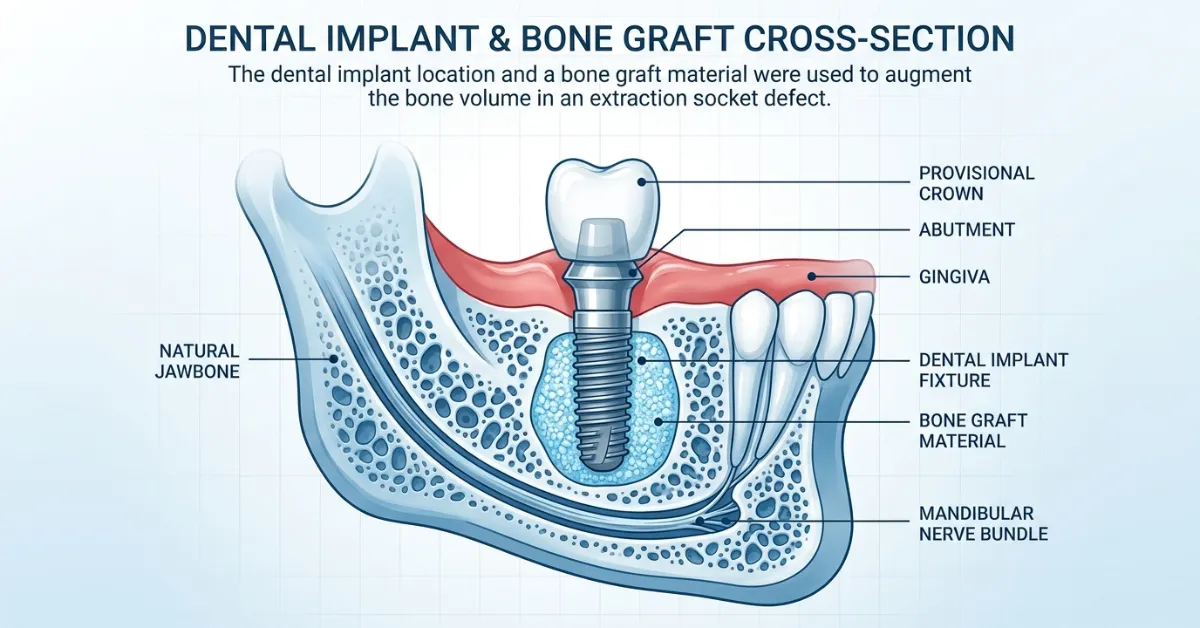
A bone graft rebuilds jawbone that has thinned out after tooth loss, gum disease, or an old extraction, since an implant needs a certain volume and density of bone to stay anchored long term. The wait between grafting and implant placement is not wasted time. It is the period where the graft material actually turns into living, load-bearing bone.
Bone Graft Healing Timeline by Type
The material used for the graft has a direct effect on how long it takes to heal, because each type integrates with your existing bone at a different speed.
| Graft type | What it’s made from | Typical healing time |
|---|---|---|
| Autograft | Your own bone, taken from another site | 3 to 6 months |
| Allograft | Processed donor bone from a tissue bank | 3 to 6 months |
| Xenograft | Bone mineral from an animal source, usually bovine | 4 to 9 months |
| Alloplast | Synthetic, lab-made bone substitute | 6 to 12 months |
Autografts and allografts tend to heal fastest because they integrate more readily with living bone cells. Xenografts and synthetic alloplasts hold their shape well and are often chosen when more structural support is needed, but they take longer for your own bone to fully replace and remodel.
What Happens Week by Week After a Bone Graft
Week 1: Initial Healing and Swelling
Swelling, mild bruising, and tenderness peak in the first two to three days, then start easing by day five to seven. The graft material is stabilizing in place but has not yet fused with surrounding bone. Antibiotics and a soft diet are standard during this stage.
Weeks 2 to 4: Early Bone Formation
Soft tissue over the graft site closes, and blood vessels begin growing into the graft material. This is the earliest stage of bone regeneration, though the site is still far too soft to support an implant.
Months 2 to 6: Bone Maturation and Integration
New bone cells gradually replace or bond with the graft material. By month four, many small to medium grafts have reached enough density for a dentist to consider implant placement. This is the window where most autografts and allografts are cleared.
Months 6 to 12: Full Maturity for Larger Grafts
Larger grafts, sinus lifts, and synthetic materials often need this longer window to reach full density and volume. Rushing an implant into a graft that has not matured raises the risk of the implant failing to fuse properly.
Why Healing Time Depends on Where the Graft Is Placed
Healing time is not just about graft material. Location changes the biology of healing too.
Socket Preservation Grafts
Placed right after a tooth extraction to stop the socket from collapsing. Because the area is small and already surrounded by healthy bone, these often heal in three to four months.
Ridge Augmentation Grafts
Used to rebuild width or height along the jaw when bone has resorbed over time. These are larger and more variable, typically needing four to six months, sometimes longer if multiple teeth worth of ridge is being rebuilt.
Sinus Lift Grafts
Needed in the upper back jaw when the maxillary sinus sits too close to where an implant needs to go. This is the slowest-healing location. Healing generally takes six months or more before implant placement, though in some cases an implant can be placed at the same time as the lift. Autogenous bone in a sinus graft can sometimes be ready in around four months, while bone substitute material heals at roughly one millimeter of new bone per month, so the amount of bone needed at the start affects the final wait.
Factors That Affect How Long a Bone Graft Takes to Heal
- Graft size: small defects heal faster than large ones
- Graft material: autograft and allograft generally outpace xenograft and alloplast
- Location: sinus grafts take longer than socket or ridge grafts
- Smoking: nicotine restricts blood flow to the graft site and slows integration
- Diabetes: uncontrolled blood sugar delays bone regeneration
- Certain medications: bisphosphonates and some osteoporosis drugs can interfere with normal bone turnover
- Nutrition: adequate protein, calcium, and vitamin D support faster bone formation
- Oral hygiene: plaque and infection at the site can stall or reverse healing
How Your Dentist Confirms the Graft Is Ready for an Implant
Time alone is not the deciding factor. Before placing an implant, a dentist or oral surgeon checks the graft with a clinical exam and imaging, usually a cone beam CT scan, to measure actual bone density and volume rather than guessing based on the calendar. Two patients with the same graft type can heal at different speeds, so imaging is what determines the real go-ahead date, not a fixed number of months.
Signs a Bone Graft May Not Be Healing Properly
Most bone grafts heal without incident, but a few warning signs are worth reporting to your dentist right away:
- Pain that worsens after the first week instead of improving
- Swelling that has not started going down after five days
- Pus, foul-smelling discharge, or a bad taste from the site
- Visible gum recession or a sinking appearance where the graft was placed
- A loose feeling if an implant was already placed alongside the graft
Catching these early usually means a simple fix. Left unaddressed, they can lead to graft failure and a longer overall timeline.
Can You Speed Up Healing
There is no way to shortcut the biology of bone formation, but you can avoid slowing it down:
- Stop smoking, or at minimum avoid it for the full healing period
- Keep blood sugar well controlled if you have diabetes
- Eat a protein and calcium rich diet
- Avoid chewing directly on the graft site until cleared
- Attend every follow-up appointment so problems are caught early
What Happens If You Wait Too Long
Waiting the full healing window matters, but waiting far past it carries its own risk. Once a graft has matured, the new bone still responds to normal biological turnover, and unused bone can slowly begin to resorb again. Most dentists consider twelve months the practical upper limit between grafting and implant placement. Beyond that point, the site may need to be reassessed, and in some cases a second, smaller graft is needed before the implant can go in.
FAQ:
How long does a small bone graft take to heal before an implant?
A small socket preservation graft can be ready for an implant in as little as three to four months.
Can an implant be placed at the same time as a bone graft?
Yes, in some cases, particularly with smaller defects, but this depends on the amount of bone loss and is decided case by case.
Is bone graft healing painful?
Most discomfort is limited to the first week and is managed with over-the-counter or prescribed pain medication. Pain that worsens after that point is not typical.
Does smoking really affect bone graft healing?
Yes. Nicotine restricts blood flow to the graft site, which is one of the most consistent factors in delayed or failed healing.
How does a dentist know the bone graft is ready?
Through a clinical exam combined with imaging, usually a cone beam CT scan, to confirm bone density and volume rather than relying on time elapsed alone.
Conclusion:
Three to six months covers most bone grafts, but the real answer depends on graft type, size, and location. Autografts and allografts tend to heal fastest, xenografts and synthetic alloplasts take longer, and sinus lift grafts are typically the slowest of all. Imaging, not the calendar, is what ultimately confirms readiness for an implant. Smoking, uncontrolled diabetes, and poor nutrition are the most common reasons healing runs longer than expected, and they are also the most within a patient’s control.