
Wisdom Teeth Hole Healing Process: Week-by-Week Guide
The wisdom teeth hole healing process usually finishes in 3 to 6 weeks for gum tissue, though bone keeps rebuilding for months.
Most people picture a wisdom tooth hole closing up in a matter of days. It doesn’t. The gum tissue over the socket usually seals within three to four weeks, but the bone underneath keeps rebuilding quietly for another two to six months. If you’re staring into a mirror three weeks post-extraction wondering why you can still see a dark opening where your tooth used to be, you’re almost certainly right on schedule.
I’ve dug through recovery timelines from oral surgery practices and general dentists to put together a realistic picture of what actually happens, week by week, and what separates normal healing from something worth a phone call.
How Long Does the Wisdom Teeth Hole Healing Process Take?
There are really two clocks running at once, and confusing them is where most of the anxiety comes from.
The soft tissue clock moves fast. Gum tissue typically covers the opening within two to four weeks. By the time you hit the one-month mark, the surface usually looks smooth and pink instead of raw and dark.
The bone clock moves slowly. Underneath that closed gum, your jawbone is filling in the socket where the tooth roots used to sit. That process can take anywhere from two to six months, and in cases involving deeply impacted teeth, occasionally longer. You won’t see this happening. You’ll just notice that the area feels solid rather than soft when you press your tongue against it, months after the visible hole seemed to disappear.
So when someone asks “how long does the hole take to heal,” the honest answer depends on which layer they mean. If they’re asking when it’ll stop looking like an open wound, three to four weeks is realistic. If they’re asking when the bone is fully rebuilt, think in months, not weeks.
Week-by-Week: What to Expect
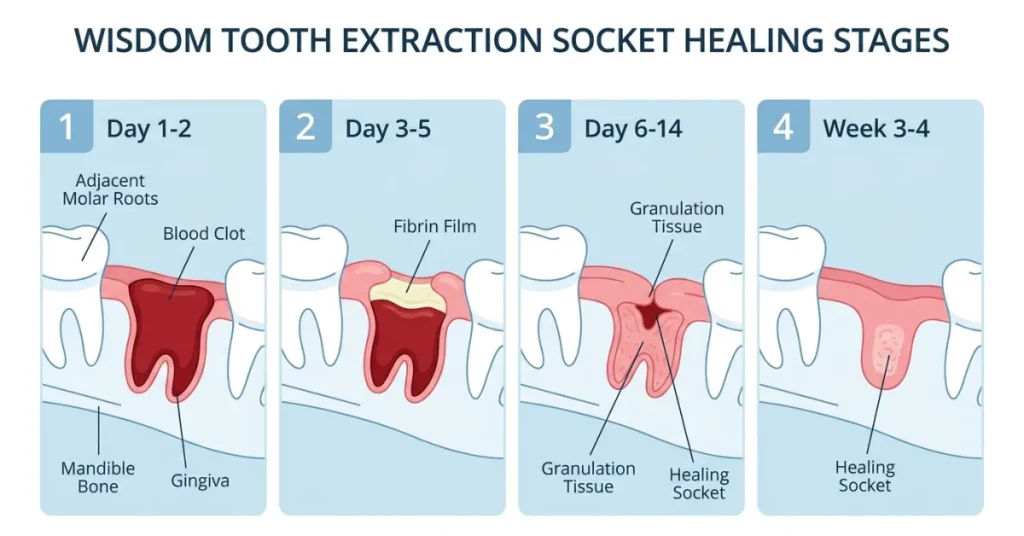
Days 1-2: A blood clot forms almost immediately in the socket. This is the single most important part of early healing. It protects the exposed bone and nerve endings underneath. Swelling peaks around day two or three, which surprises people who expect it to get better every day starting from day one. It doesn’t. It often gets worse before it gets better.
Days 3-5: A creamy white or pale yellow film starts to appear over the socket. This is fibrin, part of granulation tissue, and it’s a good sign, not an infection, even though it can look alarming if you weren’t warned about it. My own extraction site looked like this on day four, and I remember texting a photo to a friend convinced something had gone wrong. It hadn’t.
Days 6-14: Gum tissue starts closing in around the edges of the socket. Pain and swelling drop off noticeably. Most people feel comfortable eating normal, non-crunchy food again somewhere in this window. Your dentist will often want to see you around this point to check on healing and remove stitches if you had non-dissolving ones.
Weeks 3-4: The socket surface texture starts resembling the gum tissue around it. Food still might collect in there occasionally, which is normal at this stage and gets less frequent as the opening shrinks.
Months 1-3: The visible hole is mostly or fully closed on the surface. Underneath, bone is still filling in. This stretch is where “my hole never closed” worries usually pop up, because people expect total closure by now and instead see a shallow dimple or slight indentation. That’s typically just the bone still catching up to the gum.
Months 3-6: For most people, bone regeneration wraps up somewhere in this range. Larger sockets, especially from impacted wisdom teeth, sit at the longer end of that window.
Normal vs. Not Normal: A Quick Comparison
It helps to see these side by side instead of scattered through a list of symptoms.
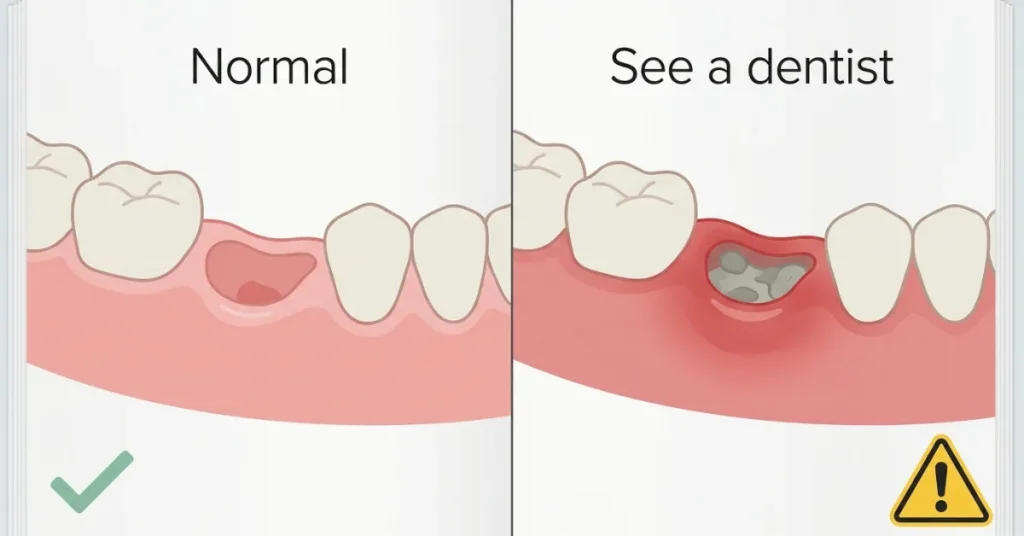
| Normal healing | Worth a call to your dentist |
|---|---|
| White or pale yellow film over the socket around day 3-5 | Grayish or foul-smelling debris, especially with bad breath |
| Swelling that peaks day 2-3, then improves | Swelling that keeps getting worse after day 3-4 |
| Mild ache managed by prescribed pain medication | Sharp, throbbing pain that starts or worsens days after surgery |
| A visible but shrinking hole for weeks | An empty-looking socket with visible bone and severe pain (possible dry socket) |
| Occasional pink-tinged saliva | Active bleeding that doesn’t slow with gauze pressure |
| Slight indentation that lingers for months | A hole that seems to be getting larger over time |
Dry socket is the complication people worry about most, and it’s real, but it’s also uncommon and it announces itself clearly. It typically shows up two to four days after extraction as pain that suddenly ramps up rather than fades, sometimes radiating toward your ear, often paired with an empty-looking socket instead of the clot or fibrin film you’d expect.
How to Clean the Hole Without Disrupting Healing
This part rarely gets covered anywhere, and it’s usually the thing people are most confused about a week or two out.
Don’t brush directly over the socket for the first several days. Instead:
- Rinse gently with warm salt water (about half a teaspoon of salt in a cup of warm water), starting 24 hours after surgery, several times a day and after meals.
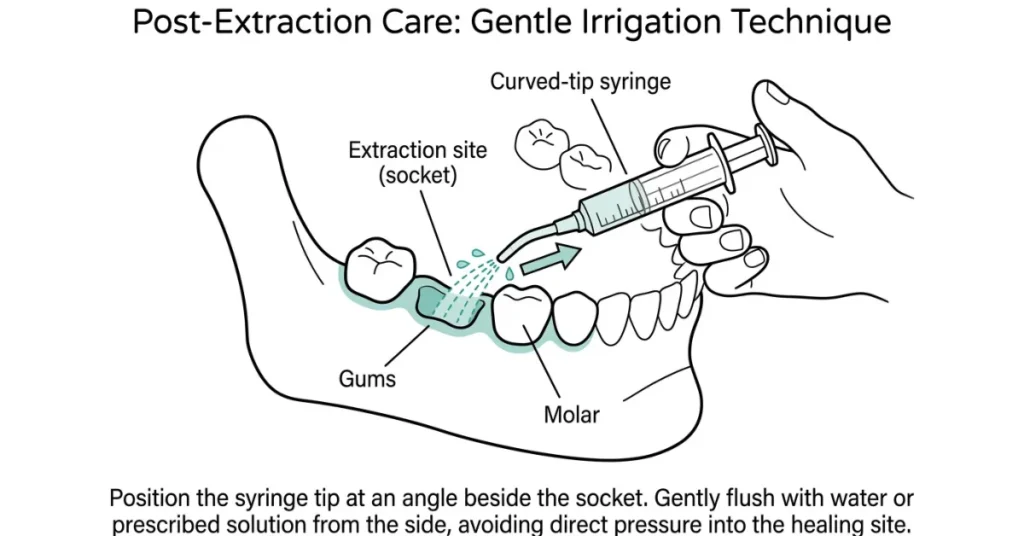
- If your surgeon gave you an irrigation syringe, wait until they say it’s safe to start, usually around day 5-7. Fill it with warm salt water and gently flush the socket from the side, not straight down into it, to avoid dislodging the clot or newly forming tissue.
- Avoid swishing aggressively or spitting hard in the first few days. The suction can pull the blood clot loose, which is one of the more common causes of dry socket.
- Once your dentist clears you to resume normal brushing near the site, do it gently, working around the socket rather than scrubbing directly into it until it’s visibly closed.
If you weren’t given a syringe and food keeps collecting in there, ask your dentist’s office. Many will give you one on request even weeks after surgery, since a lingering socket in a wisdom tooth spot is common enough that most practices keep them on hand.
Why Food Keeps Getting Stuck (and What to Do About It)
Wisdom teeth sit at the very back of the jaw, and the socket left behind is deep relative to its width, especially compared to holes from smaller front teeth. That shape is exactly what traps rice, seeds, and shredded meat, sometimes for weeks after the surface has otherwise closed over.
This isn’t a sign of infection by itself. It’s mostly geometry. A few things help:
- Rinse with warm salt water after meals, even well into the second or third week.
- Chew on the opposite side of your mouth for the first couple of weeks when possible.
- Skip small, fibrous, or seedy foods (popcorn, quinoa, sesame-topped bread) until the socket has visibly shrunk.
- Use the irrigation syringe described above once you’re cleared for it, rather than picking at the area with a toothpick or fingernail, which can irritate healing tissue or reopen it.
If food is still consistently getting trapped after a month or two, and the socket doesn’t seem to be shrinking, that’s worth mentioning at a follow-up rather than something to just live with indefinitely.
What Slows Down the Wisdom Teeth Hole Healing Process
A few factors reliably stretch out the timeline:
- Impacted or multi-rooted teeth. A tooth that had to be surgically removed in pieces leaves a larger socket than one that came out whole, and larger sockets simply take longer to fill.
- Smoking. The chemicals in cigarette smoke restrict blood flow to the area and are one of the biggest risk factors for dry socket specifically. Even a few days off cigarettes post-surgery makes a measurable difference.
- Age. Bone regeneration slows somewhat with age, which is part of why oral surgeons often recommend removing wisdom teeth in the late teens or early twenties rather than waiting.
- Underlying health conditions. Uncontrolled diabetes, poor nutrition, and conditions like osteoporosis can all interfere with normal wound healing.
- Not following aftercare instructions. Skipping salt water rinses, eating hard or crunchy foods too soon, or disturbing the clot with straws and aggressive rinsing are avoidable setbacks.
Do Upper and Lower Wisdom Tooth Holes Heal at Different Speeds?
Generally, yes, and it surprises a lot of people. Upper wisdom teeth tend to have shorter, less complex root structures and sit in less dense bone, so those sockets often close a bit faster and with less swelling than lower ones. Lower wisdom teeth are more frequently impacted, sit in denser jawbone, and are more often removed surgically rather than simply pulled, which is part of why the classic “dry socket” complication is disproportionately more common on the lower jaw. If you had all four removed at once, don’t be surprised if the bottom two feel like they’re lagging a week or two behind the top two.
When to Call Your Dentist or Oral Surgeon
Most healing is boring, in a good way. Call if you notice:
- Pain that gets sharply worse a few days after surgery instead of gradually improving
- A foul taste or smell that doesn’t resolve with rinsing
- Fever, or swelling that keeps increasing past day three or four
- Numbness in your lip, chin, or tongue that persists well beyond the day of surgery
- A socket that appears to be growing rather than shrinking over several weeks
- Any bleeding that doesn’t respond to firm gauze pressure
None of these are common. Most patients heal without a single one of them showing up. But catching a dry socket or early infection quickly makes it a minor fix instead of a drawn-out problem.
FAQ
How long does it take for a wisdom tooth hole to close?
The visible surface usually closes within three to four weeks. The bone underneath continues rebuilding for two to six months, depending on how large the socket was.
Is it normal to still have a hole two months after wisdom teeth removal?
Yes. Especially if the tooth was impacted, a shallow indentation or small opening at two months can be normal while the bone continues to regenerate underneath.
What does a healing wisdom tooth hole look like?
Expect a dark red clot during the first couple of days, followed by a white or pale yellow film around days three to five. The gum then gradually becomes pinker and smoother as it closes over the following two to three weeks.
How do you know if a wisdom tooth hole is infected?
Watch for a foul taste or smell, worsening pain several days after surgery instead of improving, fever, or swelling that continues increasing rather than gradually fading.
Can food get stuck in a wisdom tooth hole permanently?
No. Food can commonly get trapped for weeks while the socket is deep, but this should happen less often as the opening shrinks. If it keeps trapping food after a month or two, ask your dentist about an irrigation syringe or follow-up examination.
How do I clean the hole after wisdom teeth removal?
Use gentle warm salt-water rinses starting the day after surgery. Once your dentist clears you, usually around days five to seven, gentle syringe irrigation may be recommended. Avoid aggressive swishing or spitting during the early healing period.
Conclusion:
- The wisdom teeth hole healing process runs on two timelines: gum tissue closes in three to four weeks, bone takes two to six months.
- A white film around day three to five is normal fibrin, not infection.
- A visible dimple or shallow hole at the two-month mark is common, not necessarily a problem.
- Food getting stuck for the first few weeks is mostly about socket shape, not a red flag on its own.
- Sharp, worsening pain a few days after surgery, foul smell, fever, or a socket that seems to be growing rather than shrinking are the signs that actually warrant a call to your dentist.
- Lower wisdom tooth sockets, and any socket from an impacted tooth, tend to take longer than the average timeline above.

One Comment